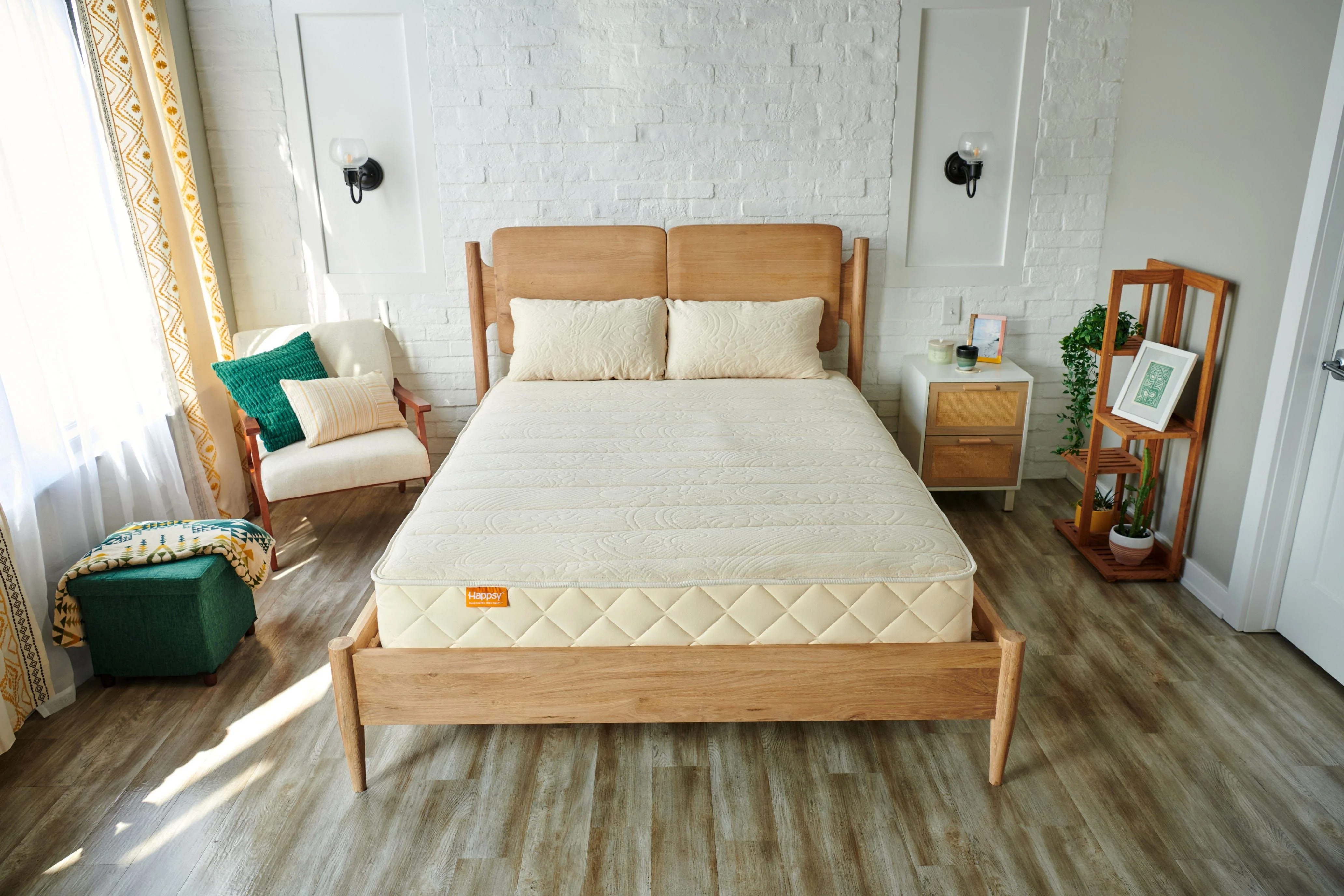
Happsy is one of the more affordable certified-organic mattresses on the market - a 10-inch latex hybrid that combines GOLS-certified organic latex with individually pocketed coils and a GOTS-certified organic cotton-and-wool cover. If you've been researching non-toxic beds, you've probably seen it on most short lists for budget-friendly organic sleep.
This review walks through the construction, who the Happsy is and isn't a fit for, how it performs across motion isolation, edge support, cooling and pressure relief, and how it compares to other organic options. Pricing and trial details below reflect publicly listed information at time of writing - check the retailer for current promotions.
Editorial note: this article is informational. We may earn a commission if you purchase through retailer links, but recommendations are based on published specs and consensus across editorial mattress reviewers.
What is the Happsy mattress?
Established in 2017, Happsy is a U.S.-made organic mattress brand focused on natural, environmentally friendly sleep solutions. The flagship product is a single hybrid model with an optional latex topper, sold in standard sizes from Twin through California King. The mattress is handcrafted in a certified organic factory, and free shipping plus a 120-night sleep trial come standard in the contiguous U.S.
Construction at a glance
- GOTS-certified organic cotton cover with organic wool fire barrier (no chemical flame retardants).
- 2 inches of GOLS-certified organic latex as the comfort layer.
- 8 inches of individually pocketed steel coils for support and motion isolation.
- Optional 2-inch organic latex topper that brings the total height to 12 inches and softens the surface.
The medium-firm version uses 15.5-gauge coils in the center and 14.5-gauge around the perimeter for stronger edge support. Happsy also offers a plush configuration with alternating 15- and 16-gauge coils for a softer feel.
Firmness and feel
Most editorial reviewers - including Sleepopolis, GoodBed and Family Handyman - rate the Happsy around a 6 to 6.5 out of 10 on the firmness scale, putting it in the medium to medium-firm range. Latex gives the surface a buoyant, responsive feel rather than the deep sink-in of memory foam. With the optional topper, the feel shifts toward medium-soft and gains noticeably more cushioning at the shoulders and hips.
By sleep position
- Back sleepers: strong fit. Latex contours just enough to fill the lumbar gap while the coils keep hips lifted.
- Stomach sleepers: also a good match for lighter to average-weight sleepers thanks to firm coil support.
- Side sleepers: the base mattress can run firm at the shoulders. Most reviewers (and Happsy's own messaging) recommend the topper for true side-sleeper comfort.
- Combination sleepers: latex's fast response and the bouncy coil base make repositioning easy.
Performance breakdown
Pulling together findings from independent test labs and long-term sleep tests, here's how the Happsy tends to score across the metrics that matter most:
Motion isolation: Hybrid latex is bouncier than all-foam, so motion transfer is a relative weakness. Pocketed coils help, but partners sensitive to movement will notice more transfer than on a memory-foam bed.
Edge support: A standout. Reinforced perimeter coils on the medium-firm model let you sit and sleep close to the edge without the dramatic roll-off common to all-foam beds.
Temperature: Cool-sleeping by design. Latex is more breathable than polyfoam, the cotton-and-wool cover wicks moisture, and the coil layer encourages airflow through the support core.
Pressure relief: Above average for back and stomach sleepers; merely adequate for side sleepers without the topper. Heavier sleepers (especially over 250 lbs) may bottom out into the coils faster than they would on a thicker hybrid.
Off-gassing: Minimal. The absence of polyurethane foam, glues and synthetic flame retardants is a recurring highlight in reviews from chemically sensitive sleepers.
Responsiveness and bounce: Among the highest scores in independent lab tests for any hybrid in this price range - easy to move on, easy to reposition.
Pros
- Genuinely certified organic: GOLS latex, GOTS cotton and wool, no polyurethane foam or chemical flame retardants.
- Strong edge support and excellent bounce / responsiveness for combination sleepers.
- Sleeps cool thanks to latex, breathable cover and pocket-coil airflow.
- Minimal off-gassing; great fit for chemically sensitive sleepers.
- 120-night sleep trial, free shipping, and a 20-year warranty.
- Among the more affordable certified-organic hybrids on the market.
Cons
- Base model can feel too firm for dedicated side sleepers without the optional topper.
- Motion isolation lags behind all-foam mattresses - sensitive partners may notice.
- Not recommended for sleepers over roughly 250 lbs.
- No split sizes for couples with very different firmness preferences.
- No handles, which makes moving and rotating the mattress awkward.
Sizing, pricing and trial
Happsy ships in standard U.S. sizes from Twin to California King. Mattress-only pricing has historically started below $1,000 for Twin and topped out under $1,800 for King and Cal King; bundles with the latex topper run several hundred dollars more. Sales and seasonal promotions are common, so always check the retailer for current pricing.
- Trial: 120 nights, with a 30-night minimum break-in period before returns.
- Warranty: 20 years (full coverage in years 1-10, prorated thereafter).
- Shipping: free FedEx/UPS Ground in the contiguous U.S.; surcharges for Alaska and Hawaii.
- Returns: full refund within the trial; Happsy arranges pickup at no charge and donates or recycles returned mattresses.
Certifications: what they actually mean
"Organic" gets thrown around loosely in the mattress industry. Happsy's stack of third-party certifications is one of its strongest selling points:
- GOLS (Global Organic Latex Standard): at least 95% organic latex, with environmental and fair-labor standards across the supply chain.
- GOTS (Global Organic Textile Standard): organic certification for the cotton cover and wool batting.
- GREENGUARD: limits on chemical emissions from the finished product.
- Organic Content Standard 100 (OCS): chain-of-custody verification of the organic fibers used.
Who Happsy is best for
- Shoppers who specifically want a certified-organic, non-toxic mattress without paying boutique prices.
- Hot sleepers - latex plus coil airflow runs notably cooler than memory foam.
- Back and stomach sleepers up to about 230 lbs.
- Allergy and chemical-sensitivity sufferers - wool and latex are naturally dust-mite resistant and the build is glue- and flame-retardant-free.
- Combination sleepers who want a responsive, easy-to-move-on surface.
Who should keep looking
- Sleepers over roughly 250 lbs who need deeper, zoned support.
- Strict side sleepers unwilling to add the optional topper.
- Couples with very different firmness preferences (no split or dual-firmness build).
- Anyone shopping primarily on price - there are cheaper non-organic hybrids if certifications aren't a priority.
How Happsy compares
Naturepedic EOS Classic: Customizable layers and split-firmness options for couples, but at a notably higher price. Better fit if you need to dial in firmness; Happsy is the value pick if you don't.
Avocado Green: Also GOLS/GOTS certified, with optional pillow-top and zoned support. Generally firmer than Happsy and meaningfully more expensive.
Saatva Latex Hybrid: Premium build with white-glove delivery, two firmness levels and stronger side-sleeper support. A step up in both feel and price.
Silk & Snow Organic: Three firmness options and zoned coils. A solid alternative if you want firmness choice; Happsy edges it on edge support.
Happsy mattress FAQ
Is the Happsy mattress made in the USA?
Yes. Happsy mattresses are handcrafted in the company's own certified-organic factory in the United States, using certified organic cotton, wool and latex. The factory is dedicated to organic mattress production, which limits the risk of cross-contamination with conventional materials.
Is Happsy good for back pain?
For back and stomach sleepers, the medium-firm Happsy provides the kind of neutral spinal alignment that often helps reduce lower-back pain. Latex contours to the lumbar curve while the pocketed coils prevent the hips from sinking too deep. Side sleepers with back pain may want to add the optional topper for additional shoulder and hip pressure relief.
Does Happsy off-gas?
Off-gassing is consistently called out as a strength of the Happsy in editorial and customer reviews. Without polyurethane foam, glues or chemical flame retardants, most testers report little to no smell at unboxing. Chemically sensitive sleepers tend to report it as one of the lowest-odor mattresses they've tried.
Do I need the optional topper?
It depends on sleep position and weight. Back, stomach and combination sleepers in the average weight range usually find the base mattress comfortable on its own. Strict side sleepers - and lighter sleepers who want a softer feel - almost always benefit from the 2-inch organic latex topper, which adds noticeable cushioning at the shoulders and hips.
How does Happsy compare to memory foam?
Memory foam contours more deeply and isolates motion better, but tends to sleep warmer and feels slower to respond. The Happsy's latex-and-coil build is cooler, bouncier and easier to move on, at the cost of some motion isolation. For chemically sensitive sleepers, the absence of polyurethane foam is the bigger differentiator.
How long does Happsy take to break in?
Most reviewers report the mattress reaches full shape within minutes of unboxing, with no significant break-in period. Happsy's own trial requires a 30-night minimum adjustment window before returns, which gives your body time to adapt to the surface.
Looking for more organic mattress options?
Browse our complete library of mattress reviews and buying guides for hot sleepers, side sleepers, and eco-conscious shoppers.