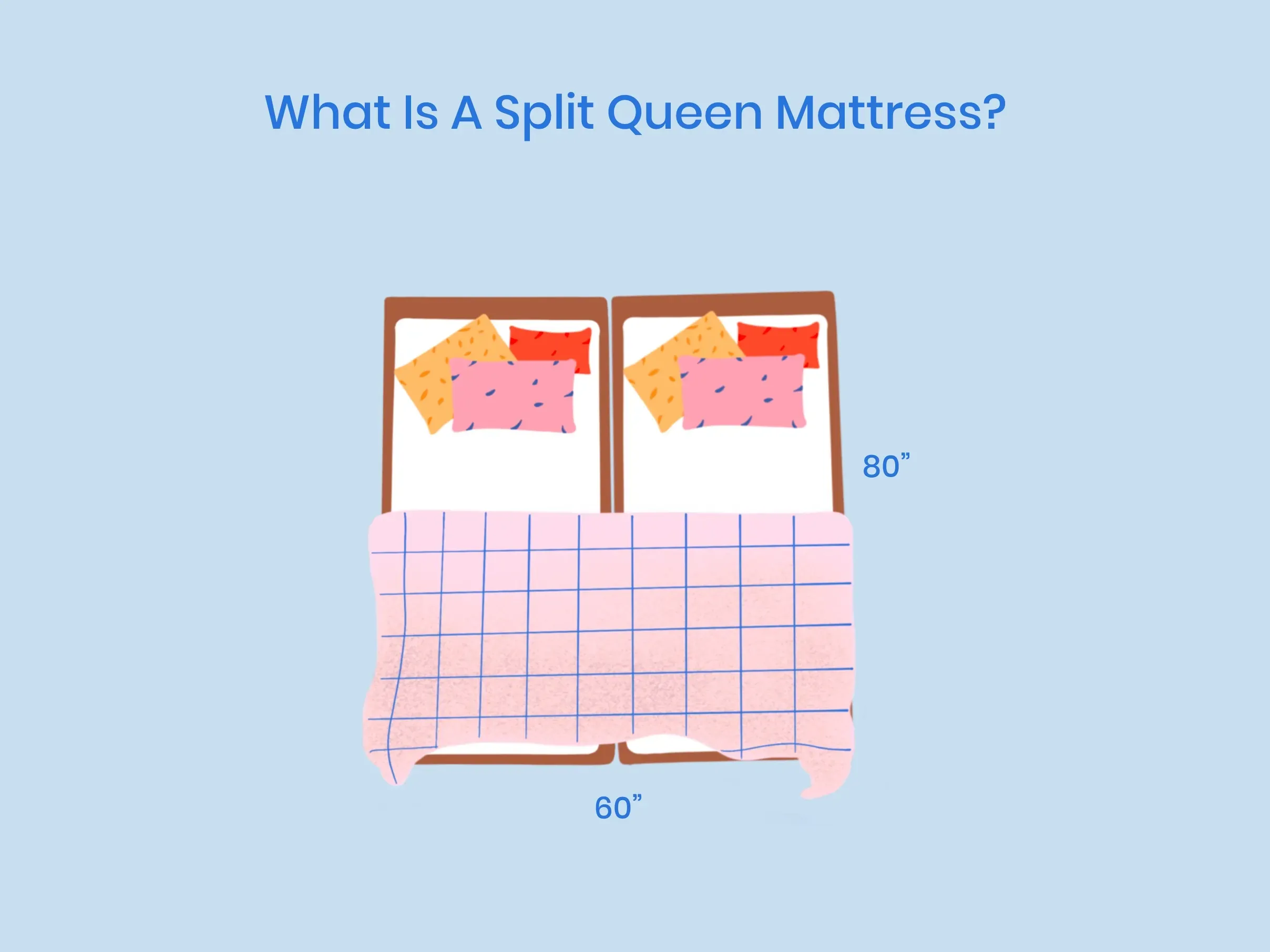
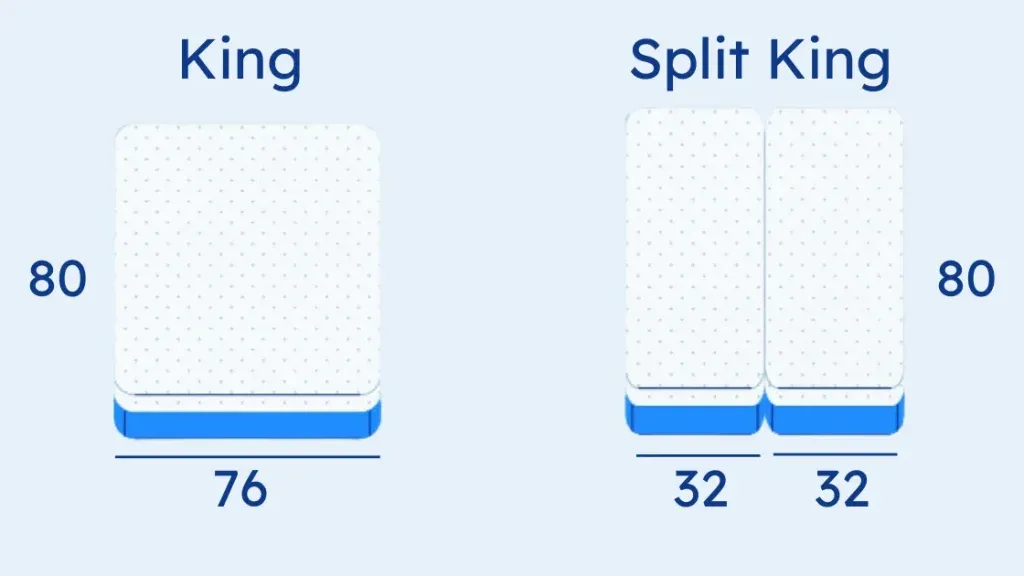
A king and a split king mattress take up exactly the same floor space - both measure 76 inches wide by 80 inches long. The difference is what you put on top of the frame: a king is one solid mattress, while a split king is two Twin XL mattresses sitting side-by-side. That single design choice changes the price, the way you make the bed, whether you can use an adjustable base, and how the bed feels when you cuddle.
If you and your partner argue over firmness, want to elevate one side at night, or need to get a mattress up a tight staircase, the split king solves real problems. If you sleep in the middle, want simpler bedding, and prefer to spend less, a standard king is the easier choice. Below is a side-by-side comparison, the trade-offs most guides skip, and a buying decision tree at the end.
King vs Split King at a Glance
Both mattress setups occupy a 76" x 80" footprint and need roughly a 12' x 12' bedroom to walk around comfortably. Where they diverge:
- Construction: King is one piece. Split king is two Twin XL mattresses (each 38" x 80").
- Price: Split king typically runs about 1.5x to 1.7x the price of the same model in king, because you are buying two mattresses.
- Adjustable base: Split king natively supports two independent bases - one partner can sit up to read while the other lies flat.
- Sheets: King uses a standard king sheet set. Split king needs two Twin XL fitted sheets plus a king flat sheet (or a dedicated split-king set).
- Move-in: Twin XL pieces fit through tight doorways and stairwells where a one-piece king will not bend.
- Middle feel: King has no seam. Split king has a small gap that you can soften with a connector strip, mattress pad, or topper.
What Is a King Mattress?
A standard (Eastern) king is a single 76" x 80" mattress - the widest non-California size most retailers stock. It gives two adults roughly 38 inches of personal width each, the same as a Twin XL, but on one continuous surface so there is no center seam.
Kings are the right pick when you sleep in the middle of the bed, share with kids or pets, or just want the simplest setup possible. They are also the cheaper option in almost every brand's lineup.
What Is a Split King Mattress?
A split king is two Twin XL mattresses (each 38" x 80") placed together on a frame or pair of frames. Combined, they cover the same 76" x 80" footprint as a king, but each side is its own mattress. That means each partner can choose a different firmness, a different feel (memory foam vs. hybrid), or a different adjustable-base position. Motion on one side mostly stays on that side, which couples with mismatched schedules notice immediately.
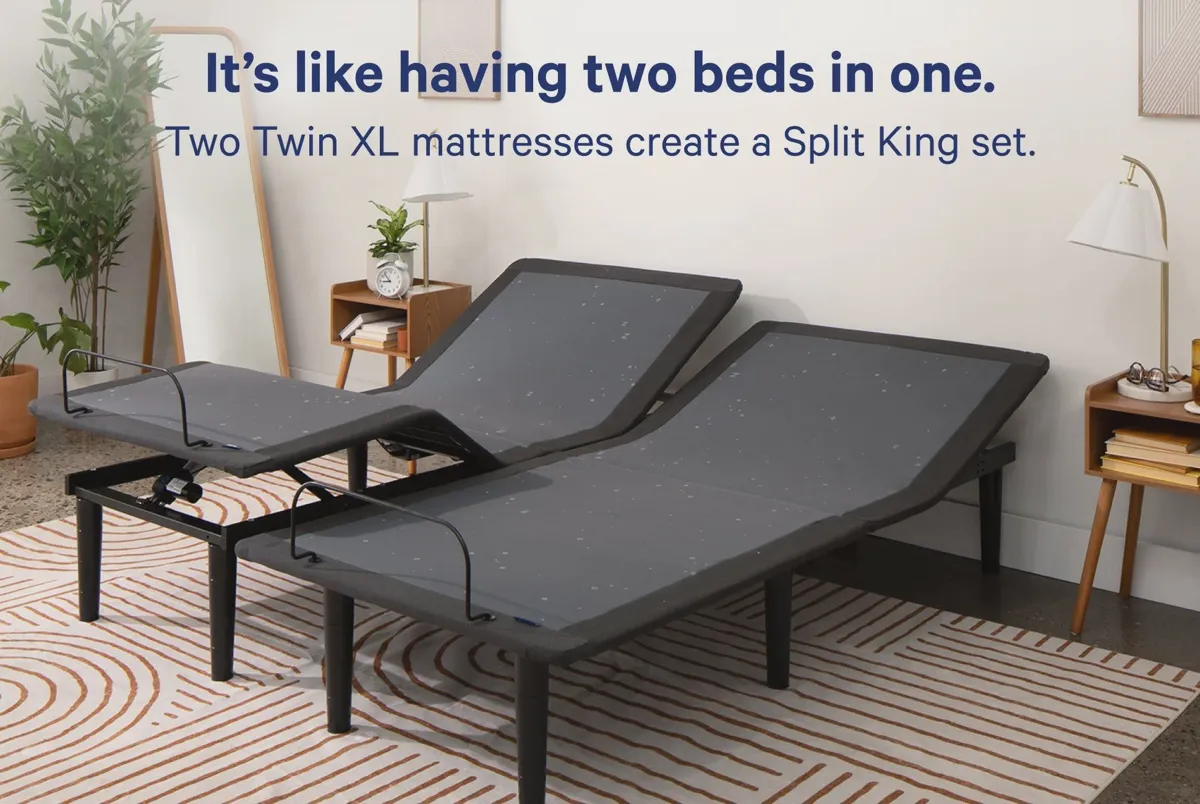
Split kings are the default setup for adjustable beds. Most adjustable bases above queen size ship as split-king-compatible because a single king mattress cannot bend with the base.
King vs Split King: Key Differences
1. Price
Expect the split king to cost roughly 1.5x to 1.7x what the same mattress model costs in king. You are buying two mattresses instead of one, and if you add two adjustable bases, the gap widens further. Across major brands, kings tend to land in the $1,200 to $2,800 range and split kings in the $1,800 to $4,200 range, with sales pushing both lower.
2. Customization and firmness
On a king, both partners share one firmness. On a split king, each side is independent - one partner can sleep on a plush memory foam Twin XL while the other has a firm hybrid. This is the single biggest reason couples upgrade to split king.
3. Motion isolation
A split king wins by design: there is no shared core, so a partner getting in or out of bed barely registers on the other side. Modern memory-foam kings isolate motion well too, but a true split is still better - useful for shift workers, light sleepers, and pet owners.
4. Adjustable bases
If you want an adjustable base in king-class size, you almost always want split king. Most manufacturers (Tempur-Pedic, Saatva, Sleep Number, Purple) ship adjustable bases above queen as a split-king pair. One side reads upright, the other side lies flat - without disturbing your partner.
5. Sheets and bedding
A king takes one fitted sheet, one flat sheet, two king pillowcases - easy. A split king takes two Twin XL fitted sheets (one per mattress) plus a king flat sheet and king pillowcases. Buying split-king-specific sheet sets is the cleanest fix; otherwise, you are mixing sizes from different sets.
6. Move-in and setup
Two Twin XLs are dramatically easier to navigate up a narrow stairwell or around a tight landing than a single king mattress, which often does not bend without damaging the foam or coils. If you live in an older home or apartment, this alone can decide it.
7. The middle gap
Because a split king is two mattresses, there is a small seam down the center. If you and your partner mostly sleep on your respective sides, you will not feel it. If you cuddle in the middle or roll across the centerline, you will. Three common fixes:
- A foam connector strip or wedge (~$30) that bridges the gap.
- A king-size mattress pad or topper laid across both halves.
- A split-king-specific bed skirt or strap kit that holds the two halves together.
King Mattress: Pros
- One unbroken sleep surface - no seam down the middle
- Lower price than a comparable split king
- Standard king sheets and bedding are easy to find
- Good for couples plus kids or pets in the bed
- Simplest setup: one mattress, one frame
King Mattress: Cons
- Both partners must agree on firmness and feel
- Hard to maneuver up tight stairwells or doorways
- Cannot pair with most adjustable bases above queen size
- Heavy to rotate or flip
Split King Mattress: Pros
- Each partner picks their own firmness and feel
- Works with two independent adjustable bases
- Excellent motion isolation between sides
- Two Twin XL pieces fit through narrow staircases
- Easier to replace one side later instead of the whole bed
Split King Mattress: Cons
- Costs roughly 1.5x to 1.7x more than the same king
- Small seam in the middle unless you bridge it
- Needs split-king-specific sheets or two Twin XL sets
- Setup is more complex (two mattresses, sometimes two bases)
Who Should Choose a Split King?
- Couples with different firmness preferences (one likes plush, the other likes firm).
- Anyone who wants an adjustable base above queen size.
- Light sleepers who get woken up by a partner's movement.
- People with back pain or acid reflux who want to sleep elevated without forcing their partner to do the same.
- Anyone moving into a home with narrow stairs or hallways.
Who Should Stick with a Standard King?
- Couples who agree on firmness and rarely fight over the bed.
- Sleepers who like to start or end the night in the middle of the bed.
- Households where kids or pets pile in regularly.
- Buyers on a budget - the same model in king is meaningfully cheaper.
- Anyone who wants the simplest possible bedding routine.
Quick Decision Tree
- Do you and your partner want different firmness or different adjustable-base positions? If yes → split king.
- Are you set on an adjustable base in king-size? If yes → split king (most adjustable bases at this size only ship in split form).
- Do you sleep across the middle of the bed or cuddle there most nights? If yes and the answers above were no → standard king.
- Is budget the deciding factor? Standard king will be ~30 to 40% cheaper for the same model.
- Tight stairs or doorways? Lean split king for the move-in alone.
Frequently Asked Questions
Is a split king the same size as a king?
Yes - both are 76 inches wide by 80 inches long. The split king is just two Twin XL mattresses (each 38" x 80") placed together to cover the same footprint.
Can you cuddle on a split king?
You can, but you will feel the seam down the middle unless you bridge it. A foam connector strip, a king-size mattress topper, or a split-king bed skirt with straps all soften the gap. Memory foam splits feel more cohesive than hybrids because the foam compresses across the seam.
What sheets do I need for a split king?
Two Twin XL fitted sheets (one per mattress) plus a king flat sheet and king pillowcases. The cleanest option is a split-king-specific sheet set, which packages all of those together. If you have a split-top king (only the head splits), you need a split-top fitted sheet - not the same as standard split-king.
Why does a split king cost more than a king?
You are buying two mattresses instead of one. Across major brands, the same model in split king runs roughly 1.5x to 1.7x the price of king. If you add two adjustable bases, the total can almost double.
Can I put a regular king mattress on an adjustable base?
Generally no. A single king mattress cannot bend without damaging its core, so most adjustable bases above queen size are sold as split-king pairs. A few specialty bases support a one-piece king, but they are uncommon.
How do I keep a split king from sliding apart?
Use a non-slip mattress pad or a split-king bed skirt with straps that runs across both halves. Most adjustable-base manufacturers also sell a retainer bar or anti-slip strip for the head end.
Bottom Line
Pick a standard king if you want the simplest, cheapest king-class setup and you do not need an adjustable base. Pick a split king if firmness disagreements, an adjustable base, motion isolation, or a tight staircase are part of the picture. Both give you the same 76" x 80" footprint - the right one is whichever solves the problem you actually have.
Still not sure? Visit a Banner Mattress showroom and lie on both setups for a few minutes each - adjustable-base demos answer the split-king question faster than any spec sheet.