When a mattress sags in the middle, the cause is almost never random. It is one of three things - worn-out core materials, a failing foundation underneath, or repeated pressure in the same spot - and each one has a different fix. Use the wrong fix and the dip comes back within weeks; use the right one and you can buy yourself another year or two before replacement.
This guide walks through how to measure the sag, find the root cause, and apply the fix that matches it. We'll also cover when a sag means warranty, and when it just means the mattress is done.
How much sag is too much?
Most manufacturers (Saatva, Tempur-Pedic, Casper, Purple) treat 1.5 inches of permanent indentation as the warranty threshold. Below that, it's considered normal body impression. Above it, you have a structural problem.
To measure: strip the mattress bare, lay a straight board (a yardstick or 2x4) across the sag, and use a ruler to measure the deepest gap between the board and the mattress surface. Do this with no one on the bed.
- Under 0.75": body impression - normal, especially in memory foam.
- 0.75"-1.5": early-stage sag - fixable with the steps below.
- Over 1.5": structural failure - file a warranty claim or plan replacement.
Why mattresses sag in the middle
The center sags first because that's where two adults' hips land. The middle column carries roughly 50-60% of total body weight every night, and unlike head and foot zones, it rarely gets a break. Three failure modes account for almost all middle sag:
1. Foundation failure (the #1 cause)
This is the single biggest reason sag appears within the first 1-3 years. A queen or king mattress needs a center support leg that touches the floor. Without it, the box spring or slats bow downward under load - and the mattress follows. Tempur-Pedic, Saatva, and Purple all void warranty on queen-size and larger if no center support is present.
Check: lift the mattress, look at the frame. If you see a center rail with no leg under it, that's your problem.
2. Slat gaps too wide
Foam and hybrid mattresses need slat gaps no wider than 2.75 inches (Saatva and Purple specify 3 inches max). Wider slats let the mattress sag between the slats, creating a washboard texture you can feel through the cover.
3. Core material breakdown
After year 5-7, polyfoam comfort layers compress, memory foam loses its bounce, and innerspring coils lose tension. Once the core is gone, no topper or plywood will permanently fix it - you're masking the problem.
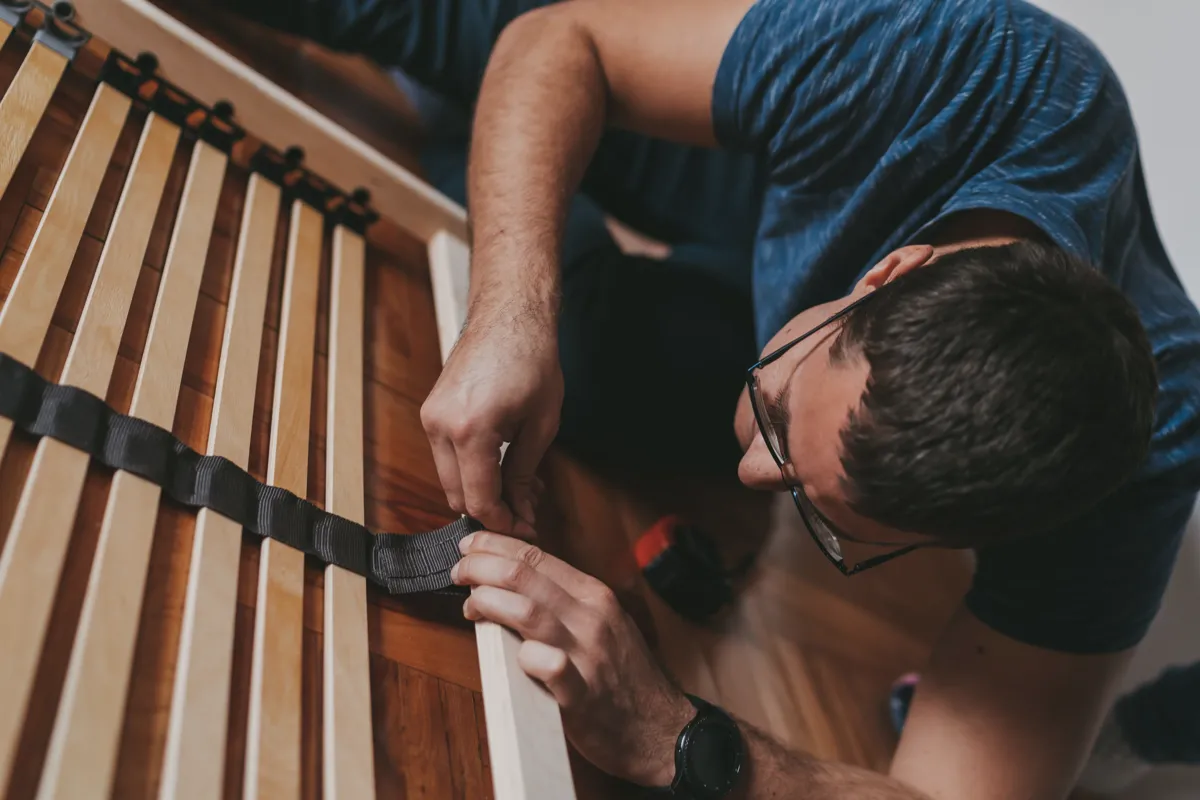
7 fixes, ranked by what actually works
Fix 1: Add a center support leg ($15-40)
If your queen or king frame has a center rail with no leg, this is the single highest-ROI fix. A screw-in adjustable support leg from any hardware store reaches the floor and stops the bow. Effects are immediate and can recover up to half an inch of sag overnight.
Fix 2: Replace the foundation ($150-500)
If the box spring is more than 10 years old, or the slats are wider than 3 inches apart, replace it. Modern foam and hybrid mattresses need either a solid platform or a slatted base with gaps under 3 inches. Bunkie boards (a 1-inch plywood substitute) are a budget option at $50-100.
Fix 3: Plywood underlayment ($30-70)
A 3/4-inch plywood sheet cut to mattress size and laid between the mattress and box spring distributes weight evenly. This is the classic Reddit fix. Caveat: plywood blocks airflow, which can encourage mold in humid climates and may void some foam-mattress warranties (Tempur-Pedic explicitly lists it as a warranty exclusion). Use it as a 3-6 month bridge, not a permanent solution.
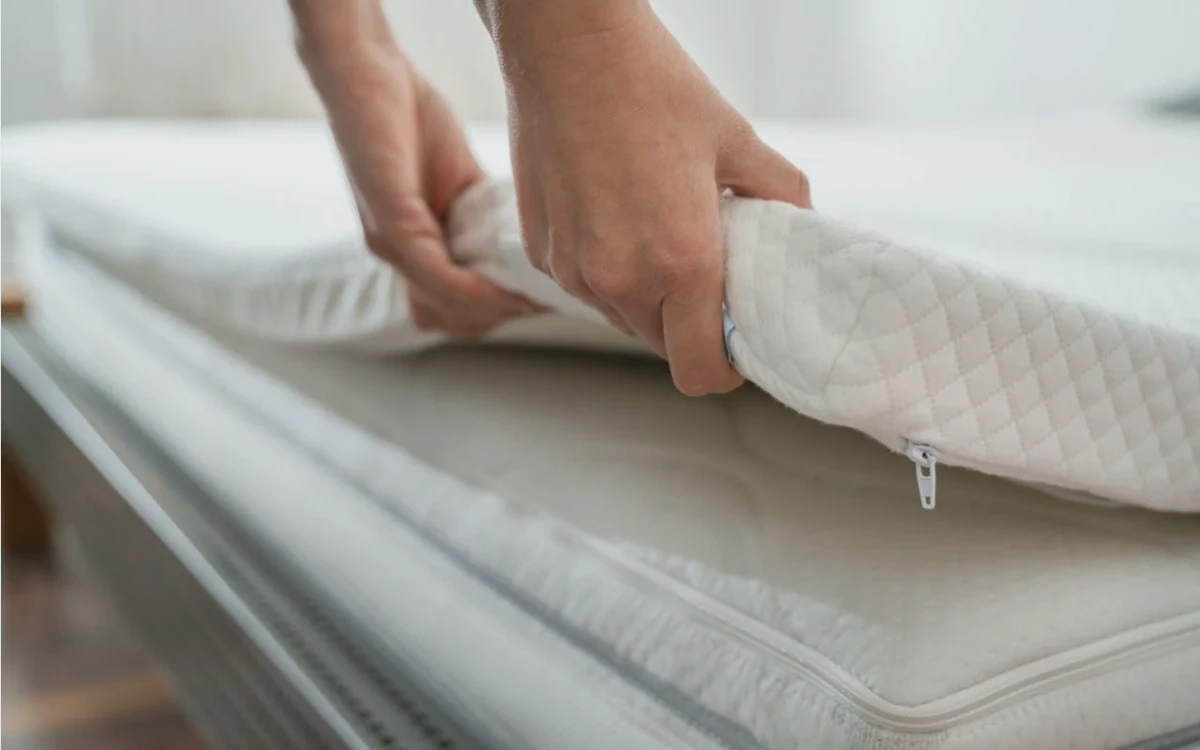
Fix 4: Mattress topper (2-4 inches, $80-300)
A dense topper - latex or 4lb+ memory foam - evens out the surface and adds buffer. Skip toppers under 2 inches; they compress into the existing sag within a week. Avoid down or fiberfill toppers, which mat down quickly.
Fix 5: Mattress helper / sag-reducer pad ($40-60)
These are dense foam wedges sized to fit under a sagging zone, between the mattress and foundation. They lift the dip 0.5-1 inch. Effective for localized center sag; less useful if the whole surface is uneven.
Fix 6: Rotate 180° (free)
If your mattress is one-sided (most modern foam and hybrid models are), rotate head-to-foot every 3 months. Do not flip unless the manufacturer explicitly says it's flippable - flipping a one-sided mattress puts the firm support layer on top.
Fix 7: File a warranty claim (free, if eligible)
Most mattress warranties cover sag over 1.5 inches for 10 years (Saatva, Casper) or longer (Tempur-Pedic: 10-year full + 15-year prorated). To file: photograph the sag with a yardstick across it, document the foundation, and submit through the manufacturer. Common denial reasons - stains on the cover, no center support leg, no original receipt - so keep the proof of purchase and use a mattress protector from day one.
How to prevent sag in the next mattress
- Buy a foundation that matches the mattress. Most foam-mattress warranties require slats under 3 inches apart and a center support leg on queens and larger.
- Use a mattress protector from day one. Stains void warranty on every major brand, and once it's stained you lose your fallback option.
- Rotate every 3 months for the first year, then twice a year. Set a calendar reminder.
- Vary your sleep position. If you and a partner each stick to the same side every night, that's where it'll sag first. Couples who swap sides every few nights see noticeably more even wear.
- Don't sit on the edge daily. Edge wear and center sag have the same root cause: repeated point loading. Use a chair to put on shoes.
When to stop fixing and replace
Replace, don't repair, when any of these are true:
- The mattress is 8+ years old (10+ for high-end latex).
- The sag is over 1.5 inches and you've already added a center support leg.
- You wake up with new back, hip, or shoulder pain that fades by midday.
- You sleep noticeably better in hotels or guest rooms.
- The cover is torn, stained, or smells musty (mold under foam is a health concern, not a comfort one).
A new quality queen mattress runs $800-2,500. Spending $150 on a topper for a 9-year-old mattress that's already past its lifespan is throwing good money after bad.
Frequently asked questions
Is a new mattress supposed to sag in the middle?
No. A brand-new mattress should not show measurable sag in the first 6 months. Light body impressions of less than 0.5 inch are normal as the comfort layer breaks in, but any visible dip is a defect - file a warranty claim immediately and keep the original receipt.
Can plywood under a mattress fix sagging?
Plywood will firm up a soft spot temporarily, but it doesn't restore the mattress core and may void warranty on foam beds (Tempur-Pedic explicitly excludes it). Use it as a 3-6 month bridge while you save for a real fix - a new foundation or replacement mattress.
How long should a mattress last before it sags?
Innerspring: 5-7 years. Memory foam: 7-10 years. Latex: 10-15 years. Hybrid: 7-10 years. Sagging before year 5 usually points to a foundation problem rather than the mattress itself, so check the support before you blame the bed.
Will a mattress topper fix a sagging mattress?
A 2-4 inch dense latex or memory foam topper masks mild sag (under 1 inch) by adding a buffer layer. It will not fix the underlying problem, and toppers compress into deeper sags within weeks. Skip cheap fiberfill toppers entirely - they flatten in days.
Does sleeping on a sagging mattress cause back pain?
Yes. A sagging center forces the spine into a U-shape (the hammock effect), straining lower-back muscles and ligaments. Most people report relief within 1-2 weeks of fixing the sag or replacing the mattress - if pain persists, see a doctor, since the mattress may have been masking a separate issue.
The bottom line
Mattress sag in the middle is almost always a foundation problem first, a materials problem second. Spend ten minutes checking the center support leg and slat spacing before spending a dollar on toppers or plywood. If the mattress is past 8 years old or the sag exceeds 1.5 inches, no fix will hold - plan the replacement and use a protector from day one on the next one.