A mattress warranty is a manufacturer's promise to repair or replace your bed if it fails because of a defect - a coil that snaps, foam that cracks, a top layer that sags far below the floor of normal use. It is not a comfort guarantee, a no-questions-asked return policy, or a hedge against years of normal softening. The difference matters: a typical mattress warranty runs 10 to 20 years, and most claim denials we see come from buyers who confused the warranty with the trial period or who unknowingly voided coverage by removing a tag, using the wrong frame, or staining the cover.
This guide walks through what mattress warranties actually cover in 2026, the sag-depth thresholds that trigger a replacement, the everyday actions that void coverage, and the exact steps to file a claim that gets approved on the first pass. We also break down warranty length and claim policy across the eight brands we get the most questions about.
How a mattress warranty actually works
A mattress warranty is a contract between you and the manufacturer (not the retailer). It promises that if the bed fails due to a manufacturing defect within the warranty term, the manufacturer will repair, replace, or refund a prorated portion of the purchase price. Most warranties are limited - they cover specific failure modes (sagging beyond a threshold, coil breakage, seam separation, foam degradation) and exclude almost everything else.
Three warranty structures you'll see
- Non-prorated: Full repair or replacement at no cost (you may still pay shipping). The strongest structure - and increasingly the standard for premium online brands.
- Prorated: You pay a percentage of the original price that scales with the mattress's age. A 20-year prorated warranty might cover 100% in year 1 and only 10% in year 18.
- Combination: Non-prorated for the first 10 years, prorated thereafter. Common on traditional innerspring brands like Sealy and Beautyrest.
Translation: a 25-year warranty that's only non-prorated for 2 years is weaker than a 10-year fully non-prorated warranty. Always read the structure, not the headline number.
What mattress warranties cover
Coverage varies by brand, but virtually every mainstream mattress warranty in 2026 covers four core failure modes:
- Indentation or sagging beyond a defined depth (measured with the mattress unloaded on a flat surface). Most brands set the threshold at 1 to 1.5 inches for innerspring and hybrid models and 0.75 to 1 inch for all-foam. Tempur-Pedic uses 0.75 inches; Saatva uses 1.5 inches; Purple uses 1 inch.
- Broken or loose coils in innerspring or hybrid units, including coils that protrude through the cover or make audible noise on movement.
- Foam splitting, cracking, or breakdown that isn't attributable to body impressions or normal compression. A visible fissure across the top comfort layer almost always qualifies.
- Manufacturing defects in the cover or quilting - seam separation, zipper failure on a zip-off cover, or a fabric flaw present at delivery.
A warranty is also distinct from a sleep trial. The sleep trial (typically 100-365 nights) covers comfort: if you don't like how the bed feels, you can return it. The warranty covers physical defects after that trial window closes. Confusing the two is the single biggest source of frustrated reviews online.
Typically covered
- Sagging or indentations beyond 0.75-1.5" (depth varies by brand)
- Broken, loose, or protruding coils
- Foam cracks, splits, or premature breakdown
- Seam separation, zipper failure, or cover defects present at delivery
- Manufacturing flaws in materials or workmanship
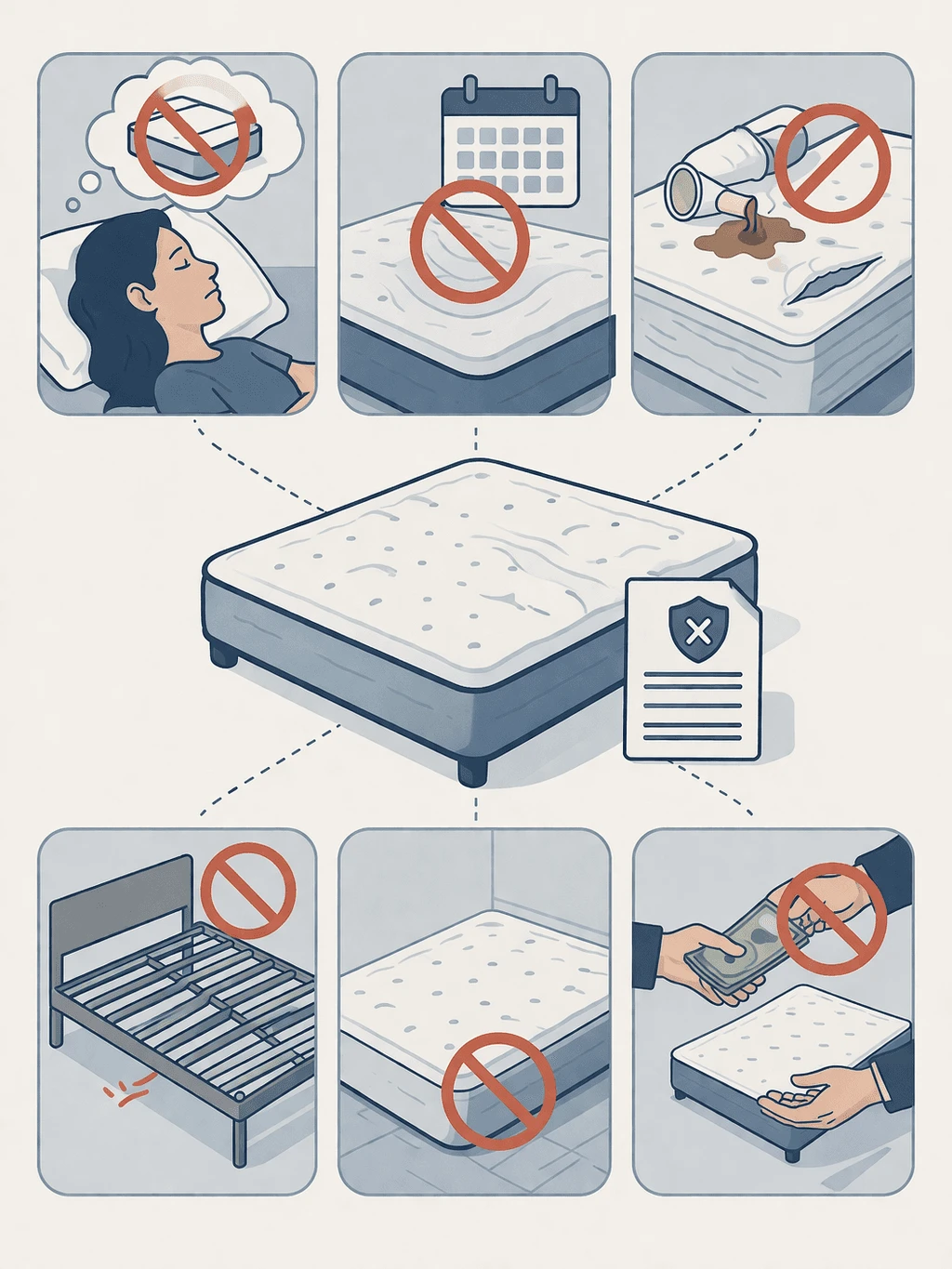
Typically NOT covered
- Normal softening or comfort preference changes ('I just don't like it')
- Stains, burns, odors, or biological damage of any kind
- Damage from improper foundation or unsupported frame
- Damage caused by jumping, pets, or commercial use
- Comfort layer breakdown after warranty term expires
What voids a mattress warranty (the rules nobody reads)
Manufacturers are strict on void conditions because the warranty has to function as a defect guarantee - not a misuse insurance policy. The five voiders below are responsible for the majority of denials we see at our review desk.
- Any stain on the mattress. Sweat, drink, urine, blood - for sanitary reasons, manufacturers will not accept a stained return for inspection. Use a washable mattress protector from day one. This is non-negotiable.
- Removing the law tag. The white legal tag sewn to the side encodes the model, batch, and warranty terms. Cut it off and the manufacturer cannot identify the unit. ("Do not remove under penalty of law" applies to retailers; the warranty consequence applies to you.)
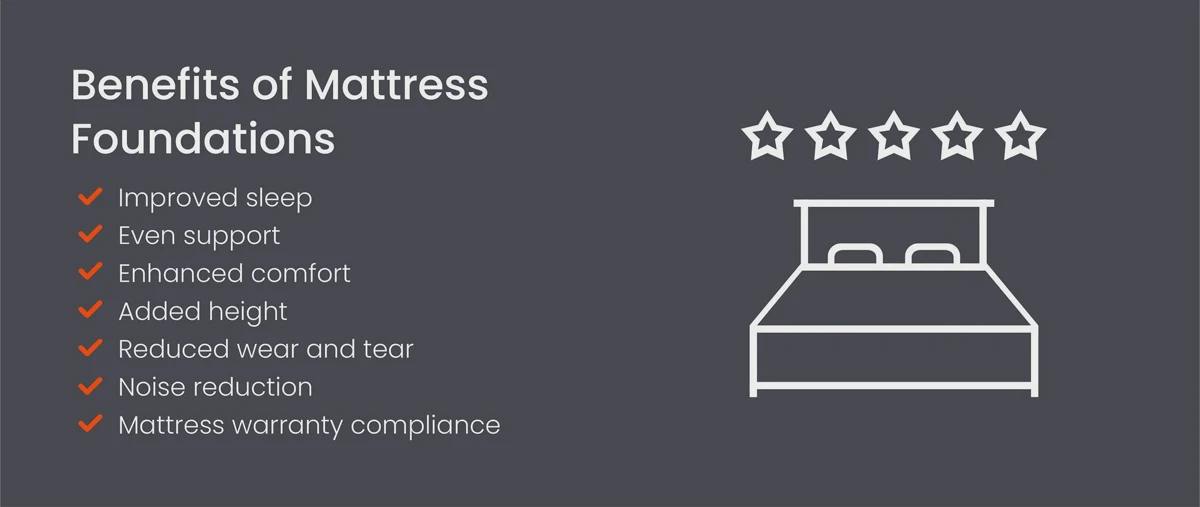
- Wrong foundation or unsupported frame. Most warranties require a rigid foundation, slats no more than 3 inches apart, and a center support leg on queen and larger sizes. A standard box spring under a memory foam mattress is the classic mistake.
- No proof of purchase. Original receipt or order confirmation is required. Save it digitally the day the bed arrives.
- Second-owner status. Mattress warranties are non-transferable - buying used voids the warranty entirely, even if the original purchase was a week ago.
How long are mattress warranties? Brand comparison
Warranty length is a rough proxy for manufacturer confidence in durability - but only when paired with the proration structure. Here's how the brands we get the most questions about stack up:
- Tempur-Pedic: 10-year full replacement, non-prorated. 0.75" sag threshold.
- Saatva: Lifetime warranty. Years 1-2 full replacement; years 3+ a Fairness Replacement program (you pay shipping plus a transportation fee). 1.5" sag threshold.
- Casper: 10-year limited, non-prorated. 1" sag threshold.
- Purple: 10-year limited on most models, non-prorated for the GelFlex Grid. 1" sag threshold.
- Nectar: Forever Warranty - fully non-prorated for 10 years, then prorated 50% replacement cost thereafter. 1.5" sag threshold.
- Helix: 10-15 year limited depending on model. 1" sag threshold.
- DreamCloud: Lifetime - non-prorated for the first 10 years, prorated 50% afterwards.
- Sealy / Beautyrest: 10-year limited combination warranty (non-prorated 1-10 yrs on flagship lines; prorated on entry models). 1.5" sag threshold.
Warranty terms change. Always confirm coverage on the manufacturer's site at the time of purchase, and screenshot the policy for your records.
How to file a mattress warranty claim (step by step)
A successful warranty claim is mostly preparation. Manufacturers approve claims that are documented and obviously legitimate; they push back on claims that are vague or arrive without paperwork.
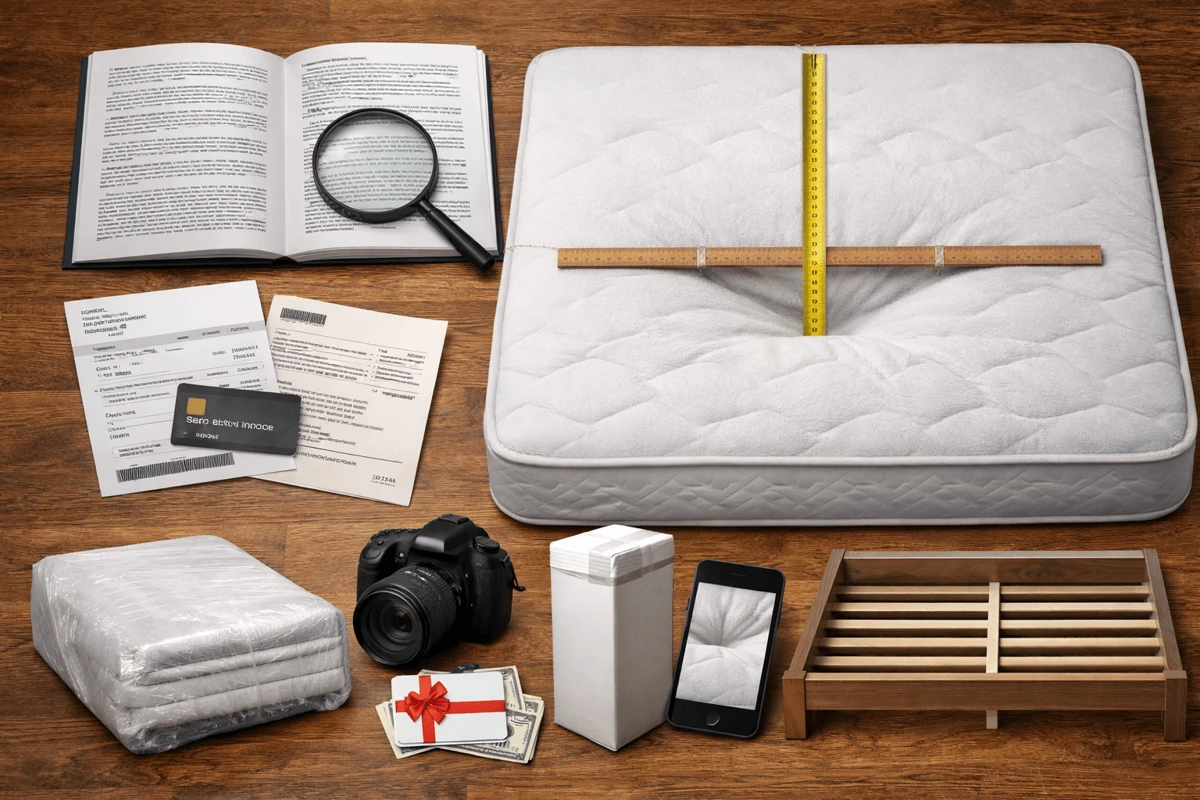
- Confirm the failure qualifies. For sagging, strip the bed and let it rest unloaded for at least an hour. Place a straightedge across the indentation and measure depth at the deepest point with a ruler. Compare to your brand's threshold.
- Document with photos. Take wide shots of the bed on its frame, close-ups of the defect, and a clear photo of the law tag with the model and serial number. For sagging, photograph the ruler showing the depth measurement. Include a date stamp on each image.
- Gather the paperwork. Original receipt or order confirmation, photo of the law tag, and (if you've moved) proof you've used a compliant foundation (a quick photo of the slats works).
- Contact the manufacturer directly. Most online brands have a warranty form on their site (Casper, Nectar, Purple). Traditional brands like Tempur-Pedic (800-821-6621), Sealy, and Beautyrest take phone claims. File with the manufacturer, not the retailer - even if you bought from Mattress Firm, Costco, or Amazon.
- Cooperate with inspection. Some brands resolve claims from photos alone; others send a third-party inspector or ask you to ship a sample of the failed material. Approval typically takes 7-30 days. If approved, expect a replacement of the same model - not a refund or upgrade - and you may pay shipping or a transportation fee per the policy.
How to protect your warranty from day one
- Use a washable mattress protector from the first night. The single biggest insurance against a denied claim.
- Keep the law tag attached. Tuck it under the bed if it bothers you visually - never cut it off.
- Check the foundation requirements before you buy a frame. If you already have a frame, photograph the slat spacing and center support; manufacturers may ask.
- Save the receipt and a photo of the law tag the day the bed arrives. Email both to yourself so they're searchable later.
- Rotate the mattress as recommended (typically every 3-6 months for the first year on one-sided models). Some warranties explicitly require this.
Mattress warranty FAQ
How long is a typical mattress warranty?
Most modern mattress warranties run 10 years (Casper, Tempur-Pedic, Purple, Helix), with some brands offering 15-year, 20-year, or 'lifetime' coverage (Saatva, Nectar, DreamCloud). Length only tells you how long you can file a claim - proration structure determines what you actually get back.
What sag depth qualifies for a warranty replacement?
Most brands set the threshold between 0.75 and 1.5 inches measured with the mattress unloaded on a flat surface. Tempur-Pedic uses 0.75", Casper and Purple use 1", and Saatva, Nectar, and Sealy use 1.5". Anything shallower is treated as normal body impression and is not covered.
Does a stain really void my warranty?
Yes - virtually every major manufacturer voids the warranty on any biological stain (sweat, urine, blood, etc.) for sanitary reasons. Inspectors will not handle a stained mattress. A washable mattress protector from day one is the simplest way to keep coverage intact.
Can I file a warranty claim with the retailer?
No - file directly with the manufacturer, even if you bought from Mattress Firm, Costco, or Amazon. Retailers may help facilitate, but the warranty contract is between you and the manufacturer. You'll need the original receipt and a photo of the law tag.
What's the difference between a sleep trial and a warranty?
A sleep trial (typically 100-365 nights) lets you return the mattress for a refund if it's not comfortable. A warranty (10-lifetime) covers physical defects - sagging, broken coils, split foam - for years after the trial period closes. Confusing the two is the most common reason people feel misled by mattress brands.
Are mattress warranties transferable?
Almost never. Mattress warranties cover the original purchaser only - buying a used mattress voids the warranty even if the original purchase was recent. Always factor that into the price of a secondhand bed.
Need help picking a mattress with a strong warranty?
Our buying guides cover warranty length, return policy, and durability for every brand we review - start with our hybrid and memory foam roundups.