Purple mattresses are made in the United States. As of 2025, all Purple mattress production happens at the company's McDonough, Georgia facility - Purple consolidated manufacturing there in early 2025 after closing its Salt Lake City and Grantsville, Utah plants. Headquarters remain in Lehi, Utah.
This guide covers where Purple mattresses come from today, how the GelFlex Grid is produced, and what "Made in the USA" actually means for the materials inside your bed.
Quick Answer: Where Purple Mattresses Are Made
2015 to 2024: Production ran out of Grantsville and Salt Lake City, Utah. Both factories closed by the end of Q1 2025.
2025 to present: All Purple mattress manufacturing happens at the McDonough, Georgia facility - currently Purple's only U.S. production site.
Headquarters: Lehi, Utah (unchanged through the consolidation).
Purple Innovation announced the consolidation in August 2024, citing roughly $15-20 million in projected annual savings and a sustained slowdown in mattress demand. The Utah factories ramped down through Q4 2024 and closed by the end of Q1 2025.
The McDonough, Georgia Plant
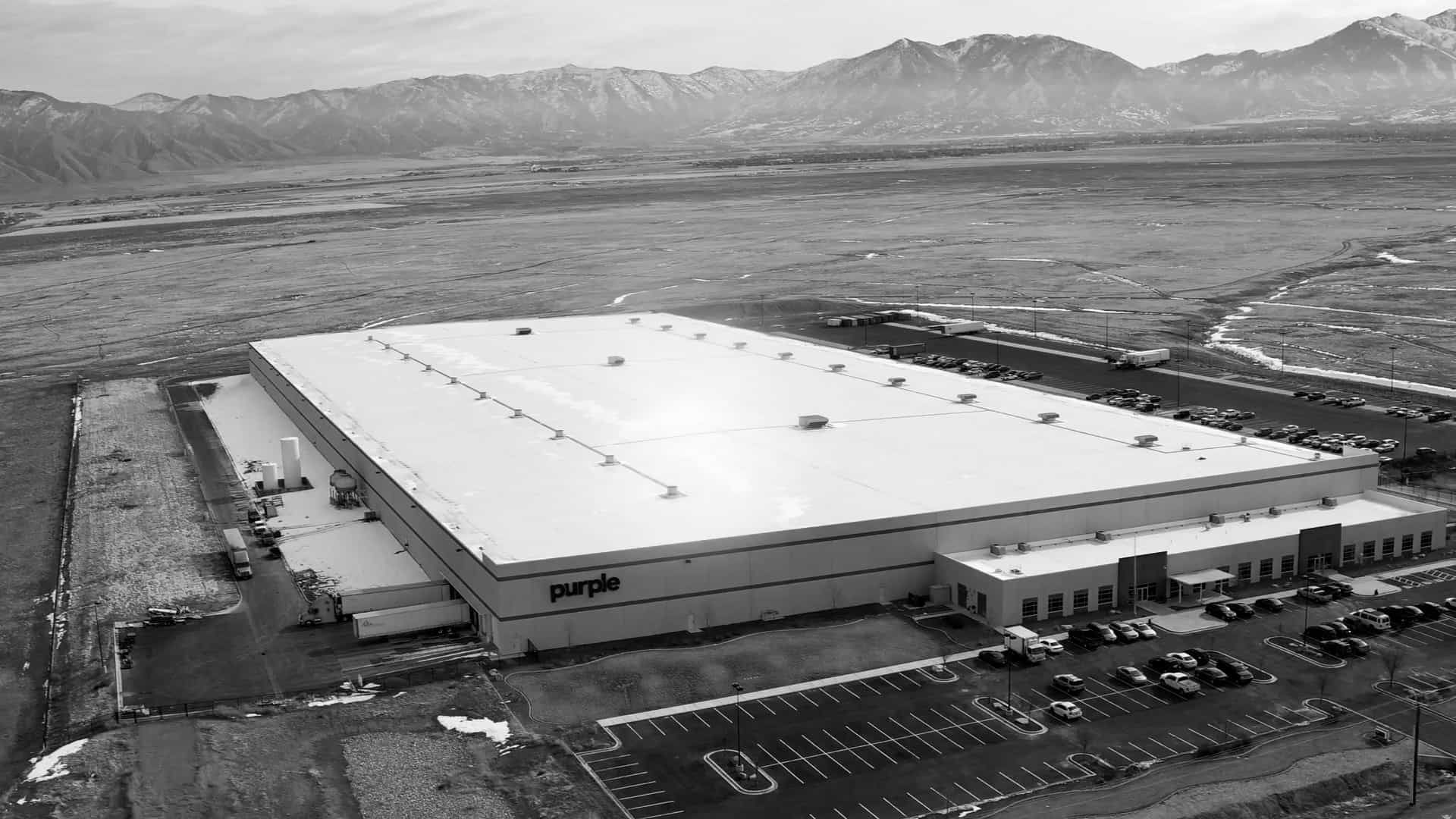
McDonough - about 30 miles south of Atlanta - has been Purple's east-coast manufacturing hub since 2021, when the company opened the facility to shorten shipping times to the eastern half of the U.S. With the Utah closures, McDonough is now Purple's only production site and houses:
- GelFlex Grid molding lines (the proprietary process Purple developed in-house)
- Hybrid mattress assembly (foam, coil, and grid integration)
- Cover sewing, quilting, and final encasing
- Vacuum-compression and roll-packing for shipping
Purple has said it plans to add a new distribution center in Utah even as production stays in Georgia, so customer-facing logistics aren't going fully east.
How the GelFlex Grid Is Manufactured
The GelFlex Grid is the part of a Purple mattress most people are buying the bed for - and it's the most distinctive piece of Purple's production process.
1. Hyper-Elastic Polymer
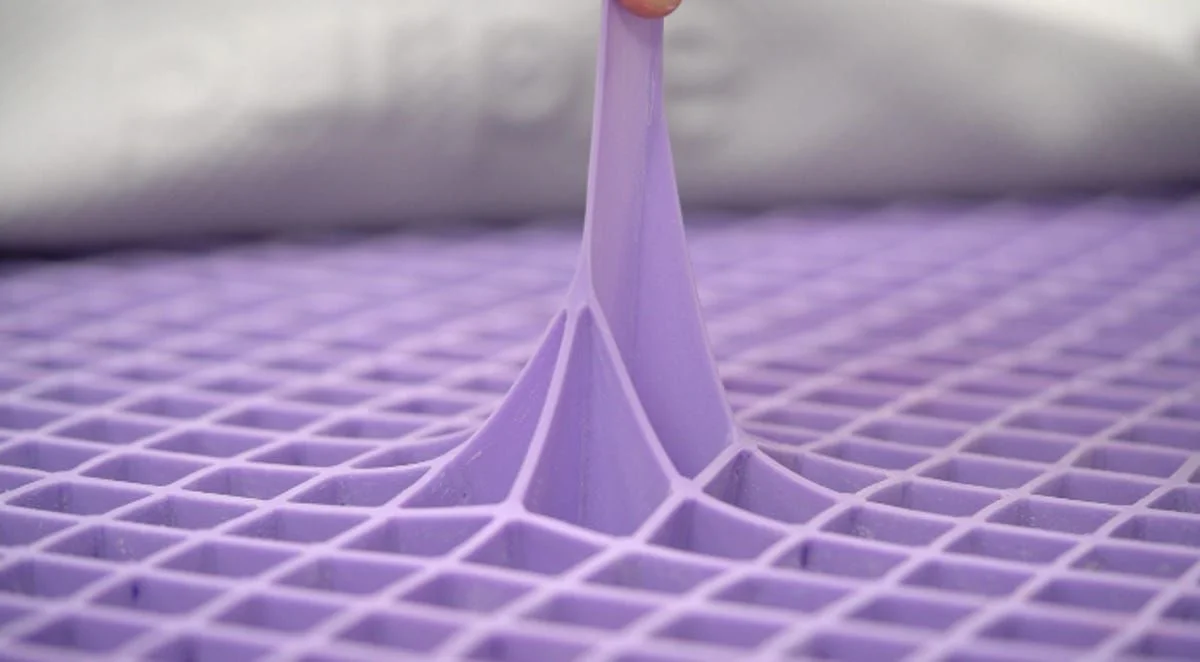
The grid is poured from a proprietary food-grade hyper-elastic polymer. The exact formulation is trade-secret, but it's a stretchable gel-like material that buckles under pressure points (shoulders, hips) and stays firm under lighter areas (lower back, legs).
2. Mold-and-Extrude Machines
Purple manufactures its grid on machines the company designed and built itself, called Mattress Max machines. They extrude the polymer into the grid's column-and-wall pattern in a single pass, which is why no other mattress brand has been able to replicate the GelFlex Grid at scale.
3. Curing and Cutting
The extruded grid is cured, then cut to size for each Purple model - Purple Mattress (2"), Restore (3"), Restore Premier (3"), Rejuvenate (3"), and Rejuvenate Premier (3").
Hybrid Layer Assembly
Most current Purple models are hybrids - GelFlex Grid on top, a responsive coil system below, all stacked between premium foams. Assembly at McDonough follows a fixed sequence:
- Base foam is cut and bonded to a fire barrier.
- Pocketed coils (zoned for lumbar support in Restore and up) are placed on the base.
- Transition foam sits above the coils to manage motion isolation.
- GelFlex Grid is placed on top.
- Cover is fitted, stretched, and stitched closed.
Materials: What's American, What's Not
Purple is clear that mattresses are designed, assembled, and fulfilled in the USA, but not every input is domestic. Here's the breakdown:
- GelFlex Grid polymer - manufactured in the U.S. on Purple's own machines.
- Foams - primarily U.S.-sourced, CertiPUR-US certified.
- Coils - U.S.-sourced for the Hybrid and Restore lines.
- Covers and fabrics - mix of domestic and imported, depending on model and SKU.
So "Made in the USA" is accurate as a final-assembly claim, but Purple - like nearly every U.S. mattress maker - relies on a global supply chain for certain raw materials.
Why Purple Consolidated to Georgia
A few practical reasons sat behind the 2024 announcement:
- Cost - Closing two Utah sites was projected to save $15-20M annually.
- Demand softness - Purple's revenue dropped 10.9% in 2023 and the broader U.S. mattress market was still cooling through 2024.
- Logistics - McDonough's location near Atlanta gives quicker freight reach to the eastern U.S., where the bulk of Purple's customers live.
Purple kept its corporate office, R&D, and four showrooms in Utah; production is the only piece that moved.
What This Means If You're Buying a Purple Mattress
If you're shopping now (post-2025), nothing has functionally changed about the product:
- Same GelFlex Grid, same models, same warranty (10 years on the mattress).
- 100-night sleep trial unchanged.
- U.S.-made designation still applies.
- Free shipping inside the contiguous U.S.
The only real difference is the shipping origin on your tracking page. Beds for east-coast customers now leave Georgia by default.
Final Take
Purple is one of the relatively few mattress brands still producing in the United States, and the move from Utah to Georgia in 2025 didn't change that story - it just consolidated it. If domestic manufacturing matters to you when picking a mattress, Purple still earns the Made-in-USA badge, with the GelFlex Grid as the clearest example of a fully proprietary American-built component.
Purple Mattress Manufacturing FAQs
Where are Purple mattresses made in 2025?
All Purple mattresses are made at the company's McDonough, Georgia manufacturing facility. Purple consolidated production there in early 2025 after closing its Salt Lake City and Grantsville, Utah factories.
Are Purple mattresses still made in Utah?
No. Purple shut down both of its Utah manufacturing plants by the end of Q1 2025. The corporate headquarters, R&D team, and four retail showrooms remain in Utah, but the actual mattresses are no longer produced there.
Are Purple mattresses really made in the USA?
Yes. Purple mattresses are designed, assembled, and fulfilled in the United States. The proprietary GelFlex Grid, most foams, and coils are U.S.-sourced, while certain fabrics and minor components come from a global supply chain - standard for U.S. mattress makers.
Why did Purple move production from Utah to Georgia?
Purple Innovation announced the consolidation in August 2024 to cut costs (projected savings of $15-20 million annually), respond to softer mattress demand, and shorten shipping times to east-coast customers from the McDonough, GA plant near Atlanta.
How is the GelFlex Grid manufactured?
The grid is extruded from a proprietary hyper-elastic polymer using Mattress Max machines that Purple designed in-house. The polymer is shaped into the brand's column-and-wall grid pattern in a single pass, cured, then cut to size for each Purple mattress model.
Compare Purple to other U.S.-made mattresses
See how Purple stacks up against Saatva, Helix, and Tempurpedic in our latest hands-on comparison.