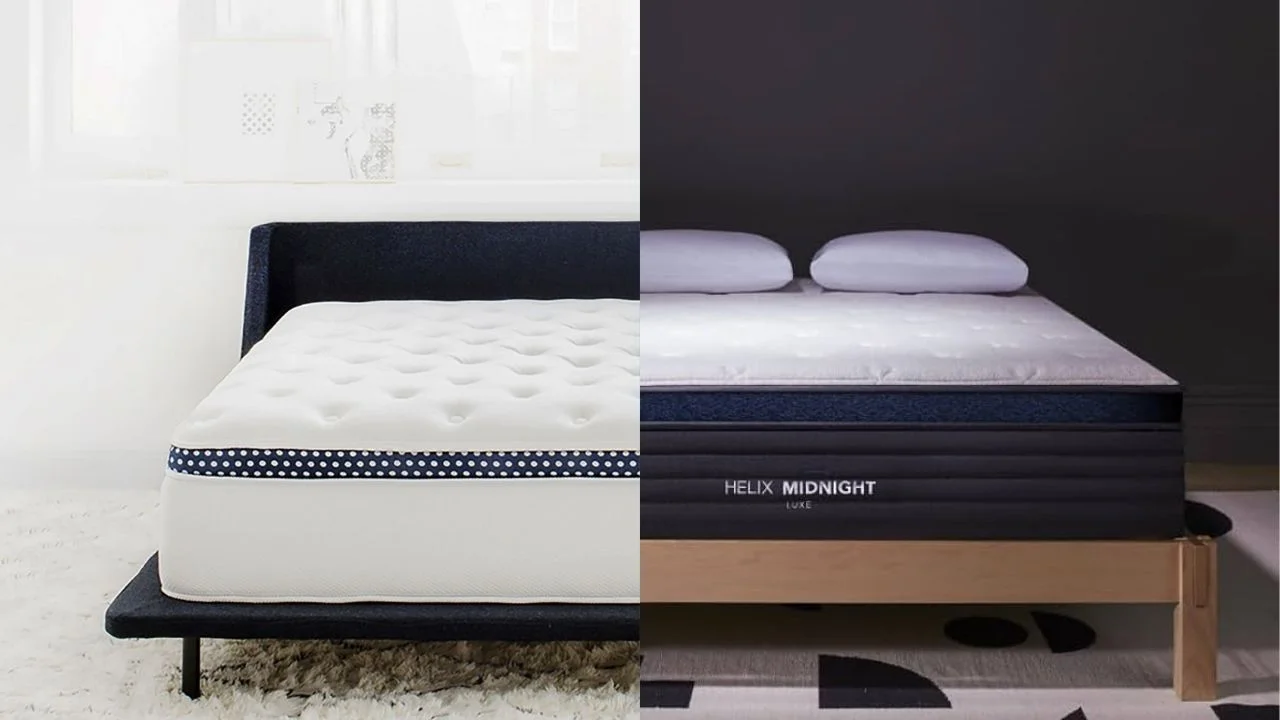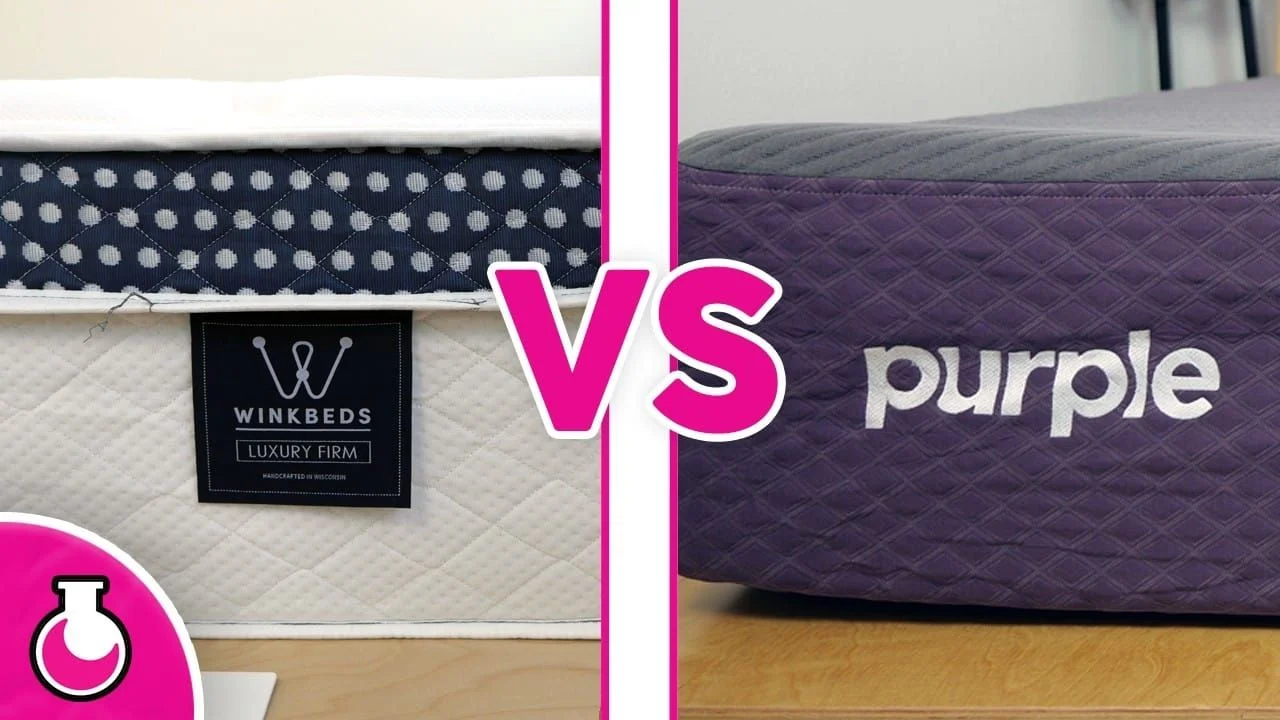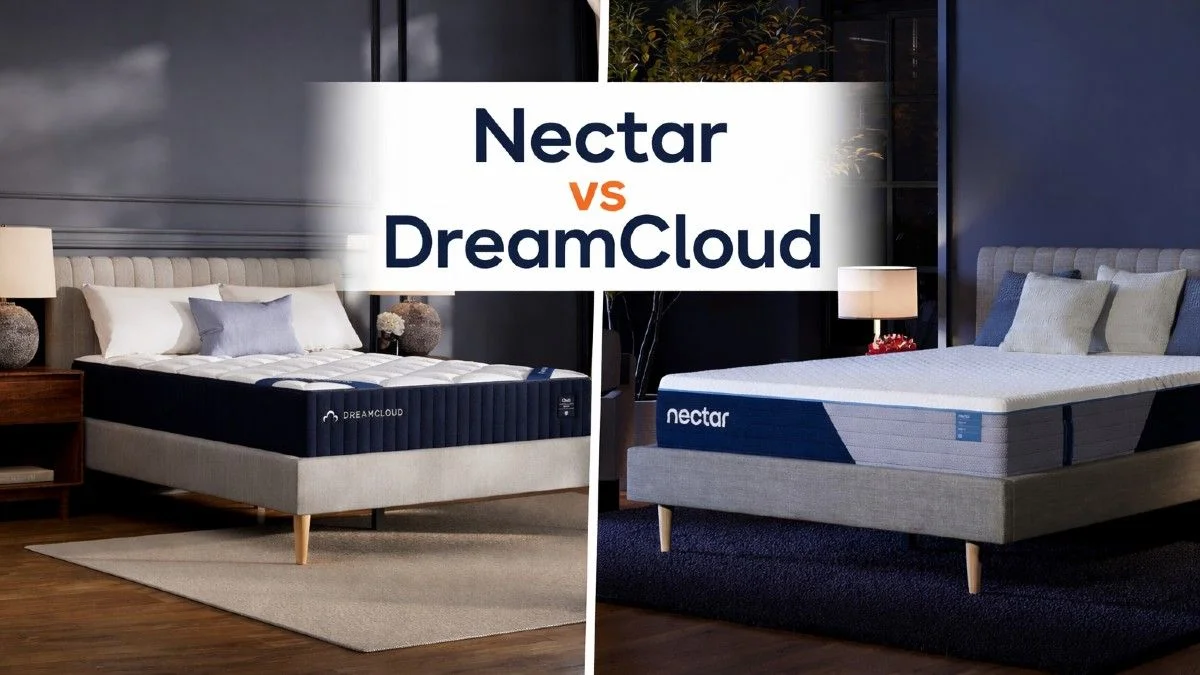
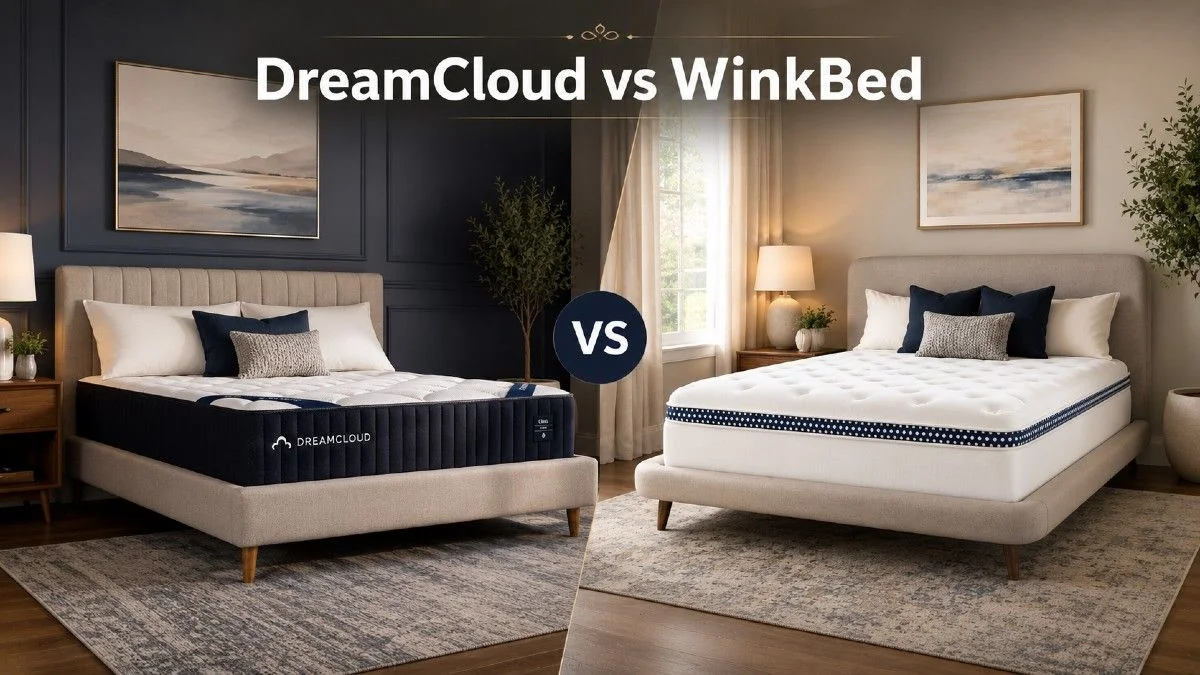
The DreamCloud and the WinkBed are both luxury hybrid mattresses built on an innerspring base with foam comfort layers on top. They look similar on paper, but they pull in different directions once you lie down. DreamCloud is the value pick with one medium-firm feel and a full year to try it. The WinkBed costs more, comes in four firmness levels, and tends to win on edge support and durability. Here is how the two compare across feel, build, performance, and price so you can match one to how you actually sleep.
DreamCloud vs WinkBed at a glance
| Feature | DreamCloud | WinkBed |
|---|---|---|
| Type | Hybrid (foam + coils) | Hybrid (foam + coils) |
| Firmness options | One medium-firm feel (about 7.5/10) | Four: Softer, Luxury Firm, Firmer, Plus |
| Height | 14 inches | 13.5 to 15 inches |
| Sleep trial | 365 nights | 120 nights |
| Warranty | Lifetime | Lifetime |
| Queen price | $649 to $1,099 | $1,799 |
| Best for | Back sleepers, budget shoppers | Side sleepers, heavier sleepers, customization |
Who should pick each mattress
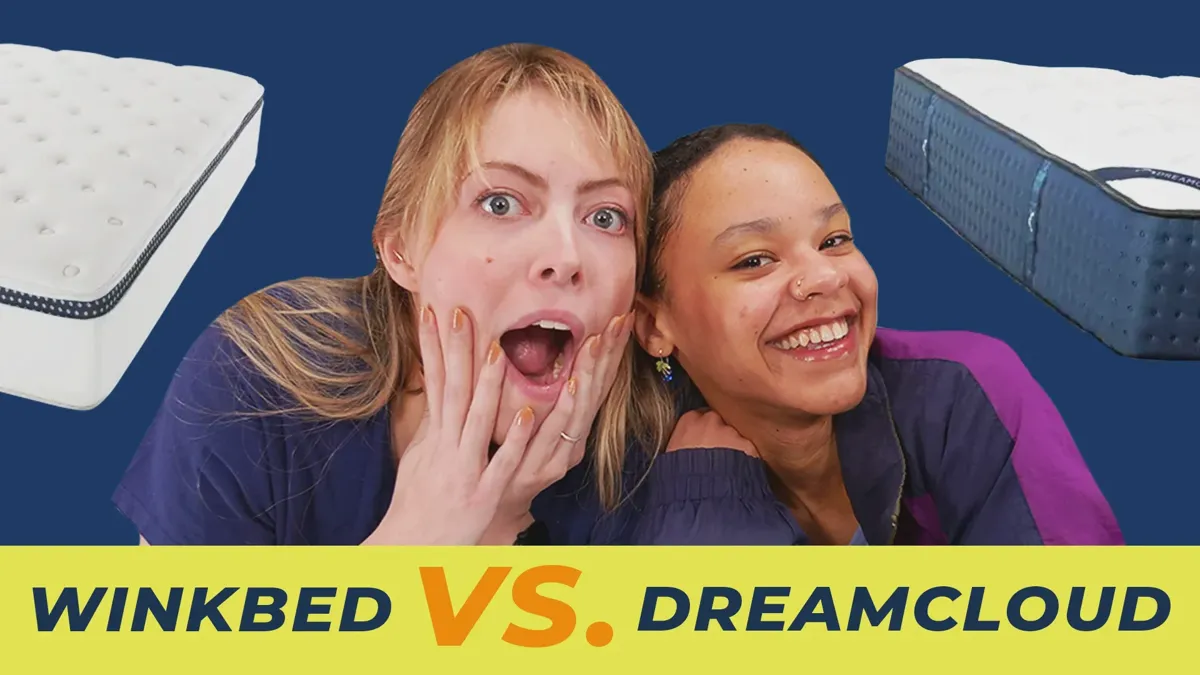
Both refs agree these beds suit different sleepers, so start with how you sleep and what you weigh.
- Choose the DreamCloud if you are on a budget: it runs frequent discounts and sits at a fraction of the WinkBed's price.
- Choose the DreamCloud if you sleep on your back or stomach: the medium-firm support keeps the hips lifted and the spine aligned.
- Choose the DreamCloud if you want a long trial: you get a full 365 nights to decide.
- Choose the WinkBed if you want to dial in firmness: four firmness levels let you tailor the feel to your body weight and position.
- Choose the WinkBed if you are a side sleeper: the Softer or Luxury Firm models contour the shoulders and hips better.
- Choose the WinkBed if you want a traditional innerspring feel: it delivers more bounce, push-back, and sturdier edges.
Where they are alike
For all their differences, the two share a similar skeleton and a few performance traits.
- Construction: both are hybrids that pair plush foam comfort layers over a pocketed coil support core.
- Temperature: both sleep cool, since the coil layers leave plenty of room for airflow and the foams are gel-infused.
- Responsiveness: both are bouncy and easy to move on, which suits combination sleepers who switch positions overnight.
- Motion transfer: neither isolates motion especially well, a downside if you share the bed with a restless partner.
The key differences
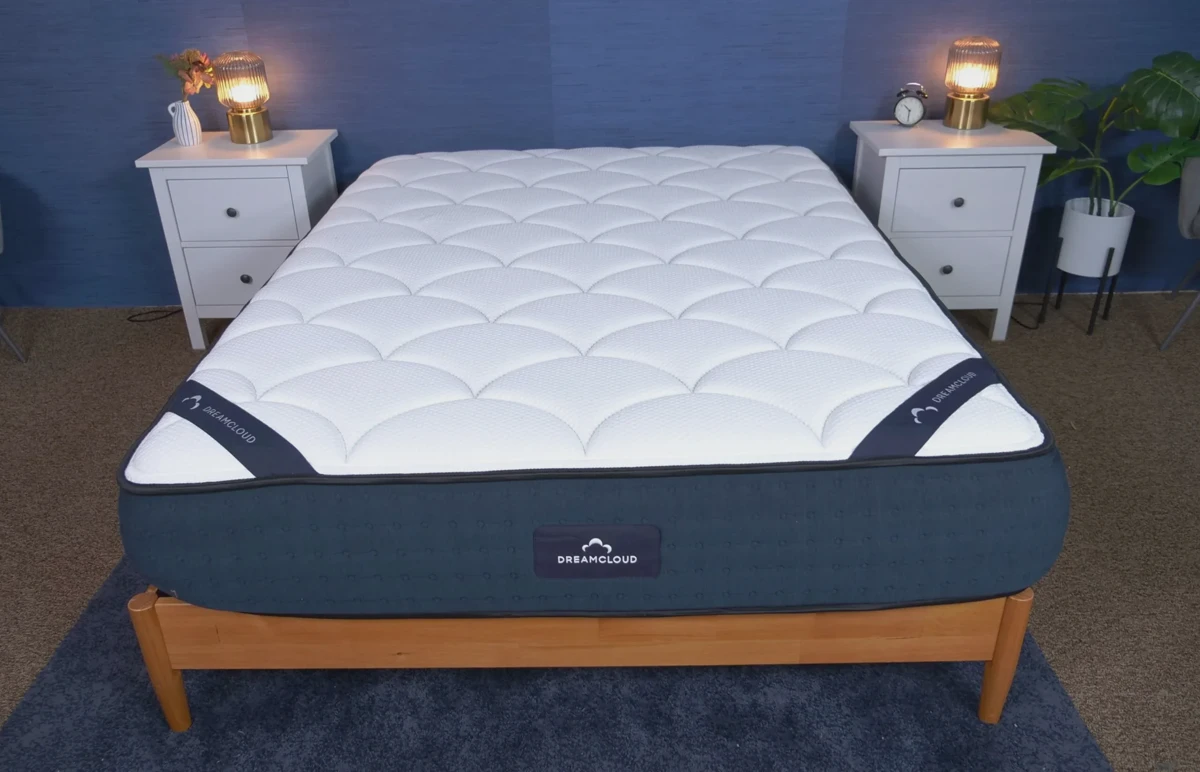
The differences come down to feel, firmness range, and a few build choices.
- Comfort layer depth: the WinkBed has a 2-inch foam pillow top, while the DreamCloud stacks about 5 inches of foam, so you sink a little deeper into the DreamCloud.
- Memory foam: only the DreamCloud uses a true memory foam layer, which gives it more of the slow, contouring sink memory foam is known for.
- Firmness range: the DreamCloud comes in one medium-firm feel, while the WinkBed offers four firmness levels.
- Edge support: the WinkBed's reinforced perimeter coils give it noticeably stronger edges than the DreamCloud.
Firmness and feel
This is where the two beds split most clearly.
How firm is each mattress
The DreamCloud lands around 7.5 out of 10 on the firmness scale, and the WinkBed Luxury Firm sits near 7 out of 10. The industry average is about 6.5, so both read firmer than average, with the DreamCloud the firmer of the two. The big difference is choice: the WinkBed comes in four firmnesses, so you can go softer or firmer than its standard model.
What each feels like to sleep on
On the DreamCloud you first feel the soft memory foam top, then notice the coils pushing back the deeper you sink. It reads as a good match for back sleeping, with strong lumbar support, but testers found it too firm for side sleeping, with pressure building up at the shoulder and hip.
The WinkBed pairs a Euro-style pillow top with a traditional innerspring feel. Back sleepers get a balance of cushion and lumbar support, and side sleepers get good pressure relief around the shoulder and hip. Its Luxury Firm model can feel slightly too soft for stomach sleepers, who may prefer the Firmer build.
By body type
- Average-weight back sleepers: both work well, with the WinkBed Luxury Firm giving a comfort-plus-support balance.
- Average-weight side sleepers: the WinkBed contours better; the DreamCloud usually feels too firm in this position.
- Heavier sleepers over 230 pounds: the WinkBed Luxury Firm suits back sleepers under 300 pounds, and heavier folks can size up to the WinkBed Plus; the DreamCloud may let the hips sink for heavyweight stomach sleepers.
- Lightweight sleepers under 130 pounds: the WinkBed's range of firmnesses makes it the safer pick, especially for back and side sleeping.
Construction and materials
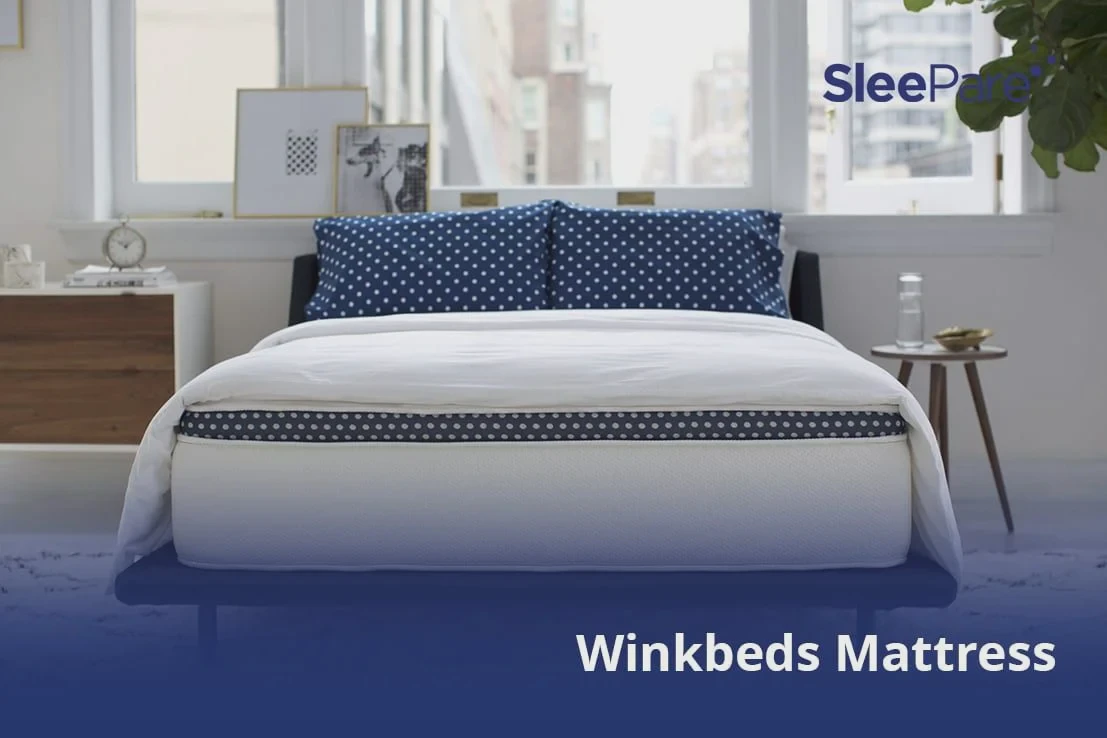
Both beds are hybrids, but the layers differ in ways you can feel.
| Layer | DreamCloud | WinkBed |
|---|---|---|
| Cover | Quilted cashmere-blend with soft foam | Tencel made from eucalyptus fibers |
| Comfort layer | Gel-infused memory foam | Dual-layer Euro pillow top with Hypersoft foam |
| Support core | Individually wrapped coils | Zoned coils with reinforced edge support |
| Height | 14 inches | 13.5 to 15 inches |
The DreamCloud's gel memory foam delivers the slow contouring sink, backed by a transition foam that keeps you from bottoming out on the coils. The WinkBed's Euro pillow top is quilted with Hypersoft foam that resists heat better than conventional memory foam, and its zoned coils add targeted lumbar support. DreamCloud is the value brand here, designed in the USA by Resident Home and assembled across a global supply chain, while WinkBeds are handmade to order in U.S. factories. If origin matters to you, it is worth reading up on where DreamCloud mattresses are made before you buy.
Performance: cooling, motion, edge, and durability
Head to head, the two trade wins across the lab-style metrics the refs tested.
Cooling
Call it a tie. Both are very breathable thanks to coil layers that move warm air out of the mattress.
Motion transfer
Neither is a standout, since both are bouncy coil beds. The DreamCloud edges ahead slightly because its thicker memory foam layer dampens movement a bit better.
Edge support
The WinkBed is the clear winner. Its reinforced perimeter coils feel more secure for sitting and sleeping near the edge, while the DreamCloud compresses a little more.
Durability
The WinkBed wins again, rated to last more than 10 years with proper care. Both carry a Lifetime warranty, but the WinkBed's reinforced build gives it the longer expected lifespan.
Pricing
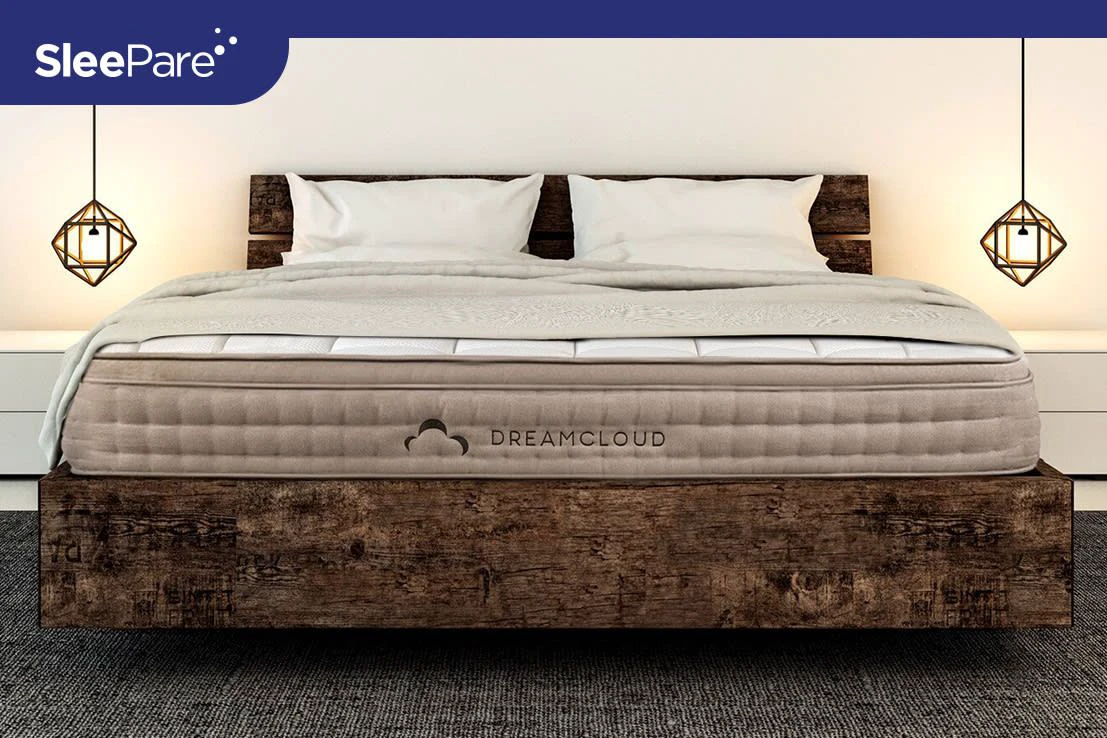
Price is the DreamCloud's biggest advantage. In one lab's testing the DreamCloud Premier Hybrid scored 9.08 against the WinkBed's category-leading 9.79, yet the Premier Hybrid cost $600 less.
| Size | DreamCloud | WinkBed |
|---|---|---|
| Twin | $399 | $1,149 |
| Twin XL | $549 | $1,249 |
| Full | $579 | $1,499 |
| Queen | $649 | $1,799 |
| King | $849 | $1,999 |
| California King | $849 | $2,049 |
DreamCloud's queen often sells in the sub-$1,000 range, while the WinkBed holds near $1,799 at full price. The gap is real, and it is the main reason DreamCloud wins on value.
Trials, shipping, and warranty
Both brands offer consumer-friendly policies, with one clear difference in trial length.
Sleep trial
The DreamCloud comes with a 365-night trial, while the WinkBed gives you 120 nights. Both require you to keep the bed about 30 days to let it break in before returning it.
Shipping and returns
Both ship free in the contiguous U.S. and offer free returns for a full refund after the break-in period. DreamCloud adds optional white glove delivery, and a Sleep Concierge helps arrange donation or disposal of a returned mattress.
Warranty
Both come with a Lifetime warranty against defects for as long as the original owner keeps the bed. After year 10, DreamCloud may opt to repair and recover the mattress instead of replacing it.
Which one should you buy
If your budget is the deciding factor and you sleep on your back or stomach, the DreamCloud is the smarter buy. It delivers a firm, supportive hybrid feel and the longest trial in the category for hundreds of dollars less. If you want to tune the firmness to your body, you sleep on your side, you weigh more than average, or you care about edge support and longevity, the WinkBed earns its higher price. Both are above-average hybrids, so the right pick is the one that matches how you sleep, not the one with the better spec sheet.
DreamCloud vs WinkBed FAQ
What are the common complaints about DreamCloud?
The most common knocks on the DreamCloud are that it can feel too firm for side sleepers, who report pressure building at the shoulder and hip, and that it has weaker edge support than the WinkBed, compressing a little near the perimeter. Testers also noted a touch of off-gassing that dissipated within about 48 hours, and motion is not isolated especially well since it is a bouncy coil bed.
Is DreamCloud a highly rated mattress?
Yes. The DreamCloud Premier Hybrid scored 9.08 in one lab's testing, placing it in the top 17 percent of mattresses tested, and reviewers rated the standard model around 4.4 to 4.6 out of 5. It rates well on cooling, responsiveness, and company policies, with its main weak spots being edge support and side-sleeper pressure relief.
What mattress compares to DreamCloud?
The WinkBed is the closest head-to-head luxury hybrid, trading firmness range and edge support for the DreamCloud's lower price. DreamCloud's sister brand Nectar shares many of the same factories and sits in a similar price tier, and shoppers cross-shopping luxury hybrids often look at Saatva as well.