DreamCloud mattresses are designed in the United States but assembled globally - primarily in China, with additional production in Vietnam, Malaysia, and Mexico, plus regional assembly in the United Kingdom and the European Union for those markets. The brand is owned by Resident Home (the same parent as Nectar), and its marketing language shifted from "made in the USA" to "designed in the USA, assembled globally" after a 2021 Federal Trade Commission ruling against unsupported origin claims.
If you want a one-line answer, that's it. The rest of this guide explains why the answer is messy, how to verify the country of origin on your own mattress, and whether assembly location actually matters for safety or quality in 2026.
Where DreamCloud mattresses are made today
DreamCloud does not publish a single factory address. Instead, the company uses a distributed manufacturing model in which different components and finished mattresses come from different facilities depending on the market and SKU.
Confirmed production countries (2026):
- China - primary foam pouring, cover sewing, and final assembly for most U.S.-bound units.
- Vietnam - hybrid assembly and pocketed-coil systems.
- Malaysia - foam and textile components.
- Mexico - some coil production and regional assembly for North American distribution.
- United Kingdom - assembly for UK customers (UK and Ireland orders).
- European Union - EU-specific manufacturing for local retailers.
- United States - design, quality engineering, and limited final assembly on certain SKUs.
The exact country printed on your law tag depends on the SKU, the order date, and the warehouse that fulfilled the shipment. Two identical-looking DreamCloud Original mattresses purchased a few months apart can ship from different facilities.
Why the "made in" question keeps getting different answers
If you search the question on Google, you will read three different answers within the first five results. That is not because reviewers are lazy - it is because DreamCloud's manufacturing story has actually changed multiple times since the brand launched in 2017.
- 2017 to 2019: Marketing copy promoted "made in the USA," and that claim spread across affiliate review sites.
- 2019 to 2020: Production shifted heavily overseas to scale with growth, but most blog posts never updated.
- 2021: The Federal Trade Commission settled with Resident Home over unsupported "Made in USA" claims, requiring refunds and a change to advertising language. Coverage at the time confirmed mattresses were finished overseas.
- 2022 to today: The brand uses "designed in the USA, assembled globally" and discloses country of origin on the law tag rather than in marketing copy.
So when you read an older article that says DreamCloud is made in California, or a 2024 forum post that says it is made in China, both can be partly true for the era they describe. The current answer is the global one.
Who owns DreamCloud and where the company is based
DreamCloud is a brand of Resident Home LLC, a U.S. direct-to-consumer mattress company headquartered in San Francisco, California. Resident also owns Nectar, Awara, and Level Sleep, and uses overlapping manufacturing partners across all four brands. That is one reason DreamCloud, Nectar, and Awara mattresses often ship from the same warehouses and use similar component sourcing - they are sister brands under one operations umbrella.
Design, product development, customer service, and warranty administration are handled in the United States. Physical production happens through Resident's network of contract manufacturers.
How to check where your DreamCloud was made
Marketing copy is unreliable. The law tag is not. Federal law (16 CFR Part 1632 and state mattress labeling rules) requires every mattress sold in the U.S. to carry a sewn-in tag listing the country of final assembly and the component origins.
1. Find the law tag
Look for a white sewn-in tag at the head or side seam of the mattress. It is the one that says "Do not remove under penalty of law" - that warning is intended for the retailer, not the consumer; you can read or even cut it off once you own the mattress. Skip the removable care label, which usually just lists washing instructions.
2. Read the origin wording
The country-of-origin line on a mattress law tag uses standardized phrasing:
- "Made in China" - fully assembled in China.
- "Finished in [country] with imported materials" - components sourced elsewhere, final assembly in the named country.
- "Made in USA of foreign components" - assembled in the U.S., but the foam or coils were imported.
- "Assembled in [country] from globally sourced components" - common DreamCloud wording in 2025 and 2026.
Any of those phrasings is legal and accurate. The phrase to watch for on older units is plain "Made in USA" without qualifier, which is what triggered the FTC action.
3. Photograph the tag
Snap a photo before the tag fades. You will need it for warranty claims and it is the only definitive record of where your specific mattress was made.
Does manufacturing location affect quality or safety?
This is the question worth focusing on, because country of origin alone is a weak proxy for either. The two metrics that actually matter are certifications and federal compliance, and both are independent of geography.
Every DreamCloud mattress sold in the U.S. must meet:
- 16 CFR Part 1633 - federal open-flame mattress flammability standard.
- CertiPUR-US - the foam industry's third-party certification for low VOC emissions, no formaldehyde, no PBDE flame retardants, and no heavy metals. DreamCloud's foams carry this seal.
- OEKO-TEX Standard 100 - textile safety certification for the cover fabric, verifying no harmful substances above defined limits.
A CertiPUR-US foam poured in a Chinese factory has been tested against the same chemical limits as one poured in Pennsylvania. The certification is what matters, not the address of the plant.
Manufacturing location can still affect:
- Lead times - overseas-assembled units may take longer to restock if a SKU goes out of stock.
- Warranty service - every DreamCloud warranty is administered through Resident Home in the U.S., so this is location-independent.
- Personal sourcing preferences - if buying domestic is important to you, DreamCloud is not the right choice; consider Saatva, Brooklyn Bedding, or Avocado instead.
What is actually inside a DreamCloud mattress
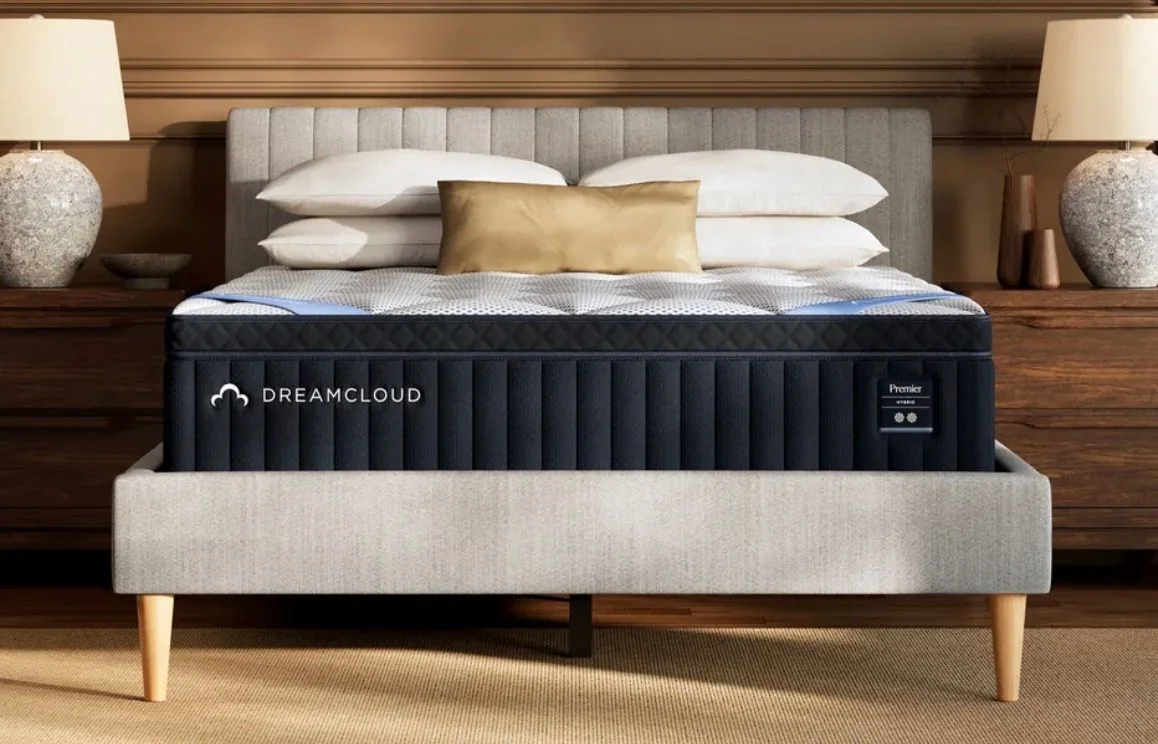
The DreamCloud Original is a 14-inch luxury hybrid built from layered foam and individually wrapped coils. From top to bottom:
- A quilted cashmere-blend cover for surface softness and breathability.
- Gel-infused memory foam comfort layer for pressure relief and heat dispersion.
- Transition foam for body contouring and motion isolation.
- A 5-zone individually wrapped coil core for support and edge stability.
- A high-density foam base for structural integrity.
The Premier and Premier Rest models add additional comfort layers and a Euro-top, but the same coil system and core chemistry. All variants carry the same CertiPUR-US and OEKO-TEX certifications regardless of which facility built them.
How DreamCloud compares to other "made in" claims
For shoppers using country of origin as a buying filter, here is the honest breakdown of how DreamCloud stacks up against common alternatives.
Mostly U.S.-made hybrids: Saatva (built to order in U.S. factories), Brooklyn Bedding (Phoenix, AZ), Avocado (Los Angeles, CA), and Charles P. Rogers (New York) all assemble the majority of their mattresses domestically. Expect to pay 20 to 60 percent more than DreamCloud for an equivalent build.
Global-supply-chain hybrids in DreamCloud's price tier: Nectar (sister brand, same factories), Allswell (Walmart-owned, similar global model), Helix (mostly U.S.-assembled but components imported), and Bear (mostly U.S.). The country-of-origin difference is real, but the certifications are the same.
DreamCloud's price point is only possible because of its global manufacturing model. If the brand assembled exclusively in the U.S., the queen-size price would land closer to $1,800 than its current sub-$1,000 sale range.
The bottom line
DreamCloud mattresses are designed in California and assembled across a global network, with China handling the largest share of U.S.-market production. That is neither a red flag nor a stamp of approval on its own - what matters is whether the mattress carries CertiPUR-US and OEKO-TEX certification, meets federal flammability rules, and comes with a real warranty and trial. DreamCloud checks every one of those boxes.
If the country on the law tag is a hard requirement for you, look at Saatva, Avocado, or Brooklyn Bedding. If you want a luxury hybrid at a mid-range price and you care more about certifications than geography, DreamCloud's manufacturing model is exactly why the brand can offer the price it does.
DreamCloud manufacturing FAQ
Are DreamCloud mattresses made in the USA?
Not entirely. DreamCloud mattresses are designed in the United States by Resident Home in San Francisco, but assembled globally - primarily in China, with additional production in Vietnam, Malaysia, Mexico, and limited U.S. assembly. The brand updated this language in 2021 after an FTC ruling against unsupported "Made in USA" claims.
Are DreamCloud and Nectar made in the same factory?
Often yes. Both brands are owned by Resident Home LLC and share a network of contract manufacturers in China and Southeast Asia. Two mattresses from the two brands may ship from the same facility and use foam from the same pour batch, though each model has its own build specification.
Why did the FTC fine DreamCloud?
In 2021, the Federal Trade Commission settled with Resident Home (DreamCloud's parent) over advertising that claimed mattresses were made in the USA when they were actually finished overseas. The settlement required refunds to affected customers and a permanent change to origin claims.
Is a Chinese-made mattress lower quality than a U.S.-made one?
Not inherently. Quality depends on materials, build specification, and certifications - not country of assembly. DreamCloud foams are CertiPUR-US certified and covers are OEKO-TEX certified, meaning they meet the same chemical and emissions standards regardless of where they were poured or sewn.
How do I find out where my specific DreamCloud was made?
Read the sewn-in white law tag at the head or side seam of the mattress. It must list the country of final assembly under federal law. Marketing copy can shift over time, but the law tag is the definitive record for your exact unit.
Still deciding on a DreamCloud?
Compare DreamCloud against our other in-depth mattress reviews and find the right fit for your budget, sleep style, and origin preferences.