
How iSense and Sleep Number differ
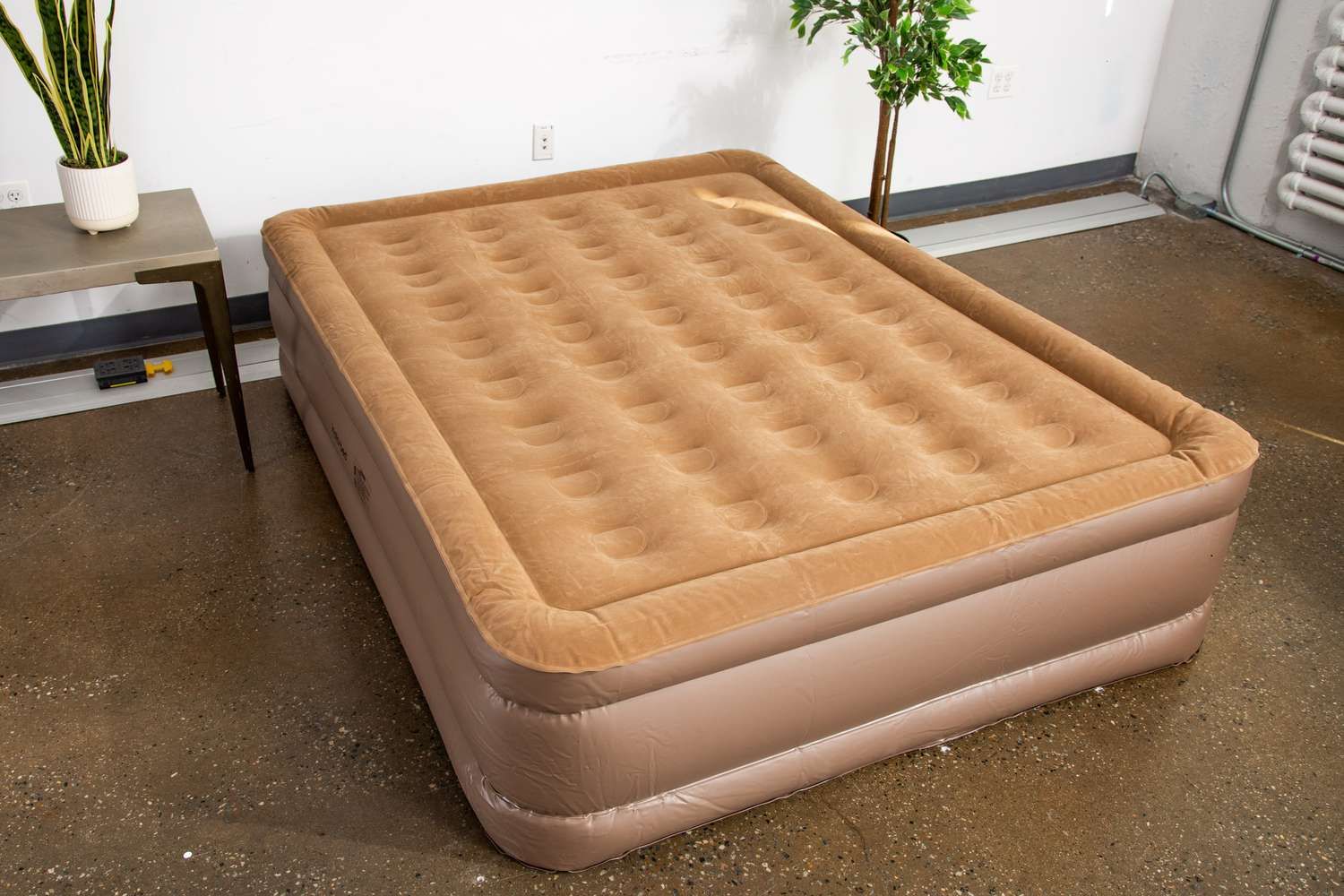
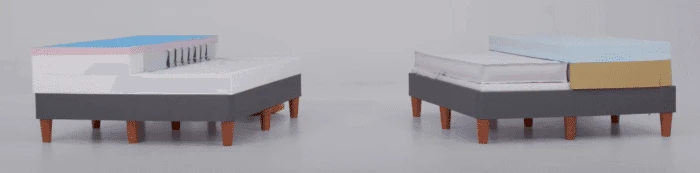
If you are shopping for an adjustable bed, iSense and Sleep Number are the two names that come up most, and they both let you change the firmness on each side from a remote or a phone app. The difference is in how they build that adjustability. Sleep Number is an air bed: a pump moves air in or out of one large chamber under each sleeper, and that air is the primary support system. iSense takes a different route. It nestles 14 small air cylinders (7 on each side) inside layers of foam, with pocketed coils underneath doing the heavy lifting on support.
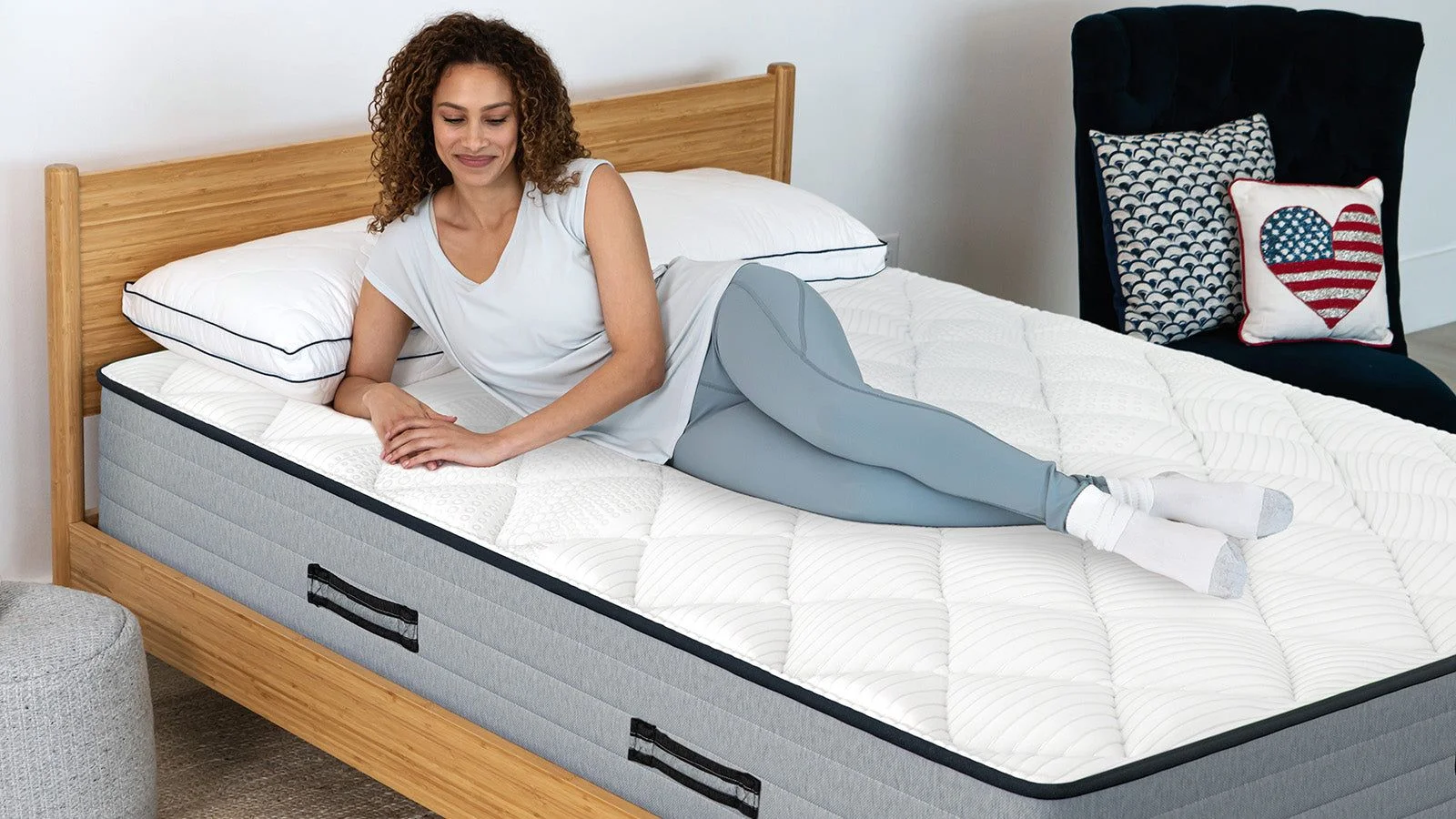
That construction choice changes how each bed feels. Because Sleep Number leans on air, the surface shifts when you move during the night, and adjusting the number mostly changes how much you sink rather than how much real support you get. With iSense, more air firms up the foam and less air softens it, so you are tuning a foam-and-coil mattress rather than inflating a bladder. As NapLab put it after testing the iSense Hybrid Premier, with or without the air the bed would still be a high-quality 13.5-inch mattress on its own.
Support and firmness across the range
Adjustable firmness is the headline feature for both brands, but support and firmness are not the same thing. On a Sleep Number, taking air out gives you a softer, deeper sinkage, but the support underneath does not improve. NapLab's reviewer recommends a Sleep Number only for people who want to stay in the medium-firm range of 6 to 7 out of 10, noting that any softer than that and support begins to drop.
iSense holds support more steadily across its range because the foam and coils carry the load regardless of the air setting. NapLab measured the Hybrid Premier at 4.5 out of 10 at its softest setting (11) and 7 out of 10 at its firmest (99), and found that sinkage barely changes between those extremes. In its tests the bed scored a perfect 10 for pressure relief, against 8.8 for the comparison mattress. The practical takeaway is that iSense gives you a usable spread of firmness without giving up support at the soft end, which is the trade-off that limits Sleep Number.
Motion transfer and surface recovery
Motion transfer is where the air-versus-foam split shows up most clearly. Air moves, so on a bed supported primarily by air, movement on one side carries across to the other. iSense argues that because its air chambers sit inside foam rather than acting as the main support, motion is absorbed before it travels. NapLab's instruments back the general direction of that claim: the iSense Hybrid Premier measured a motion-transfer acceleration of 7.01 m/s2, about 16 percent below the average mattress they have tested.
Surface recovery is a related point. On a Sleep Number, deflating the bed for a softer feel can leave a visible body impression when you get up. iSense recovers its surface regardless of the firmness setting, and NapLab clocked the Hybrid Premier fully recovering in about 0.5 seconds. None of this makes Sleep Number a bad bed, but if you share the mattress with a restless partner, the foam-wrapped design has a structural advantage.
How the test numbers stack up

NapLab runs the same battery of objective tests on every mattress it reviews. Here is how the iSense Hybrid Premier scored against the average of the beds in that comparison.
| Test | iSense Hybrid Premier | Comparison average |
|---|---|---|
| Pressure relief score | 10 | 8.8 |
| Motion transfer acceleration | 7.01 m/s2 | 8.65 m/s2 |
| Edge support score | 9.1 | 8.6 |
| Response time, fully recovered | 0.5 sec | 0.9 sec |
| Comfort layer thickness | 7.5 in | 4.1 in |
| Mattress thickness | 13.5 in | 12.0 in |
| Trial | 180 nights | 168 nights |
| Warranty | 10 years | ~14 years average |
The numbers tell a consistent story: iSense leads on pressure relief, motion isolation, edge support, and recovery speed, with a thicker comfort layer, while the comparison set carries a longer average warranty. iSense is also fiberglass-free and ships in a box, according to NapLab's spec sheet.
Price, trial, and warranty
Pricing is one of the bigger separators. NapLab lists the iSense Premier at $2,999 for a queen. Sleep Number's lineup spans from the entry c2 at $1,099 up to the Innovation-series i10 at $4,799 and the Climate360 at $9,999 for a queen, and an adjustable base is sold separately, adding roughly $1,099 to $2,099. So iSense lands below Sleep Number's comparable high-end Innovation models, though Sleep Number's cheaper Classic beds undercut it.
The trial and warranty terms diverge in a way worth reading closely. iSense offers a 180-night risk-free trial (after a required 45-night break-in) and a 10-year full-replacement warranty. Sleep Number offers a 100-night trial and a 15-year limited warranty that is prorated after the first two years.
| Year | iSense 10-year full warranty | Sleep Number 10-year prorated portion |
|---|---|---|
| Years 1-2 | $0 | $0 |
| Year 3 | $0 | You pay 40% of replacement cost |
| Year 5 | $0 | You pay 50% |
| Year 7 | $0 | You pay 60% |
| Year 10 | $0 | You pay 75% |
iSense also notes that after year 2, Sleep Number owners may be responsible for shipping, labor, installation, and return freight on a warranty claim. That detail comes from iSense's own comparison page, so treat the framing as a vendor's, but the proration schedule itself matches Sleep Number's published limited-warranty structure.
Smart features and controls
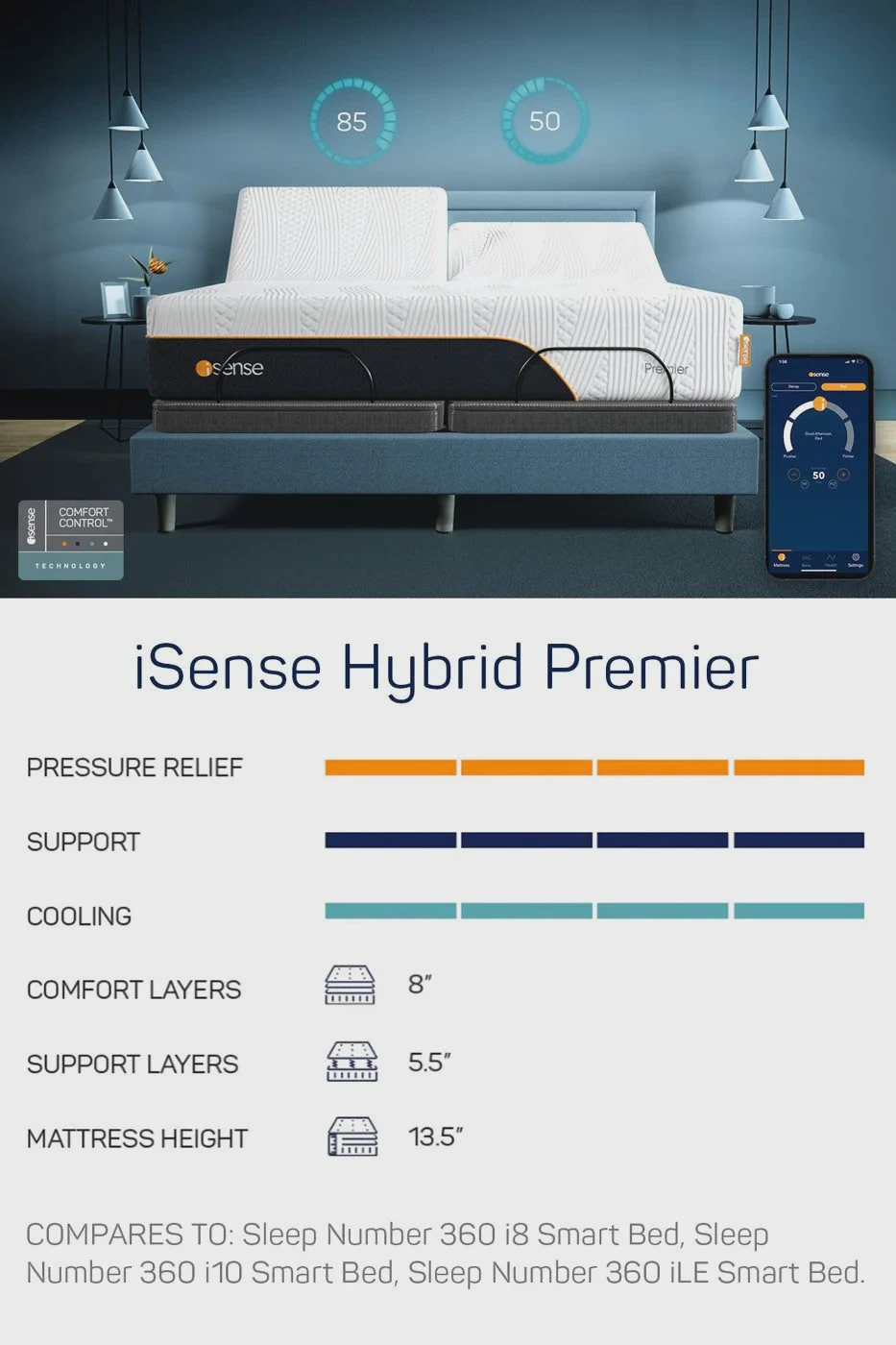
Both brands run on the same three-part control setup: a pump or compressor on the floor, a physical remote, and a smartphone app, all letting you adjust each side independently. Sleep Number's long-running SleepIQ system tracks your sleep and feeds back recommendations through its app, and the 360 Smart Bed needs a Wi-Fi connection within about 8 feet of the bed to run its app integration and sleep tracking.
iSense pairs its remote and app with a built-in sleep tracker too, syncing heart rate, breath rate, time to fall asleep, and time spent in light, mid, and deep sleep for each side. The gap here is smaller than the marketing suggests: Sleep Number has the more mature tracking platform, but both beds cover the core smart functions. iSense leans more on physical comfort adjustment than on sleep analytics.
Which one is right for you
Sleep Number builds a solid bed with real adjustability, a 100-night trial, and a long warranty, and its Classic series gives you the lowest entry price of the two. But its support is arguably best only in the medium-firm range, and you are paying a premium for air-based adjustability plus a separate adjustable base. NapLab's reviewer, who has tested well over 100 mattresses, says that for most sleepers who settle into a fixed firmness anyway, a high-scoring alternative at a lower price wins 9 times out of 10.
iSense makes the stronger case if motion isolation, steady support at softer settings, and a longer 180-night trial matter to you, and it sits below Sleep Number's high-end models on price. If your firmness preference never strays far from one setting and you want the most established sleep-tracking app, Sleep Number still has a place. For couples with different firmness needs and a restless sleeper in the bed, the foam-wrapped iSense design is the safer bet.