Short answer: no - Puffy mattresses are not considered toxic by any of the third-party programs that certify mattress foam in the United States. Every Puffy model uses CertiPUR-US certified foams, the cover is Oeko-Tex Standard 100 certified, and Puffy publicly states none of its mattresses contain fiberglass. That puts Puffy in the same chemical-safety tier as most other mainstream bed-in-a-box brands (Nectar, Saatva foam models, Tempur-Pedic). It does not make Puffy an organic or all-natural mattress - those are different categories with different certifications.
If you searched this query because of a specific concern (a smell, a lawsuit you heard about, a child or chemical sensitivity in the home), the rest of this guide breaks the question into the parts that actually matter: what each certification covers, whether Puffy contains fiberglass, what off-gassing is and how long it lasts, and where Puffy genuinely falls short for chemically-sensitive buyers.
What "non-toxic" means for a mattress
There is no FDA standard for a "non-toxic mattress." The phrase is a marketing umbrella for a few specific things: low volatile organic compound (VOC) emissions, no added flame-retardant chemicals like PBDEs, no heavy metals or formaldehyde in the foam, and a cover textile tested for skin-contact safety. Independent certifications are how a brand proves any of that.
CertiPUR-US (the foam)
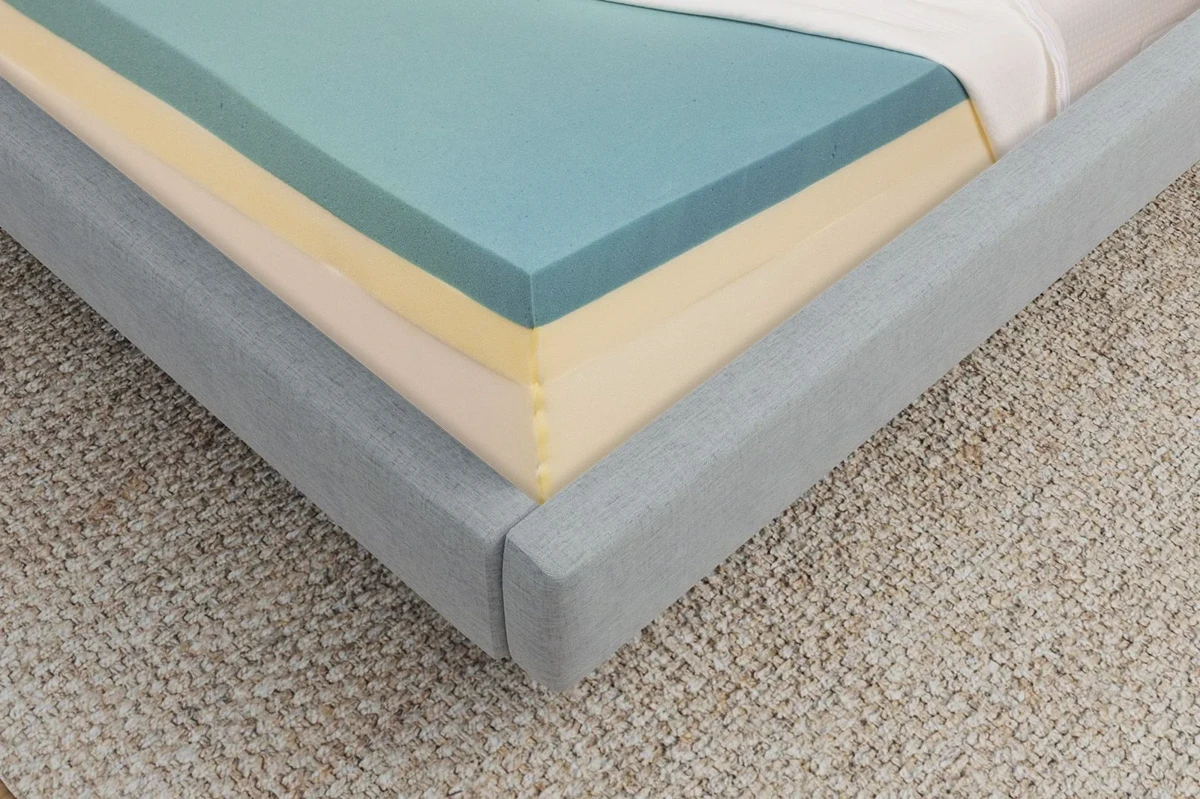
CertiPUR-US is the program that certifies the polyurethane and memory foam itself. Puffy's foams are independently tested to be free of ozone depleters, PBDE/TDCPP/TCEP flame retardants, mercury, lead and other heavy metals, formaldehyde, and phthalates regulated by the CPSC, and are emissions-tested for low VOCs (under 0.5 parts per million). Puffy is listed in the public CertiPUR-US directory, which you can verify yourself at certipur.us.
Oeko-Tex Standard 100 (the cover)
The cover textile that touches your sheets is certified to Oeko-Tex Standard 100, which tests every component of a fabric (thread, dye, prints, accessories) against a list of substances harmful to human health. This is the same textile certification used by major children's clothing and bedding brands.
What Puffy is NOT certified as
Puffy is not GOLS (organic latex), GOTS (organic cotton), or GREENGUARD Gold certified, and it is not made of natural materials. If your priority is an all-natural or organic mattress, look at brands like Avocado, Naturepedic, or Saatva's Zenhaven line - Puffy is engineered foam, just engineered foam that has been tested clean.
Do Puffy mattresses contain fiberglass?
No. Puffy has stated directly - and repeated on its support pages - that none of its mattresses use fiberglass as a flame barrier. This is one of the more important questions to ask in 2026 because a wave of low-cost foam mattresses (largely on Amazon and Walmart) used woven fiberglass under the cover as a cheap fire-retardant layer, and several of those have been the subject of class-action lawsuits when shed fiberglass contaminated homes.
Instead of fiberglass, Puffy uses a synthetic fire-resistant sock that meets the federal 16 CFR 1633 open-flame standard. That barrier is built into the construction; you should never need to unzip the cover, and Puffy's care guidance is consistent with that - keep the cover on the mattress.
Off-gassing: what it is, what to expect
Off-gassing is the smell new memory foam releases when it is unboxed and the foam decompresses. That smell is real and it is not the same as toxicity - every CertiPUR-US foam mattress will off-gas to some degree because the smell is residual VOCs from the foaming process, even when total emissions are below the certification threshold.
What Puffy gets right on chemical safety
- All foam layers are CertiPUR-US certified for low VOCs and free of PBDEs, formaldehyde, heavy metals, and phthalates.
- Cover is Oeko-Tex Standard 100 certified for skin-contact safety.
- Confirmed fiberglass-free across every Puffy model (Cloud, Lux, Royal, Monarch).
- Fire barrier meets 16 CFR 1633 without using glass fiber.
- Listed in the public CertiPUR-US directory, so the certification is independently verifiable.
Where Puffy falls short
- Not an organic or all-natural mattress - uses engineered polyurethane and memory foam.
- Not GREENGUARD Gold certified, which some chemically-sensitive buyers specifically look for.
- Will off-gas a noticeable smell for the first 24 to 72 hours, occasionally up to a week in poorly ventilated rooms.
- Cover should not be removed; if you want a fully washable cover or natural fiber surface, look elsewhere.
How long off-gassing lasts
For a Puffy mattress, expect the noticeable smell to fade within 24 to 72 hours in a ventilated room. A small percentage of buyers report a faint smell up to a week. If it is still strong after 7 days, that is unusual - contact Puffy customer service. To speed it along: unbox in a room with airflow, leave windows open if you can, and do not put sheets on for the first night if smell-sensitivity is a concern.
Who should think twice about Puffy
Puffy is a safe choice for the vast majority of households. The buyers who should consider an alternative are:
- People with diagnosed multiple chemical sensitivity (MCS) - even certified low-VOC foam emits some VOCs. An organic latex or organic cotton mattress is a closer match.
- Buyers who want a mattress with no synthetic foam at all - Puffy is fundamentally a memory foam product.
- Households that cannot ventilate a room for 1-3 days - off-gassing in a sealed studio with poor airflow can take longer to clear.
For everyone else - including most parents, allergy sufferers, and chemically-cautious shoppers who want a foam mattress - Puffy clears the bar that mainstream certifications set.
Common questions
Is the Puffy mattress non-toxic?
By the standards used to certify mattress safety in the U.S., yes. Puffy's foams are CertiPUR-US certified (no PBDEs, no formaldehyde, no heavy metals, low VOCs) and the cover is Oeko-Tex Standard 100 certified. "Non-toxic" is a marketing word, not a regulated one - but Puffy meets the same independent thresholds the rest of the mainstream foam industry is held to.
Do Puffy mattresses have fiberglass?
No. Puffy has confirmed across its product line - Cloud, Lux, Royal, and Monarch - that no model uses fiberglass as a fire barrier. Puffy uses a synthetic fire-resistant sock that meets the federal 16 CFR 1633 flammability standard without glass fiber.
How long does a Puffy mattress off-gas?
Most owners report the new-foam smell fades within 24 to 72 hours of unboxing in a ventilated room. A small fraction notice a faint smell up to a week. If you want to minimize it, unbox in a room with airflow and leave the mattress uncovered for the first night.
Is Puffy safe for kids and babies?
Puffy is safe for older children - every model is CertiPUR-US and Oeko-Tex certified. For infants under 12 months, pediatric guidance is to use a firm, flat crib mattress designed for infant sleep, not an adult memory foam mattress; that is a sleep-safety question, not a chemical-toxicity question.
Is Puffy GREENGUARD Gold certified?
No. Puffy holds CertiPUR-US (foam) and Oeko-Tex Standard 100 (cover) certifications, but is not currently listed as GREENGUARD Gold. If GREENGUARD is specifically required for your purchase, look at brands like Avocado or Naturepedic that hold that certification.
Is Puffy an organic mattress?
No. Puffy is engineered foam - it is certified for low emissions and chemical safety, but it is not made from organic latex, organic cotton, or natural wool. For organic, look at GOLS- and GOTS-certified brands.
Need help choosing a non-toxic mattress?
Banner Mattress carries CertiPUR-US certified foam mattresses and natural-material options. Visit a showroom to compare in person, or browse our certified mattress guides online.