The short answer
Purple mattresses are not toxic by any mainstream chemical-safety standard. The polyurethane foam layers carry CertiPUR-US certification (low VOCs, no formaldehyde, no heavy metals, no ozone depleters, and no PBDE flame retardants), and the finished mattresses hold Intertek's CleanAir GOLD indoor-air certification. The proprietary GelFlex Grid is a food-grade hyper-elastic polymer originally engineered for medical cushions and wheelchair seating.
Two caveats worth knowing before you buy: a Costco-exclusive Purple Renew model has carried a California Prop 65 warning for phthalates, and Purple uses a non-fiberglass fire sock - but the brand isn't certified organic. If those nuances matter to you, the details are below.
What "non-toxic" actually means for a mattress
There is no FDA definition of "non-toxic" for mattresses. In practice, the industry uses three independent certifications as proxies, and Purple holds the two that apply to conventional foam construction:
- CertiPUR-US - tests the polyurethane foam itself for low VOC emissions (under 0.5 parts per million), and bans formaldehyde, mercury, lead, other heavy metals, ozone depleters, PBDE/TDCPP/TCEP flame retardants, and certain phthalates.
- CleanAir GOLD (Intertek) - tests the finished mattress for indoor-air-quality emissions, the highest of three tiers.
- GOLS / GOTS - organic certifications for latex and textile components. Purple does not carry these (it's not an organic brand). If certified-organic matters, look at Avocado or Naturepedic instead.
What's actually inside a Purple mattress
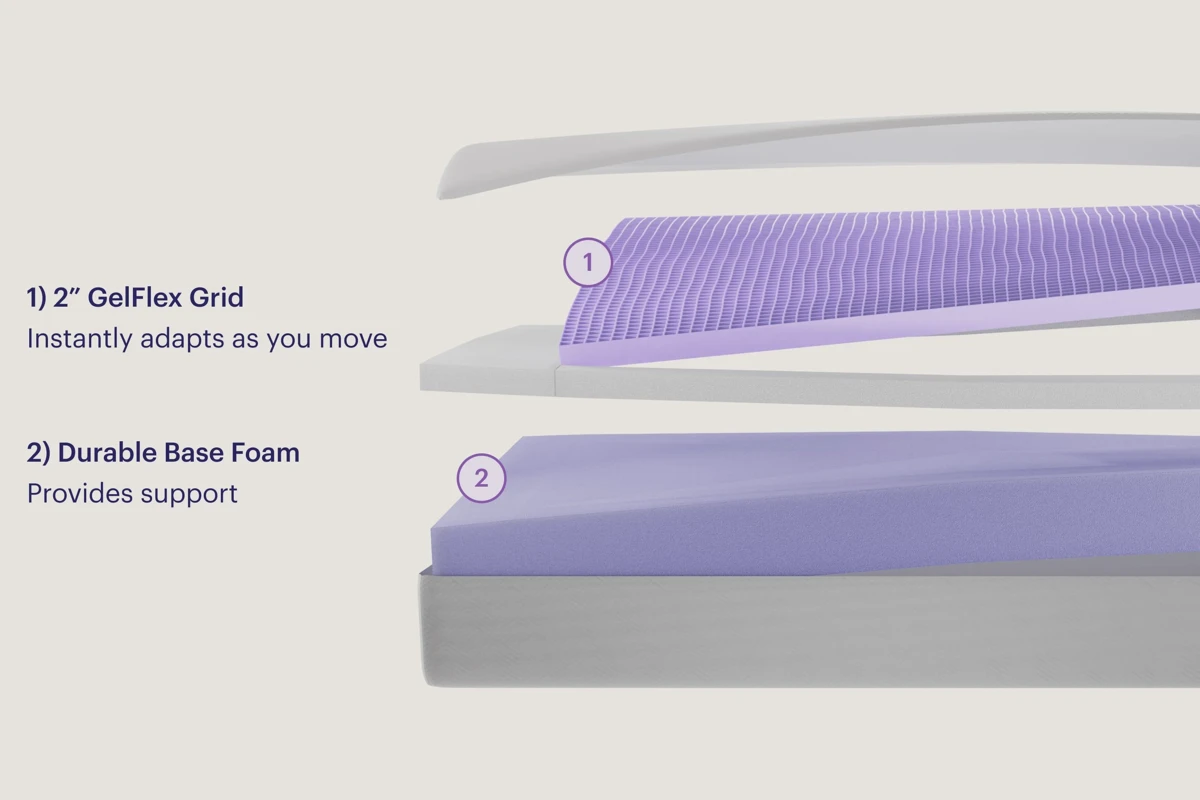
Every Purple mattress has the same signature top layer: the GelFlex Grid (originally branded "Hyper-Elastic Polymer" or "Floam"). It's a food-grade plastic polymer formed into an open lattice that flexes under pressure points and stays firm everywhere else - the so-called "column buckling" effect Purple uses for pressure relief and airflow.
Below the grid, the layers vary by model:
- Essential Collection (PurpleFlex, Purple Mattress, Purple Plus) - all-foam: GelFlex Grid over CertiPUR-US polyfoam (1.8-2.5 lb/cu ft density).
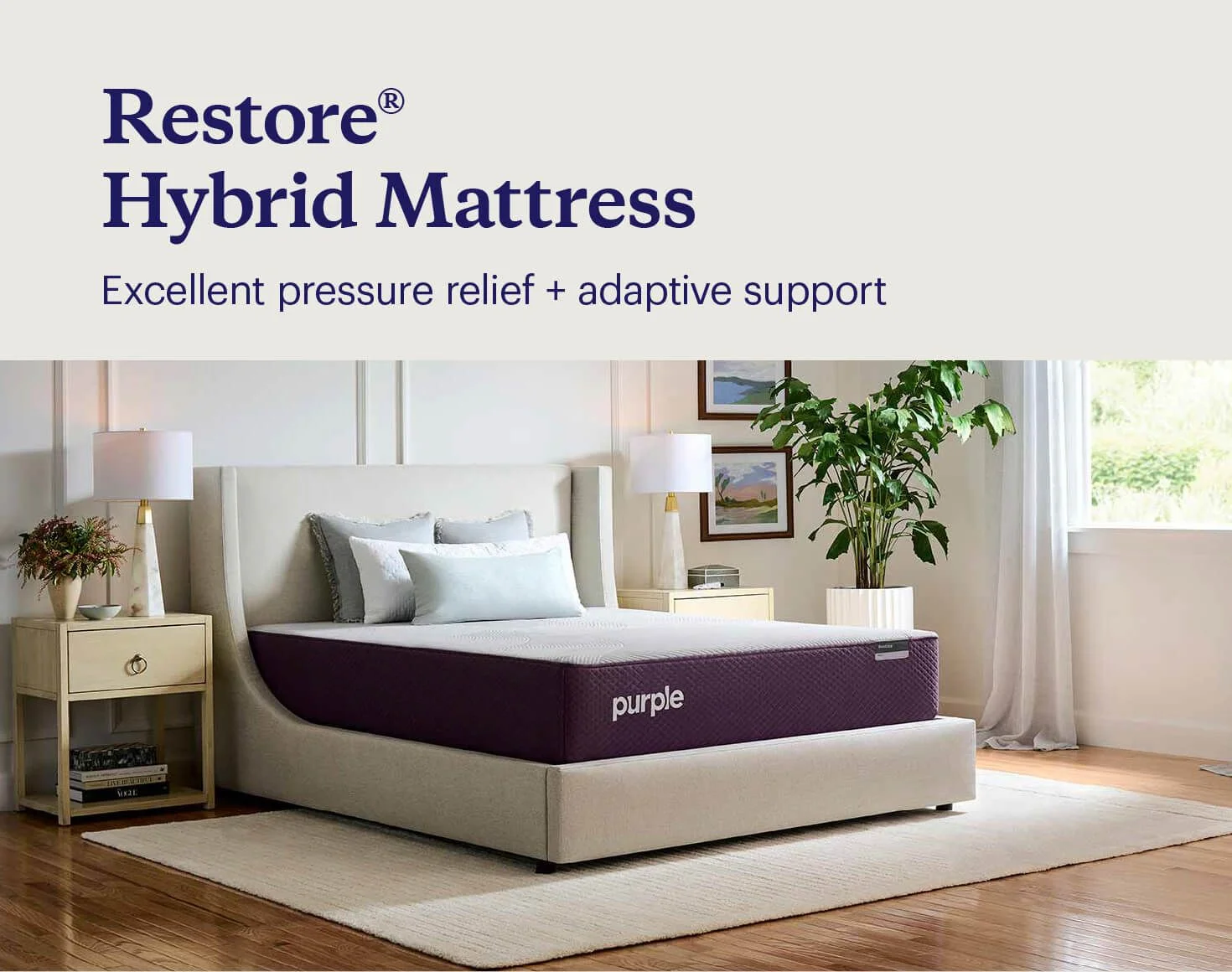
- Restore Hybrid line - GelFlex Grid + polyfoam + 682-789 pocketed coils, with antimicrobial polyester/elastic cover.
- Rejuvenate Luxe Collection - higher-density GelFlex Grid Plus, Active Response Comfort Foam, Talalay latex (Premier model only), and zoned coils up to 1,130 in queen.
The fiberglass question
This is the one most readers actually care about. Purple confirms that none of its mattresses contain fiberglass. To meet the federal flammability standard (16 CFR 1633), Purple uses a knit fire-resistant fire sock barrier rather than the spun-fiberglass barriers that have caused well-publicized lawsuits against budget brands like Zinus and Linenspa.
Practical takeaway: you don't need to worry about removing the cover and releasing fiberglass strands the way you would with a $250 boxed mattress. Purple's cover is removable for spot cleaning per the brand's care guide.
About the California Prop 65 warning
If you bought (or shopped) a Purple mattress at Costco, you may have seen a Prop 65 sticker citing diisononyl phthalate (DINP) and di-ethyl hexyl phthalate (DEHP). This appeared on the Costco-exclusive Purple Renew model and was first widely discussed in a 2024 r/Mattress thread.
Two things to keep in mind:
- California's Prop 65 list contains roughly 900 substances and triggers warnings at far lower thresholds than federal exposure limits. Many products carry the warning preemptively to avoid litigation, even when they don't pose a meaningful exposure risk in normal use.
- DINP and DEHP are plasticizer phthalates that have been phased out of children's products federally. They're still used in some adhesives and films inside mattresses. The warning is real; the actual exposure during sleep is not well characterized.
If you want to avoid the question entirely, the standard Purple Mattress, Purple Plus, and the Restore/Rejuvenate hybrid lines (sold direct or through Mattress Firm, Macy's, etc.) do not currently carry Prop 65 warnings to our knowledge. Check the law tag on the specific unit before purchase if it matters to you.
Off-gassing: how much, how long
Every foam mattress shipped compressed in a box releases a faint smell when it expands - that's normal off-gassing of trapped VOCs from manufacturing. With CertiPUR-US foam, the total VOC level is below 0.5 ppm, which is well within the threshold for indoor air quality.
Purple recommends airing the mattress in a ventilated room for several hours before sleeping on it. Most users report the smell dissipates within 24-72 hours. If you have asthma, MCS (multiple chemical sensitivity), or are particularly fragrance-sensitive, set up the mattress in a guest room and ventilate for a week before moving it.
Are Purple mattresses safe for kids?
For children over 12 months, yes - same certifications apply, and the firmer Purple Mattress and Restore Hybrid Firm options are reasonable picks. Purple's edge support on the hybrid models is solid enough for active sleepers who tend to roll.
For infants under 12 months, Purple does not make a crib mattress, and we wouldn't recommend any adult mattress for that use. Look at Naturepedic or Newton Baby instead.
How Purple compares to other "safe" mattress brands
If your bar for "non-toxic" is CertiPUR-US foam, every major direct-to-consumer brand (Saatva, Helix, Nectar, Tempurpedic, DreamCloud, Layla, Puffy) clears it. The differentiators come down to fiberglass and organic certifications:
- Fiberglass-free, conventional foam: Purple, Saatva, Helix, Tempurpedic, Tuft & Needle.
- Certified organic (GOLS/GOTS): Avocado, Naturepedic, Birch, PlushBeds.
- Has had fiberglass concerns: Zinus, Linenspa, several Amazon-only brands. Read the law tag carefully.
Frequently asked questions
Do Purple mattresses contain fiberglass?
No. Purple uses a knit fire-resistant sock instead of spun fiberglass to meet federal flammability requirements. None of the current Essential, Restore Hybrid, or Rejuvenate Luxe models contain fiberglass.
Why does my Purple mattress have a Prop 65 warning?
The Costco-exclusive Purple Renew model has carried a California Prop 65 warning citing phthalates (DINP, DEHP). Many manufacturers add Prop 65 warnings preemptively because California's listing thresholds are lower than federal exposure limits. The mainstream Purple Mattress, Purple Plus, and Restore/Rejuvenate hybrids sold direct don't currently carry the warning to our knowledge - check the specific unit's law tag if this matters to you.
What is the GelFlex Grid made of?
It's Purple's branded "Hyper-Elastic Polymer," a food-grade plastic originally developed for wheelchair cushions and medical seating. It's coated with a thin layer of inert food-grade polyethylene powder during shipping to prevent the lattice from sticking to itself; Purple states the powder is harmless if any residue remains.
How long does a Purple mattress off-gas?
Most users report the new-mattress smell fades within 24-72 hours of unboxing in a ventilated room. CertiPUR-US foam releases under 0.5 ppm of total VOCs, which is below indoor-air-quality concern thresholds. Anyone with chemical sensitivities should ventilate for a full week before sleeping on it.
Are Purple mattresses certified organic?
No. Purple does not carry GOLS or GOTS certifications because the polyfoam, polymer grid, and polyester/spandex covers are synthetic. If you specifically want certified-organic, look at Avocado Eco Organic, Naturepedic, or PlushBeds instead.
Is the GelFlex Grid safe to sleep on long term?
There is no published evidence of harm from long-term contact with the polymer (it sits under the cover, not against your skin). The polymer itself has a 20-plus-year track record in medical seating. The bigger long-term unknown is durability - Purple's grid hasn't been independently sleep-tested over a decade-plus span the way conventional foam has.
Shopping for a non-toxic mattress?
Visit a Banner Mattress showroom to compare Purple, Saatva, Helix, and certified-organic options side by side - and read the law tag with our team before you buy.