
There is a specific feeling to a hotel bed: cool, crisp, smooth, and impossibly clean. It is one of the small reasons a $300 room feels like a treat. The good news is the formula is not a secret, and the sheets that produce it are not exotic. Hotels rely on a small set of weaves, fibers, and finishes - and once you know what they are, you can buy the same thing for your own bed.
Below is what actually drives that hotel feel, what to ignore on the label, and the brands hotels and bedding editors keep coming back to in 2026.
What makes a sheet feel 'hotel quality'
Five things - in roughly this order of importance:
- Fiber: long-staple cotton (Egyptian, Pima/Supima, or premium upland). Long fibers spin into smoother, stronger yarn that resists pilling and gets softer with washing.
- Weave: percale for crisp and cool, sateen for silky and smooth. Both are used in luxury hotels - they just feel different.
- Construction: single-ply yarn. Multi-ply lets manufacturers inflate thread count with weaker thinner threads.
- Thread count: 200-400 for percale, 300-600 for sateen. Anything claiming 1000+ is almost always multi-ply marketing.
- Finish and laundry: high-temperature commercial laundering, rotary ironing, and a touch of starch. This is the part you cannot fully replicate at home - but a hot wash, a hot dryer pull at 80 percent, and folding off the line gets close.
Notice what is not on the list: color, pattern, or 'Egyptian-sounding' brand names. White dominates hotels because it bleaches cleanly at high temperatures and signals freshness - not because it is inherently better fabric.
Lighting matters too - see our guide for choosing bulbs by lumen output and color temperature.
Percale vs sateen: which 'hotel feel' do you actually want
This is the single biggest decision and the one most shoppers skip.
Percale is a one-over-one-under weave. It feels matte, lightweight, and crisp - the rustle of fresh hotel linens, the cool slap of the sheet on your legs in summer. Marriott, Four Seasons, and most resort properties favor percale for guest rooms because it photographs as 'crisp white' and feels cool in any climate. Pick it if you sleep hot or love that just-ironed crunch.
Sateen is a four-over-one-under weave. It feels smooth, drapey, and slightly warm - closer to silk against the skin. Ritz-Carlton, St. Regis, and many city luxury properties lean sateen for the heavier hand and the way it photographs lustrous in editorial shots. Pick it if you sleep cold, like sheets to feel substantial, or want that 'slip into a robe' softness.
Both can be hotel-quality. Neither is objectively better. If you genuinely cannot decide, buy a percale set first - it is the more universal feel and easier to layer with a sateen duvet cover later.
The thread-count trap
Thread count is the number of vertical and horizontal threads per square inch. It is a useful spec only inside a single weave and a single fiber, and only up to a point.
- Percale: 200-400 is the sweet spot. Above 400 the weave loses its breathability.
- Sateen: 300-600 is ideal. Above 600 you usually get multi-ply yarn or polyester blending.
- 1000+ thread count: almost always multi-ply (each thread is two or three thinner threads twisted together and counted multiple times) or a microfiber blend. Skip.
The Federal Trade Commission has flagged inflated thread-count claims for years. A 300-thread-count single-ply Supima sheet will outperform an 800-thread-count multi-ply set every time.
Fiber types, ranked
- Egyptian cotton (genuine, Giza-grown, ELS): the gold standard. Extra-long fibers, exceptionally smooth, durable. Look for Cotton Egypt Association certification - most 'Egyptian cotton' on Amazon is not.
- Supima / Pima cotton: American extra-long-staple cotton. Effectively as good as Egyptian for sheets, easier to verify (Supima is a trademarked, traceable brand), and used by Boll & Branch, Brooklinen Luxe, and Company Store Legends Hotel.
- Long-staple upland cotton: the workhorse of mid-tier hotel bedding. Good - just not heirloom-good.
- Linen: luxurious, breathable, expensive, and intentionally rumpled. Resort and beach-house properties (Soho House, some Aman lodges) use it. Not the right pick if you want crisp.
- Bamboo / Tencel / eucalyptus: silky, cool, sustainable. Increasingly common in hot-climate hotels. Good alternative if you sleep hot but find percale too crunchy.
- Microfiber / polyester: what budget motels use. Cheap, durable, traps heat, never feels luxurious. Skip.
What hotels actually buy
If you want the literal sheet from your favorite hotel, most major chains sell theirs through brand stores:
- Marriott Hotels Store: 300-thread-count cotton percale and a deluxe sateen set. The Marriott percale is the literal sheet in most Marriott, Westin, and Sheraton rooms.
- Ritz-Carlton Shop: Frette-made sateen with a higher hand-feel and price tag to match.
- Kimpton x Frette: what Kimpton properties use. Italian-made, sateen-leaning.
- Hilton to Home: the Hilton/Doubletree sheet, T-250 percale.
If you would rather buy from a sheet brand directly:
- Boll & Branch Signature Hemmed: organic Supima sateen, the editor's pick at most major outlets.
- The Company Store Legends Hotel Supima: Wirecutter and Spruce 'best overall' for years. Comes in both percale and sateen.
- Pure Parima Ultra Percale: genuine Egyptian Giza cotton, around $160 - the value play if you want true ELS.
- Brooklinen Luxe Sateen: the most-reviewed sateen on the internet, and reasonably priced for what it is.
- Cozy Earth Bamboo: if you sleep genuinely hot and want temperature regulation over crispness.
Other things hotels get right (that you can copy)
- Deep pockets. Look for fitted sheets with 15+ inch pockets. Modern mattresses and toppers are tall - anything less slips off corners overnight.
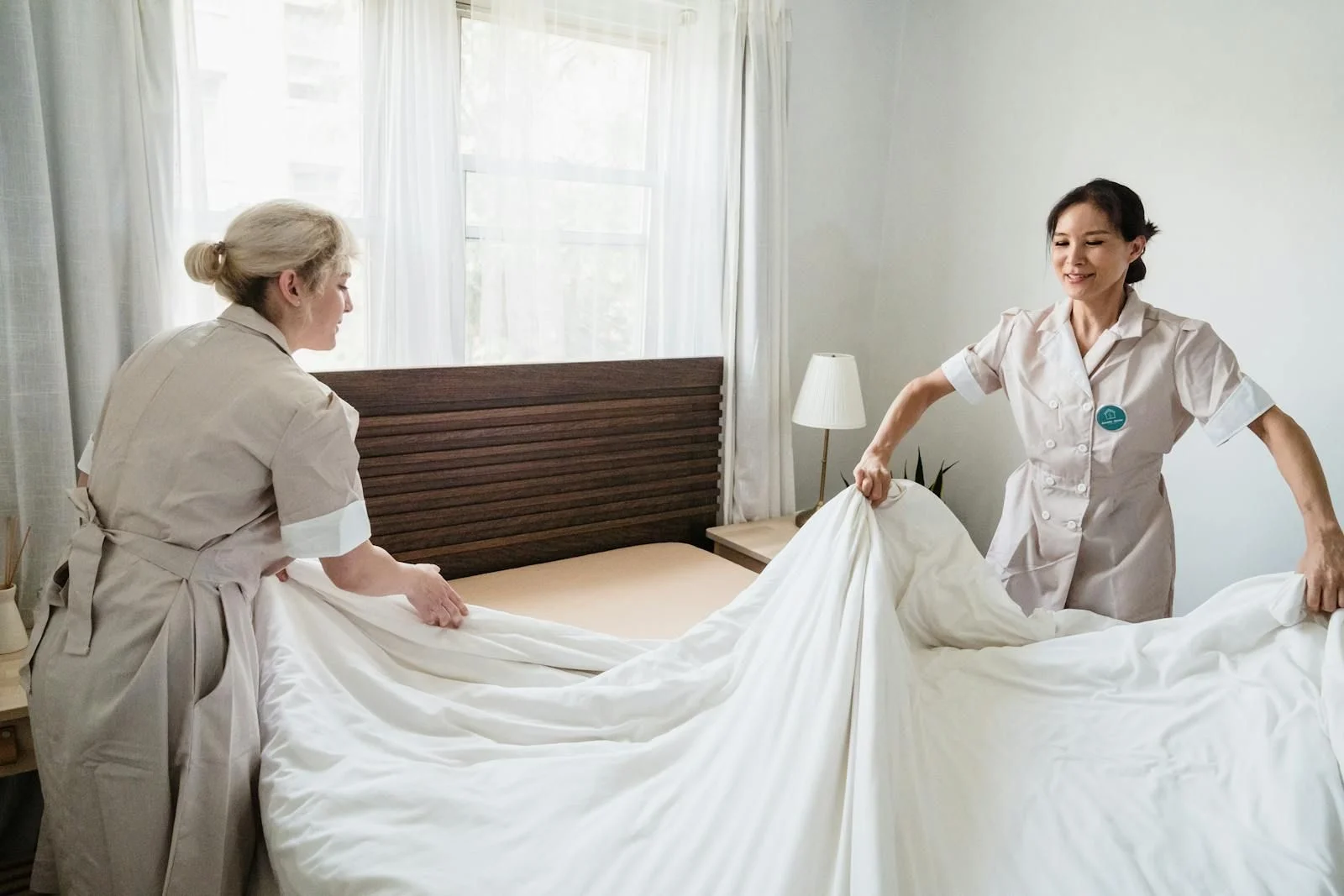
- Two flat sheets, no fitted (the 'triple sheet' setup). Many luxury hotels skip the fitted sheet entirely: one flat sheet tucked tight under the mattress, one flat sheet between you and the duvet, and the duvet sandwiched in a third top sheet. Easier to launder, lasts longer, and crisper. Try it for one week.
- Iron the pillowcases. If you do nothing else, iron the cases. It is the single highest-impact 30 seconds in home laundry.
- Two sets, rotated. Hotels run at least three sets per bed. Two sets at home is the minimum to keep one always laundered and let each rest between uses - both wear better and feel fresher.
- Wash hot, dry hot, fold off the line. Cotton tightens slightly when hot-washed, which is what gives hotel sheets that drum-tight feel. Pull them at 80 percent dry, smooth the wrinkles by hand, and fold immediately.
How to shop without getting fooled
When you are reading a product page, scan in this order and stop the moment something disqualifies the set:
- Fiber content. 100 percent cotton (Supima, Pima, Egyptian, or long-staple). Walk away from blends.
- Weave. Percale or sateen, stated explicitly.
- Ply. Single-ply preferred. If they don't say, assume multi-ply.
- Thread count in range. 200-400 percale, 300-600 sateen.
- Pocket depth and elastic specs.
- Return / trial window. Real bedding brands offer at least 30 nights.
Percale
- Crisp, cool hand - feels like a fresh hotel bed
- Breathable; best for hot sleepers and warm rooms
- Gets softer with washing; ages well
- Quiet, matte finish (no shine in photos)
Sateen
- Smooth, silky, slightly warm - drapes like a luxury robe
- Wrinkle-resistant; needs less ironing
- Heavier hand - feels substantial in winter
- Subtle sheen; higher-end editorial look
Frequently asked questions
What sheets do 5-star hotels actually use?
Most luxury hotels use either 300-thread-count single-ply percale or 400-600-thread-count sateen, made from long-staple cotton (Egyptian Giza or American Supima). Marriott, Four Seasons, and Westin lean percale; Ritz-Carlton, St. Regis, and Aman lean sateen. The literal sheets are usually made by Frette, Standard Textile, or Sferra and resold through hotel brand stores.
Is a higher thread count always better?
No. Thread count above roughly 400 for percale or 600 for sateen almost always means multi-ply yarn - two or three thinner, weaker threads twisted together and counted multiple times. A 300-thread-count single-ply Supima sheet will feel and last better than an 1800-thread-count multi-ply one. Use thread count as a sanity check, not a quality score.
Why are hotel sheets so cool and crisp?
Three reasons. First, percale weave - one-over-one-under construction is naturally breathable. Second, commercial laundering at high temperatures, which tightens the cotton fibers. Third, rotary ironing with a touch of starch, which produces that flat, drum-tight feel. You can replicate the first two at home; the third needs a pillowcase iron.
Are Egyptian cotton sheets always good?
Only if they are genuinely Egyptian Giza cotton, certified by the Cotton Egypt Association. The label 'Egyptian cotton' is unregulated in most markets, and most cheap 'Egyptian cotton' sheets on Amazon are blended or short-staple. Supima - American extra-long-staple cotton - is a trademarked, traceable alternative and just as good for sheets.
How often should I replace hotel-quality sheets?
Genuine long-staple cotton percale or sateen sheets, washed weekly and rotated with a second set, last 4-7 years before the hand-feel noticeably degrades. Microfiber and low-quality cotton sets last 1-3 years. The first sign of replacement: thinning at the foot of the flat sheet or pilling at the pillowcase center.
Should I buy fitted or flat for a hotel feel?
Both. The most luxurious hotel beds use the 'triple sheet' setup - one flat tucked under the mattress, one over you, and a third encasing the duvet - with no fitted sheet at all. Easier to launder, longer-lasting, and gives you that taut hospital-corner feel. If that is too fussy, a deep-pocket fitted sheet is fine for everyday.
Upgrading the rest of the bed?
Sheets are step one. The mattress under them, the pillow you sink into, and the duvet that finishes the bed all contribute to the hotel feel. Browse our 2026 mattress and bedding guides for the rest of the build.