Why a Gray Throw Blanket Is a Must-Have for Your Bed
Five styling techniques, room-by-room pairings, and the right size and material for your bed.
A gray throw blanket is one of the most versatile pieces you can add to a bed - neutral enough to slip into any palette, textural enough to do real styling work, and practical when an extra layer matters. This guide covers why gray works, how to style one across five popular bedroom looks, the size to buy for your bed, and the materials worth the money.
Why gray works on a bed (when most "neutral" colors don't)
Gray sits between warm and cool, so it pairs cleanly with both white-and-wood Scandinavian palettes and richer jewel-tone bedding. Unlike beige, gray reads modern. Unlike pure white, it hides everyday use and isn't dependent on perfect light. A medium-gray throw is the closest thing to a universal accessory in bedding.
A second advantage: gray is forgiving across light temperatures. Warm bulbs push it toward greige; cool daylight reveals more blue undertones. That shift is why the same blanket can read cozy at night and crisp in the morning without ever feeling out of place.
How to style a gray throw blanket on a bed
Five repeatable techniques, ranked from quickest to most considered.
1. The casual foot-of-bed drape
The easiest move, and the one most editorial bedrooms use. Fold the throw in thirds the long way, lay it across the foot of the mattress so it covers roughly the bottom third of the bed, and let one end fall a few inches longer than the other. The asymmetry reads styled instead of staged.
Pick a throw with visible texture - cable knit, waffle, chunky boucle - so it stands apart from a smooth duvet.
2. The neat center fold
Fold the throw into a clean rectangle (roughly 18 by 30 inches) and place it dead-center at the foot of the bed. This is the hotel-look that photographs best and is the right pick if your duvet already has a strong pattern. The throw becomes a punctuation mark, not a layer.
3. The diagonal cascade
Drape the throw from one upper corner of the mattress diagonally across the bed, letting it pool slightly at the opposite foot corner. Best on king and queen beds where there's enough width to read the line.
4. The full layer
Spread the throw across the entire foot half of the bed, on top of the duvet. Smooth, no folds. This is the warmest of the styled options and the right look for fall and winter. Choose a lightweight throw - heavy faux fur over a duvet looks bulky.
5. The rolled accent
Roll the throw tightly and place it at the foot of the bed or on a bench. The roll keeps the foot of the bed visually clean while adding a textured horizontal line. Works especially well in minimalist or hotel-style rooms.
Matching a gray throw to your bedroom style
A neutral throw lets you commit to a bedroom personality without buying new bedding every season.
Scandinavian. Pair a light-gray waffle or cotton throw with crisp white sheets, a linen duvet, and one warm-wood element (headboard, side table). Avoid black accents - they harden the look.
Industrial. A charcoal chunky-knit or wool blanket softens metal frames, concrete walls, and leather. Skip anything shiny; matte textures matter most here.
Bohemian. Layer a gray throw over a patterned duvet (block-print, kantha, or vintage rug-style). The gray cools off a busy palette and keeps the bed from reading chaotic.
Coastal. A light heather-gray cotton throw over white bedding, paired with one navy or sea-green pillow, gives the beachy palette without feeling literal.
Modern. Solid charcoal or slate, fine knit, no fringe. Pair with a single contrast pillow in a saturated color (mustard, terracotta, or ink blue) for a chic, minimalist finish.
What size gray throw to buy for your bed
Throw blankets sold as "throws" are typically 50 by 60 inches - sized for couches, not beds. For bed styling, you want a larger size so the throw drapes properly without looking undersized.
Twin and twin XL beds. A 50 by 60 inch standard throw works, draped horizontally across the foot.
Full and queen beds. Look for 60 by 80 inches (sometimes labeled "oversized throw"). Standard throws read too small here.
King and California king beds. Go up to 70 by 90 inches or 80 by 90 - full coverlet-throw territory. A 50 by 60 throw looks lost on a king bed.
If a brand only lists one size, check the dimensions, not the name - sizing labels are not standardized.
Materials worth knowing
A few material rules of thumb:
Cotton and cotton waffle are the all-season default. Breathable, washable, gets softer with use. Look for combed or long-staple cotton; coarse short-staple cotton pills fast.
Cable knit and chunky knit add the most visible texture. Wool knit is warmest; cotton knit is more washable. Both shed initially.
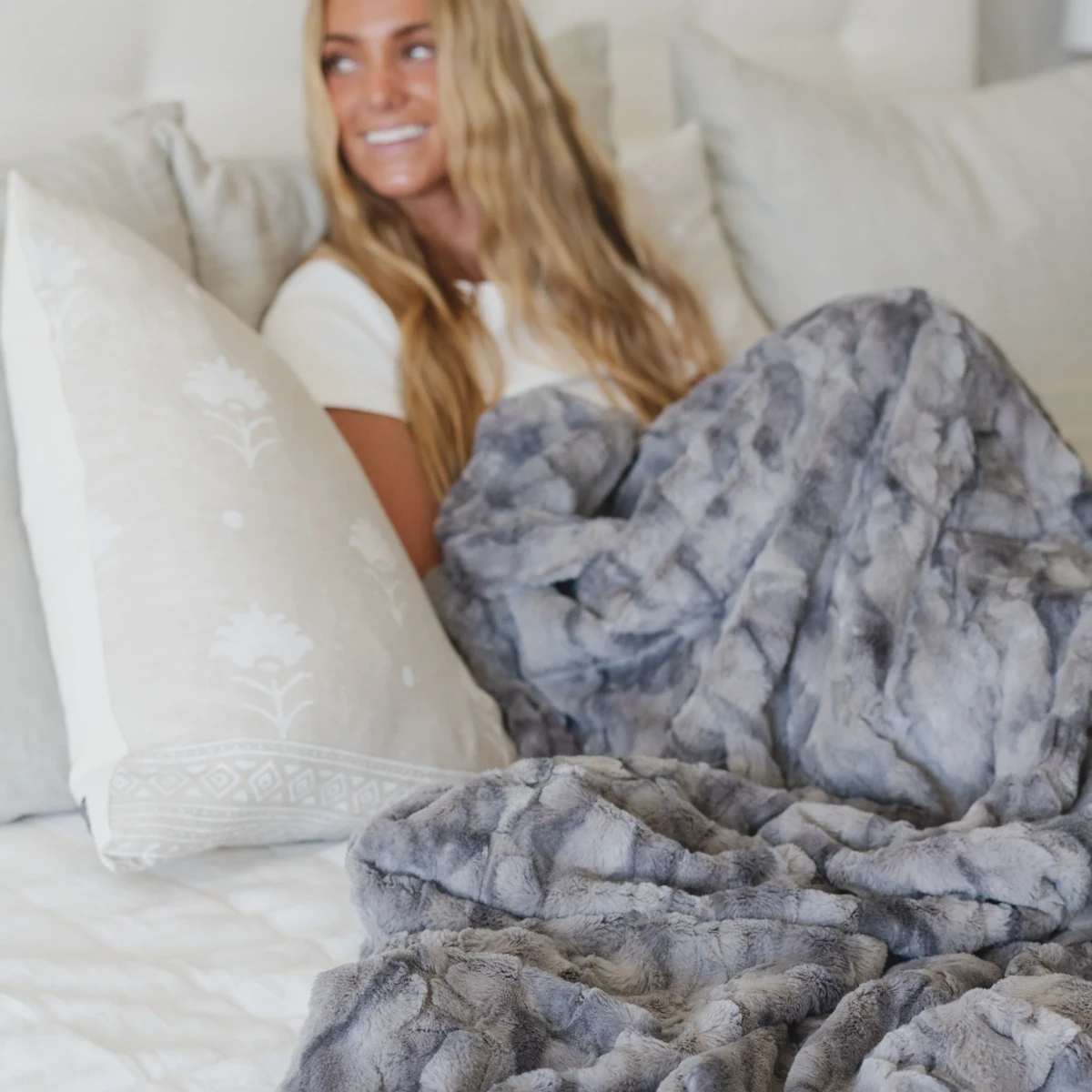
Faux fur and sherpa are heavy and warm - good for winter, polarizing year-round. Choose a low-pile faux fur (under 1 inch) for a more grown-up look; high-pile reads dorm.
Linen and cotton-linen blends are the lightest weight and the most casual-modern. Wrinkles are part of the look.
Polyester fleece is the cheapest and the least flattering on camera. Avoid for styled bedrooms; reserve for utility blankets in a closet.
Common styling mistakes to avoid
- Buying a 50x60 throw for a king bed. It will look like a napkin.
- Matching the throw exactly to the duvet color. Contrast - even subtle tonal contrast - is what makes the layer read intentional.
- Layering three textures of similar weight. Pick one statement texture (chunky knit) and let the rest be smooth.
- Letting fringe sit on the floor. If your throw has fringe, fold so the fringe lies on top of the mattress, not pooling on the rug.
Frequently asked questions
What size throw blanket is best for a queen or king bed?
For queen beds, look for an oversized throw around 60 by 80 inches. For king and California king beds, go to 70 by 90 or 80 by 90 inches. Standard 50 by 60 inch throws are sized for couches and look undersized on a queen or king.
What colors go well with a gray throw blanket?
Gray pairs cleanly with white, cream, and warm wood for a soft palette; with navy, forest green, or charcoal for a moody one; and with mustard, terracotta, or blush pink as a single accent for contrast. Avoid matching the throw exactly to the duvet - tonal contrast is what makes the layer look intentional.
Where should a throw blanket go on a bed?
The most common placement is across the foot of the bed, either folded in thirds and draped horizontally, folded into a centered rectangle, or laid diagonally from corner to corner. The foot of the bed adds texture without interfering with how you actually sleep.
How do I make a throw blanket look styled, not messy?
Fold the throw deliberately (in thirds long-ways, or into a clean rectangle), keep one obvious asymmetry - a longer drape on one side or a slightly off-center placement - and use a texture different from your duvet. Three smooth layers look flat; one chunky texture against smooth bedding looks intentional.
What is the best material for a gray throw blanket on a bed?
Cotton or cotton waffle is the most versatile year-round option - breathable, washable, and easy to style. For winter or a more luxurious look, choose chunky knit or a low-pile faux fur. Avoid polyester fleece for styled bedrooms; it photographs cheap and pills quickly.
Shopping for new bedding to go with that gray throw?
Browse our bedding guides for sheets, pillows, and mattress picks that work in every style.