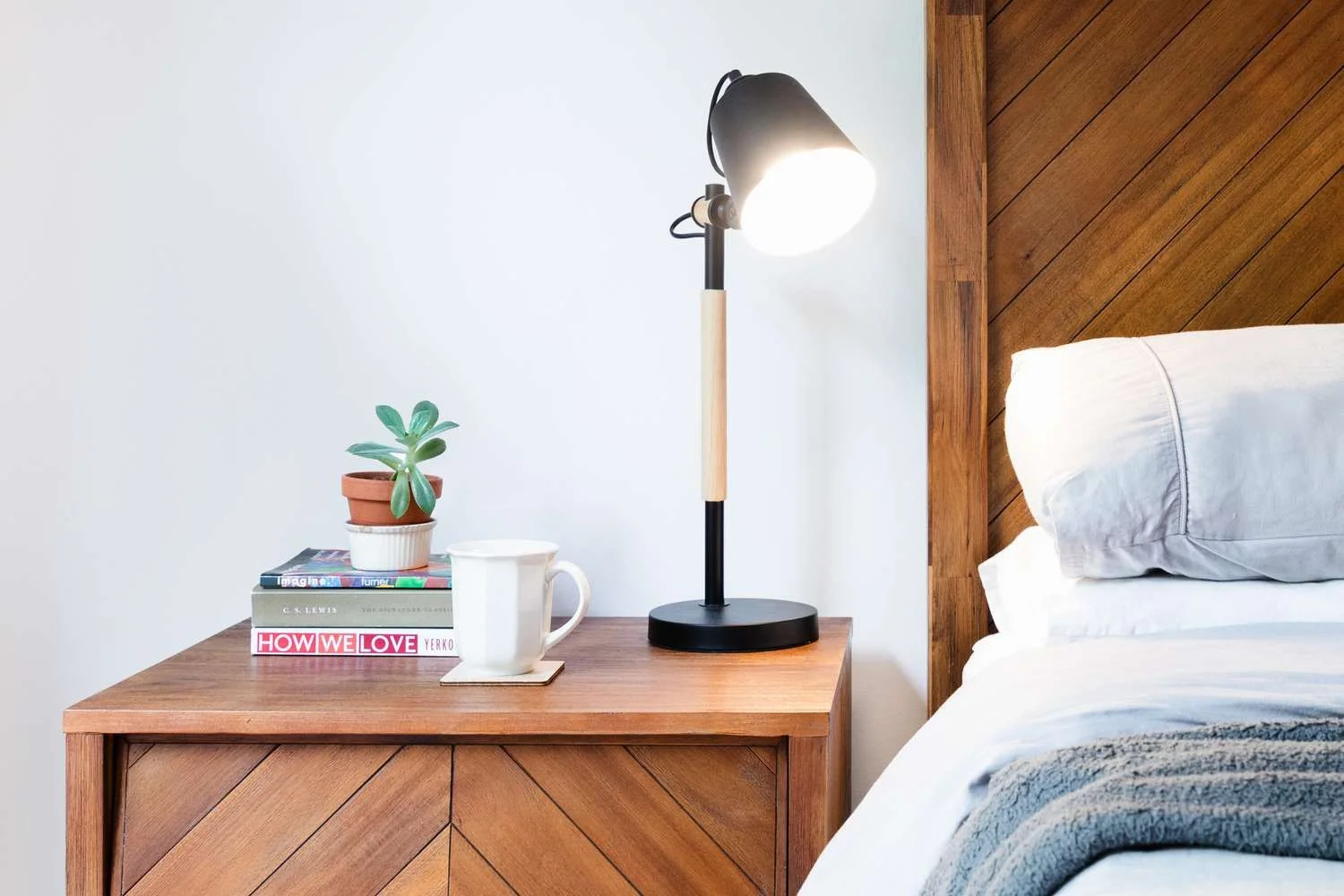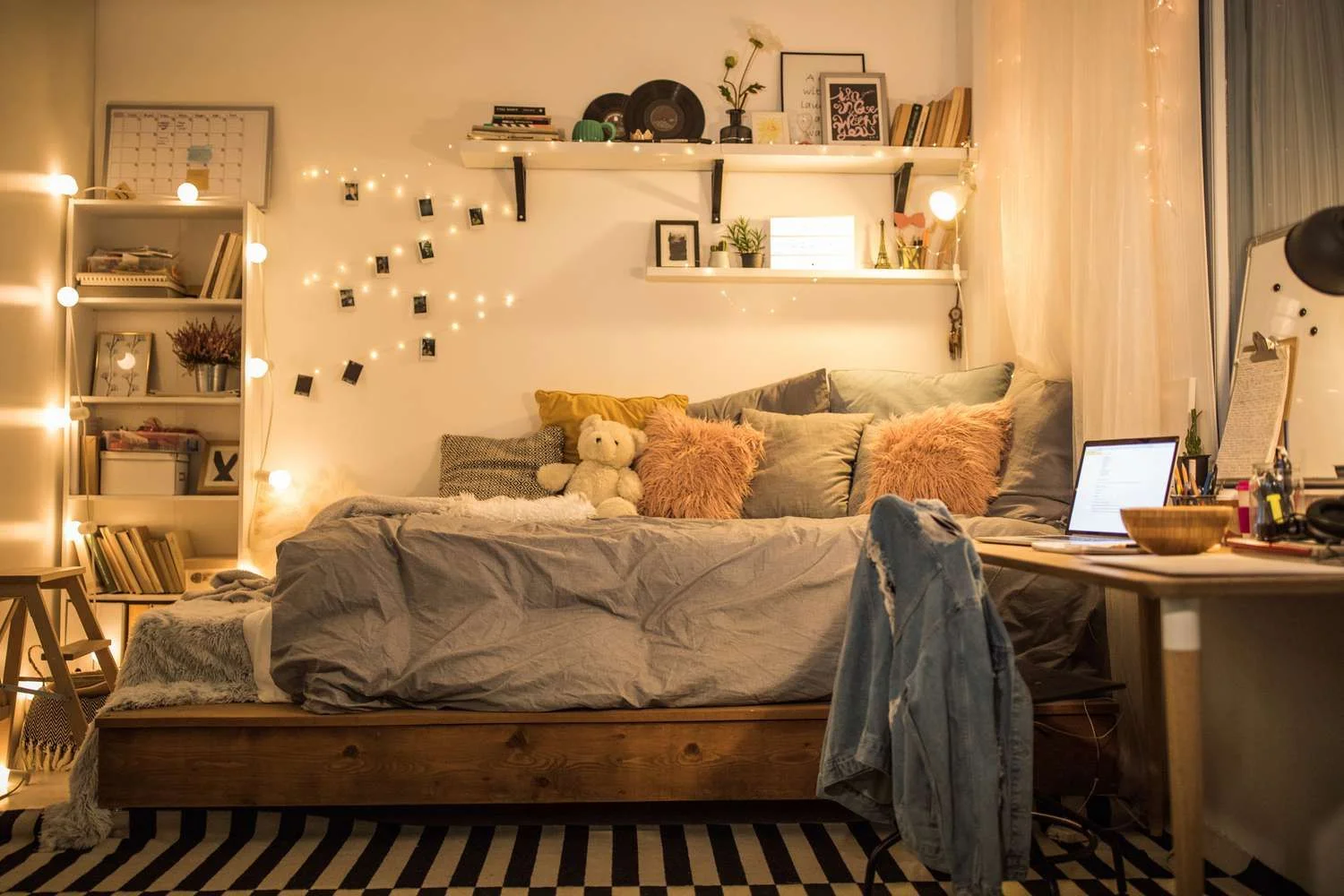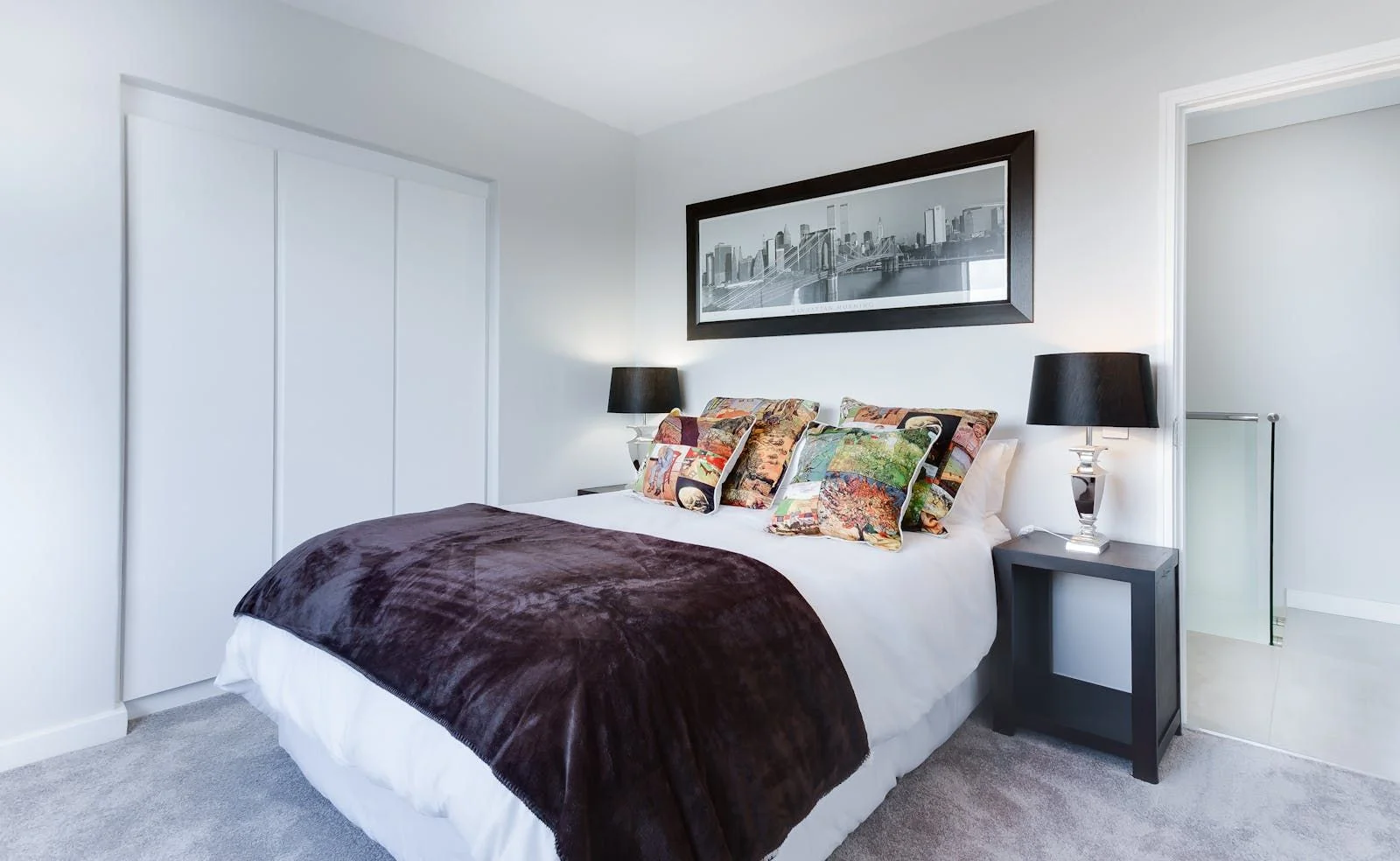
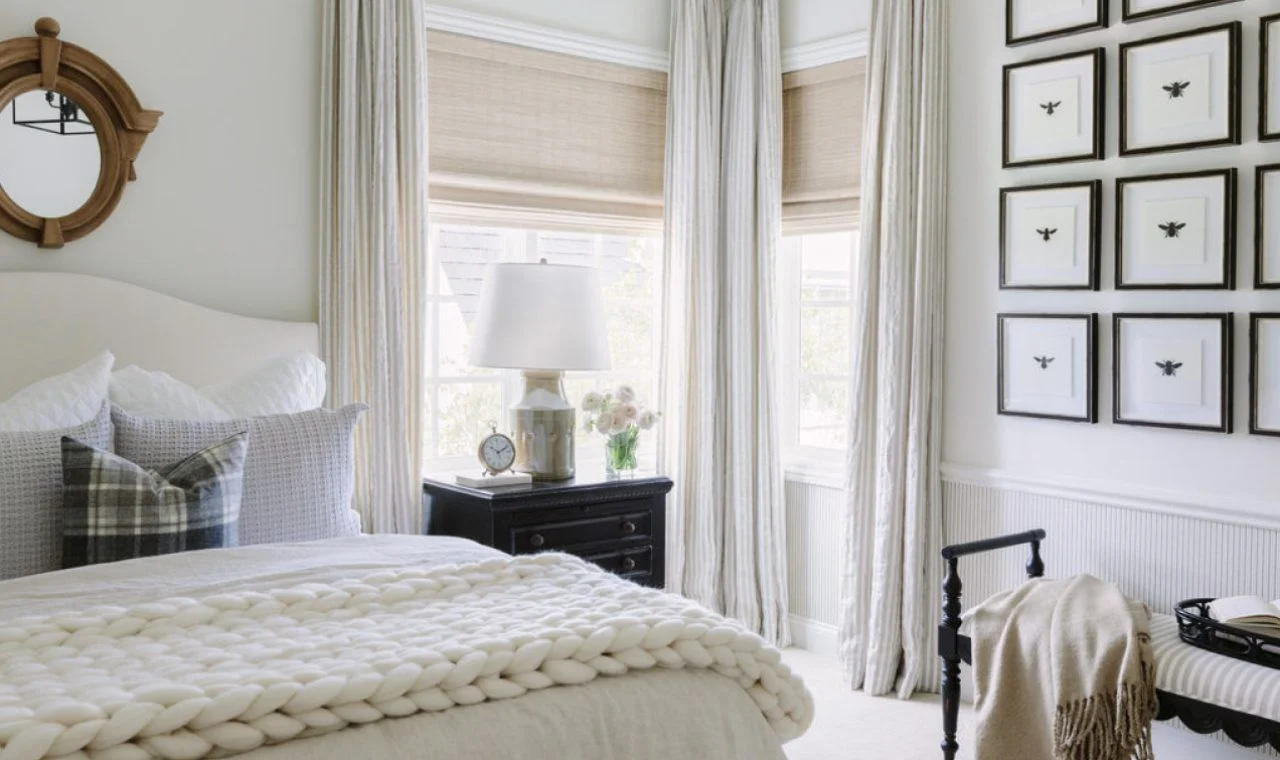
The fastest answer: aim for a lamp 24-30 inches tall (roughly 2-3 inches taller than your nightstand), with a shade about one-third the nightstand's width. When you sit up in bed, the bottom of the shade should land near chin or shoulder level - high enough to light a book, low enough that the bulb stays out of your eyes.
That single rule covers 90% of bedrooms. The rest of this guide is the matrix for the other 10%: tall headboards, low platform beds, and king setups where a 24-inch lamp will look like a teacup on a buffet.
The nightstand lamp sizing rule (one sentence)
Lamp height ≈ nightstand height + 2-3 inches. Shade width ≈ one-third the nightstand width. Shade bottom at chin level when seated upright in bed.
Editorial consensus agrees on the range. The Lightopia bedside-lamp guide puts the band at 24-30 inches for a 24-26 inch nightstand. Furniture Row's lamp-size guide uses a 1:1 to 1.2:1 ratio for bedrooms (27-inch nightstand → 27-32 inch lamp). And Reperch's nightstand-lamp guide adds the one-third-width shade rule.
Lamp height by nightstand height
Pick the row that matches your nightstand. The lamp range gives you a 1:1 minimum and a 1.2:1 ceiling - go to the top of the range if you have a tall headboard or a thick mattress.
20-inch nightstand: lamp 22-26 inches tall, shade 8-10 inches wide.
24-inch nightstand: lamp 26-29 inches tall, shade 10-12 inches wide. This is the most common combination - most queen platform setups land here.
27-inch nightstand: lamp 28-32 inches tall, shade 12-14 inches wide. Standard for taller traditional case-goods.
30-inch nightstand: lamp 30-34 inches tall, shade 14-16 inches wide. Common with king beds and high-profile headboards.
The chin-level check
Numbers are a starting point; ergonomics is the test. Sit upright against the headboard with the lamp on. The bottom of the shade should sit roughly between your chin and shoulder - typically 19-21 inches above the mattress top, or 22-27 inches above the nightstand surface when measured straight up.
Why it matters: too high and the bulb glares straight into your eyes when reading. Too low and the shade traps light at lap level, leaving the page dim. The chin-line gives you a wide cone of light on the book without the filament in view.
Match the headboard, not just the nightstand
If you have a tall upholstered or paneled headboard (50+ inches), a 24-inch lamp will look swallowed. Visually, the top of the shade should land somewhere between the top of the mattress and the top of the headboard - never above the headboard, and not so low it disappears behind the nightstand profile.
Conversely, with a low platform bed and a wall-hung sconce-style headboard or no headboard at all, scale down - a tall lamp will tower over a 10-inch mattress and look top-heavy.
Lamp width by bed size
Twin / full: shade 8-11 inches wide. Small nightstands (16-18 inches) pair best with compact bases and shorter shades.
Queen: shade 10-14 inches wide. Standard sweet spot for most U.S. bedrooms.
King / California king: shade 14-16 inches wide, lamp 28-32 inches tall. The wider bed and (usually) larger nightstands need more visual mass - a 24-inch lamp looks undersized next to a 76-inch-wide bed.
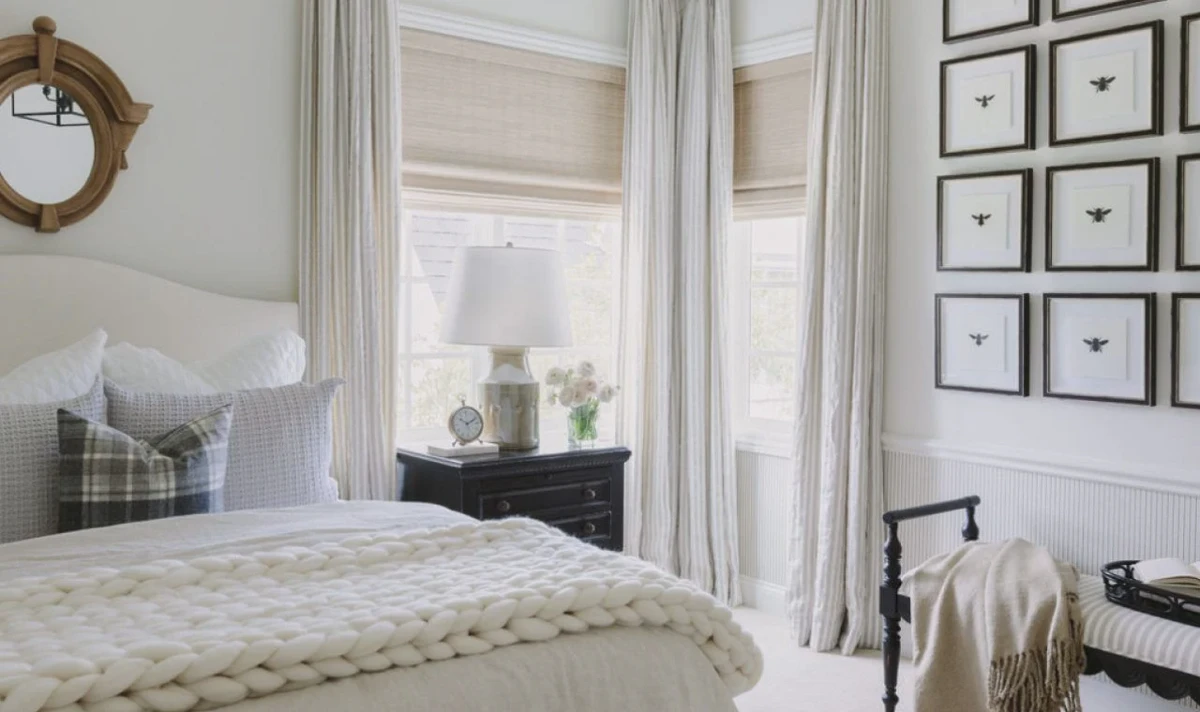
Signs the lamp is the right size
- Shade bottom sits between chin and shoulder when you sit upright in bed.
- Shade width covers about a third of the nightstand's widest point.
- Top of the shade is below the top of the headboard.
- You can read without seeing the bulb.
- Visual weight feels balanced against the bed - neither dwarfed nor towering.
Signs it is wrong
- Bulb glares directly into your eyes when reading - lamp is too tall or shade is too short.
- Shade overhangs the nightstand edge - base is too wide for the surface.
- Lamp looks like a teacup next to a king bed - too short, scale up to 28-32 inches.
- Cord pulls tight to the outlet - base is too far back; reposition or get a longer cord.
- Light only reaches your lap, not the book - shade is too low or too opaque.
Shade proportions: the 2:1 and 2/3 rules
Two interior-design ratios are worth memorising:
- Shade width ≈ 2× lamp base width. A 6-inch base wants a 12-inch shade. Anything narrower looks pinched; anything wider looks top-heavy.
- Shade height ≈ 2/3 the lamp base height. A 16-inch base pairs with a roughly 10-11 inch shade. Reversing the ratio (tall shade, short base) reads as cheap.
These work for any bedroom lamp regardless of bed size. They are the reason a $300 lamp can look right and a $40 lamp with the wrong shade can look wrong.
What about a pair of lamps?
Symmetry reads as intentional. If both sides of the bed have nightstands, get a matching pair - same height, same finish. If only one side has a nightstand (e.g., a corner-tucked bed), pair the lamp with a floor lamp or wall sconce on the other side so the room feels balanced rather than lopsided.
For couples reading at different times, a touch-dimmer or pull-chain on each lamp beats a single switched fixture. Three-way bulbs (50/100/150W or LED equivalents) give independent light levels without a separate dimmer.
Bulb and bulb temperature
For reading, you want 400-800 lumens per lamp and a colour temperature of 2700-3000 K (warm white). Cooler 4000 K and up suppresses melatonin and makes the room feel like a hotel lobby.
Smart bulbs that shift from 2700 K early in the evening down to 1800 K (candle-like) close to bedtime are useful for sleep hygiene - pair with a habit of dimming the room for 30-60 minutes before lights-out.
Nightstand lamp size FAQ
What size lamp for a 24-inch nightstand?
Roughly 26-29 inches tall, with a shade about 10-12 inches wide. Use the 2-3 inch rule: lamp height = nightstand height + 2-3 inches. The bottom of the shade should land at chin level when you sit up in bed.
Should the lamp be taller than the headboard?
No. The top of the shade should sit below the top of the headboard for visual balance. If you have a 50+ inch upholstered or paneled headboard, scale the lamp up to the 30-34 inch range - but never past the headboard line.
How wide should the lampshade be?
Two rules apply at once. Versus the nightstand: shade width should be about one-third the nightstand's widest dimension. Versus the lamp base: shade width should be roughly twice the base width. If your nightstand is 18 inches wide and the base is 5 inches, aim for a 10-12 inch shade.
What size lamp for a king bed?
Taller and wider than a queen setup - 28-32 inches tall with a 14-16 inch shade. King beds are 76 inches wide and usually flanked by larger nightstands, so a 24-inch lamp looks undersized. Get a matching pair, not a mismatched single.
How high should the lamp be above the mattress?
When the lamp sits on the nightstand, the bottom of the shade should be 19-21 inches above the mattress top - chin-to-shoulder height when you sit upright. That keeps the bulb out of sightline and puts the light cone on a book.
What about a low platform bed with no headboard?
Scale down. A 22-26 inch lamp on a low (18-20 inch) nightstand reads as intentional; a tall traditional lamp will look top-heavy. Consider a wall-mounted sconce instead - it frees the nightstand surface and visually balances a minimalist setup.
The 60-second checklist
- Measure the nightstand: height (top of surface to floor) and width (left-to-right at the widest point).
- Lamp height = nightstand height + 2-3 inches. Use the top of the range for tall headboards.
- Shade width = nightstand width ÷ 3. Or, 2× the lamp base width - whichever is larger.
- Sit-test: bulb should disappear from sightline; shade bottom at chin level.
- Bulb: 400-800 lumens at 2700-3000 K for reading. Add a dimmer or three-way bulb if your partner reads later.
- Buy in pairs unless the room geometry forces asymmetry.