Why packing a mattress correctly matters
A mattress is one of the most expensive things in your bedroom and one of the easiest to ruin during a move. Drag it across a doorway and you tear the cover. Fold an innerspring and you break coils that never recover. Leave a memory foam mattress compressed for a week and the cell structure collapses.
This guide covers every common mattress type - innerspring, memory foam, hybrid, and latex - and walks through the exact packing sequence professional movers use, with the trade-offs of each protection method (bag, box, vacuum-compress) so you can pick the right one for your move.
Before you start: what packing method should you use?
There are three real options, in order of protection:
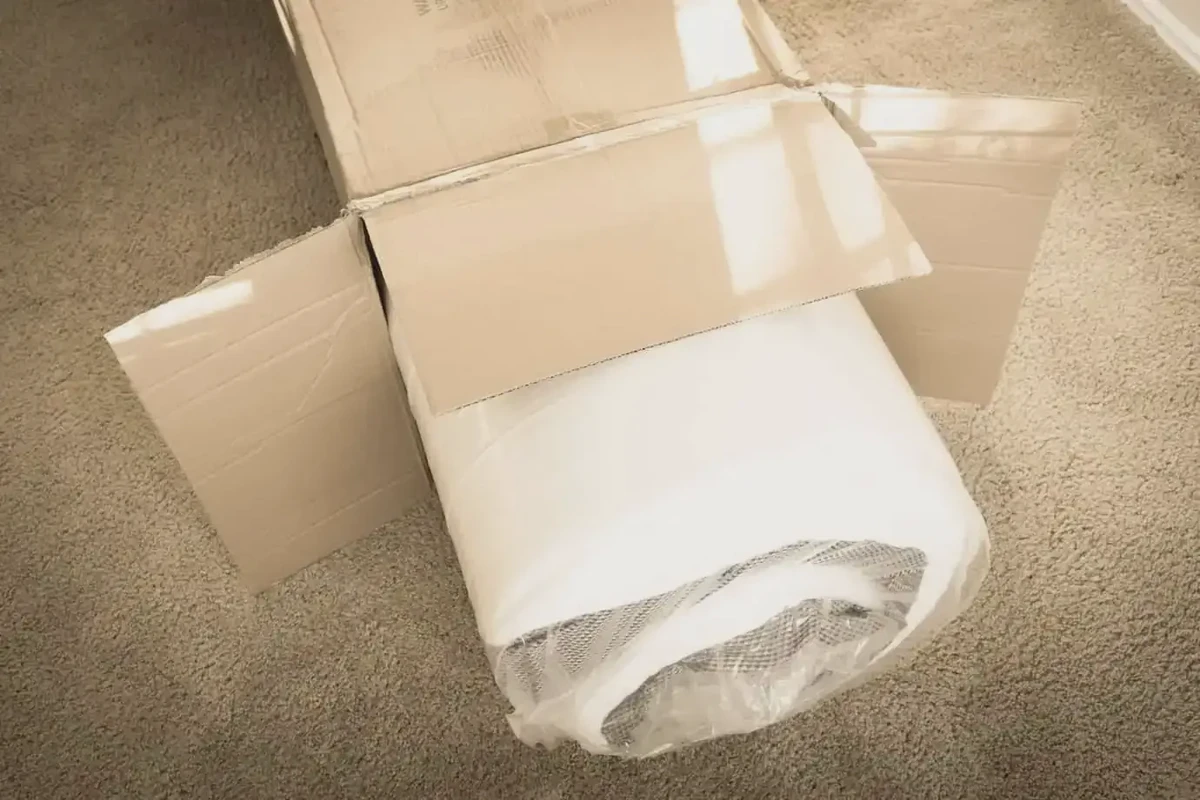
1. **Mattress bag (cheapest, most common).** A 3.5-mil polyethylene bag, sealed with packing tape. Protects from dirt, moisture, and minor scuffs. Works for any mattress type. Cost: $5-$15. 2. **Mattress box (most protection).** A double-walled cardboard box sized to your mattress (twin/full/queen/king). Best for long moves, storage, or if the mattress is going on its side in a truck. Cost: $25-$60. 3. **Vacuum-compression bag (foam only).** A heavy-duty bag with a one-way valve. Lets you suck the air out with a shop vac and roll the mattress to roughly a third of its size. Memory foam and latex only - never use it on an innerspring or hybrid. Don't leave it compressed for more than 24-48 hours.
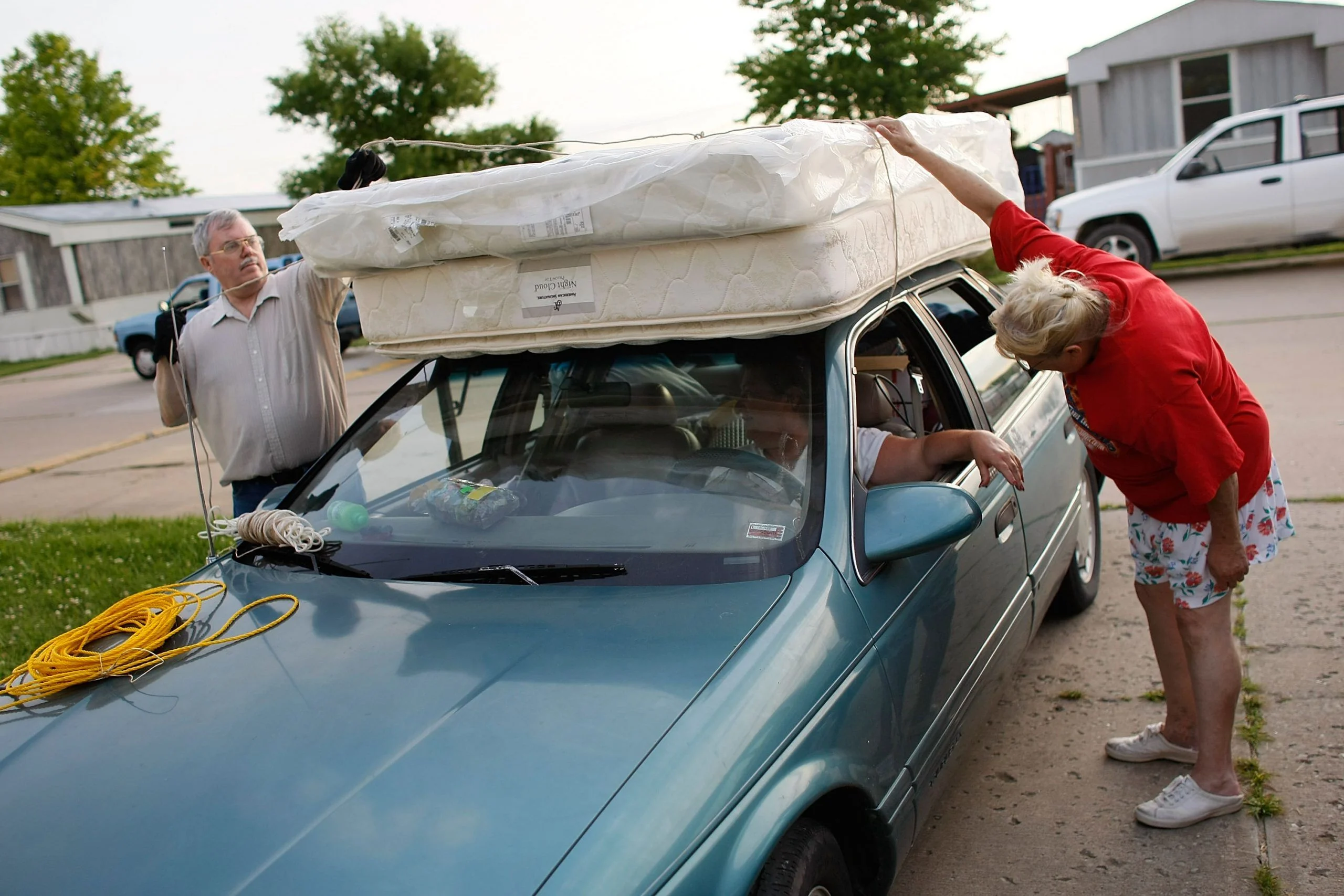
If the move is local and the mattress will lay flat in the truck, a bag is enough. For long-distance, storage, or a roof-rack move, use a box. For a small car or apartment elevator, vacuum-compression is the only realistic option for a foam mattress.
For families moving with infants, lighter and smaller-form options call for a different playbook - see our picks for the best pack n play mattress for travel.
What you'll need
Avoid plastic sheeting taped together: it tears, leaks, and bunches under tape. A purpose-made mattress bag fits properly and seals at the seams.
Step 1: Strip and clean the mattress
Remove all sheets, mattress protectors, and toppers. Vacuum both sides and the perimeter with an upholstery attachment to pull out dust mites, hair, and any bed bug debris that could ride along to the new place.
If there's a stain, spot-clean with a damp cloth and a small amount of mild detergent - do not soak it. The mattress must be completely dry before bagging. Sealing in any moisture leads to mildew within a week, especially in a hot truck.
Step 2: Measure and buy the right bag or box
Mattress bags and boxes are sized by mattress dimensions, not by name alone. Measure length, width, and depth (a pillow-top adds 4-6 inches of depth). Pick a bag rated 3.5 mil or thicker - anything thinner tears at the corner seams under tape.
Common size mapping:
- Twin / Twin XL: 39" × 75"-80"
- Full: 54" × 75"
- Queen: 60" × 80"
- King: 76" × 80"
- California King: 72" × 84"
Step 3: Clear the path
Before you lift anything, walk the route from the bedroom to the truck. Move picture frames off walls, prop doors open, and fold back any rugs that could slide. Remove the bedroom door if the mattress is going to scrape it. Measure the tightest doorway - if the mattress depth plus the bag is wider than the door, you'll need to flex the mattress (foam) or angle it diagonally (innerspring).
Step 4: Slide the mattress into the bag
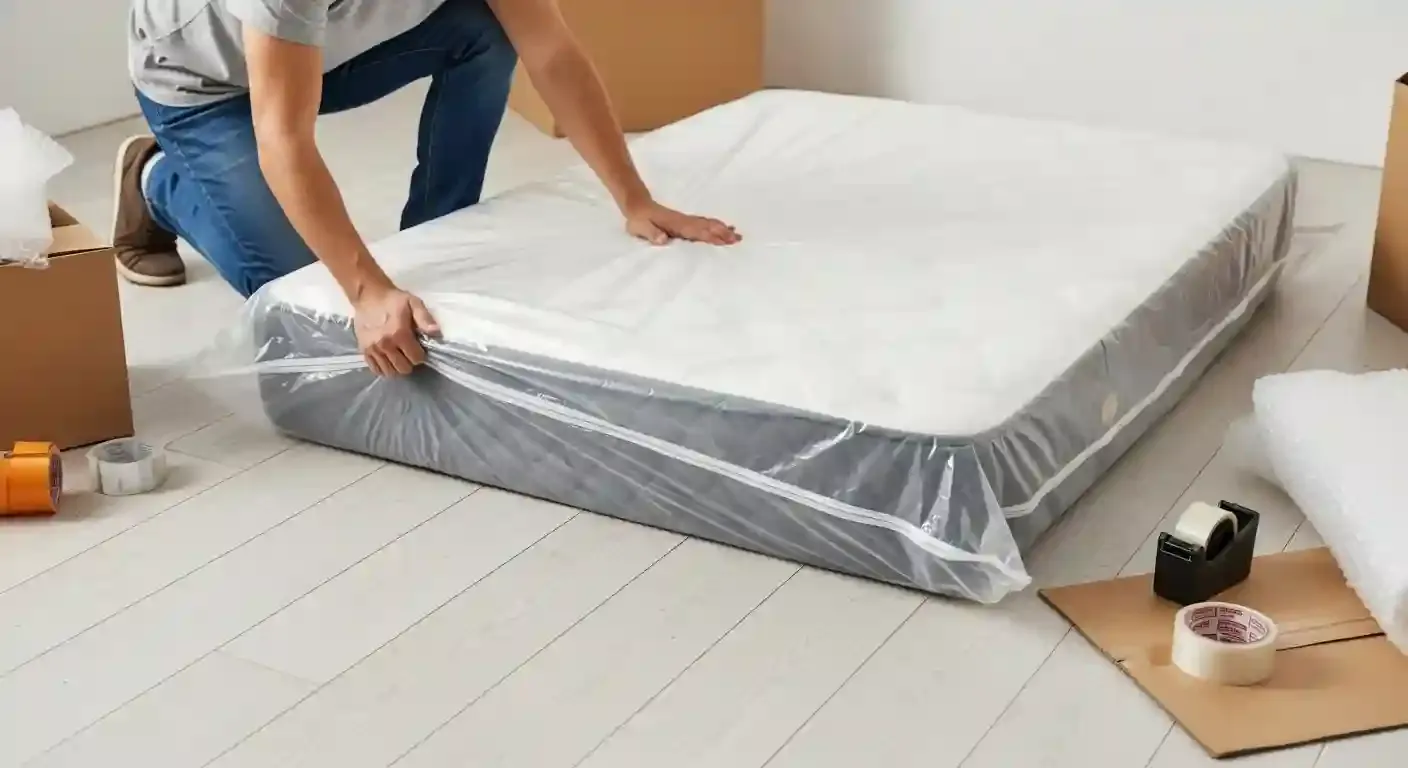
Lay the bag flat on the floor with the open end facing the foot of the bed. Tip the mattress on its side, walk it onto the bag, then lower it flat. Pull the bag up and around like a giant fitted sheet. With a second person on the opposite end, pinch the open end closed.
Fold the open end like wrapping a present and seal it with two passes of 2-inch packing tape. Run a strip of tape around the perimeter where the bag overlaps so it doesn't blow open mid-carry. Reinforce the four corners - that's where the bag almost always fails first.
Step 5 (optional): Vacuum-compress a foam mattress
This only works for memory foam, latex, and all-foam mattresses. Do not attempt this with an innerspring or hybrid - you will permanently bend the coils.
- Use a compression bag with a valve, not a regular mattress bag.
- Seal all sides with tape except for the valve.
- Insert the vacuum hose into the valve and run it for 5-10 minutes until the mattress is roughly a third of its original thickness.
- With the vacuum still running, tape the valve shut.
- Roll the mattress from the foot end. Strap it tight with two ratchet straps.
Unpack within 48 hours. Lay the mattress flat for 24-72 hours before sleeping on it so the foam can rebound fully.
Step 6: Add an outer protective layer
For a long-distance move or a truck packed wall-to-wall with furniture, slide the bagged mattress into a mattress box, or wrap it in two moving blankets and secure with stretch wrap. The blanket layer is what saves the cover from rubs and tears when chair legs press into it during transit.
Step 7: Carry it out without breaking your back
A queen mattress weighs 50-80 lb; a king can hit 130 lb. Use two people, one at each end, with a hand under the bottom edge and the other on the side. Lift with your legs, keep your back straight, and walk slowly. A flat dolly under the long edge turns it into a two-step task instead of a sweaty 20-minute fight.
Warning: never fold or roll an innerspring
Folding a coil mattress permanently kinks the steel coils, and the damage is invisible until you sleep on it. Always transport innersprings flat or on their side - never folded, never rolled.
Step 8: Load it into the truck the right way
How you load depends on the mattress type and how full the truck is:
- Innerspring or hybrid: Stand it on its long side against a wall of the truck, foam-side facing in, and strap it with a ratchet strap to a hook on the wall. Never lay anything heavy on top, even flat - that compresses the coils for the entire drive.
- Memory foam or latex (uncompressed): Lay flat on top of furniture if the surface is smooth and continuous. If it has to go on its side, support both ends so the mattress doesn't bow in the middle for hours.
- Vacuum-compressed foam: Stand the rolled bundle upright in a corner and strap it. It takes up almost no room.
Use a ratchet strap at least every 3 feet of mattress length - a queen gets two straps, a king gets three. If you only have rope, tie a trucker's hitch at each anchor point.
Step 9: Driving and unloading
Drive smoothly - sudden stops shift the load and compress whatever is leaning against the mattress. If you secured it on a roof rack, drive under 55 mph and avoid highways with crosswinds; a mattress acts like a sail and can rip free even with three straps.
At the new place, unstrap and carry the mattress in flat. Open the bag immediately - even sealed plastic sweats from temperature changes and the inside can be damp. Stand the mattress on its side for an hour to let any residual moisture evaporate before you put sheets on it.
Common mistakes that ruin a mattress in transit
- Folding an innerspring to fit a small car. Permanently bends the coils.
- Leaving foam compressed for more than 48 hours. The cells stop rebounding.
- Using duct tape directly on the mattress fabric. The adhesive transfers and stains the cover.
- Stacking boxes on a flat-laid mattress. Even soft pillows leave compression marks if they sit there for 8 hours.
- Skipping the bag because it's a short move. Dust, grease from the truck floor, and rain at the curb all stain a bare mattress on a 10-minute trip.
- Dragging the mattress across the floor. The bottom seam splits within 20 feet.
Mattress-by-mattress packing cheat sheet
Innerspring. Use a bag plus a blanket, or a box. Cannot fold or roll. In the truck, keep it flat or on its side - never compressed.
Hybrid. Same as innerspring: bag plus blanket or a box; flat or on its side; never folded.
Memory foam. Bag for normal moves; vacuum-compression bag for tight spaces. Folding only short-term. Can roll for up to 48 hours. Flat preferred in the truck.
Latex. Bag normally; vacuum-compression bag for tight spaces. Don't fold, but you can roll up to 48 hours. Flat preferred in the truck.
Pillow-top. A box is recommended because the soft top abrades easily. Don't fold or roll. Transport flat only.
When to hire a mover instead
If the mattress is a king, a heavy hybrid, or has to come down a narrow stairwell, paying $80-$150 for two movers and a box truck for the bedroom set is usually worth it. The risk of tearing a $1,200 mattress on a banister is higher than people assume. Most full-service movers will also bring their own mattress bags and dollies as part of the load fee.
Bottom line
Use a 3.5-mil bag at minimum, an outer blanket or box for any move over an hour, and never fold an innerspring. Match the truck position to the mattress type, strap it down, and unpack it the day you arrive. Done right, the mattress comes off the truck looking exactly like it did before the move.
Frequently asked questions
Can I fold a mattress in half to fit it in my car?
Only all-foam or latex mattresses, and only briefly - under an hour. Innerspring and hybrid mattresses must stay flat or on their side. Folding them bends the coils permanently.
How long can a memory foam mattress stay rolled up?
Up to 48 hours is safe. Beyond that, the foam cells lose their ability to fully decompress, leaving permanent dents. Manufacturers ship new mattresses rolled, but they go from factory to your door in about a week - never longer.
Do I need a mattress bag for a 10-minute move?
Yes. The dirt and grease on a moving truck floor, plus any rain on the way to the curb, will stain a bare mattress on even the shortest trip. A $10 bag is cheaper than a $200 deep cleaning.
Can I reuse a mattress bag?
If the seams aren't torn, yes - fold it flat and store it. Cheaper bags usually rip at the corners under tape and aren't worth saving.
Should I move the mattress on its side or flat?
Flat is gentler on every mattress type, but on its side is safer in a packed truck because nothing can be stacked on top. Innersprings tolerate either; foam mattresses bow in the middle if propped on their side for hours, so support both ends if you go that route.