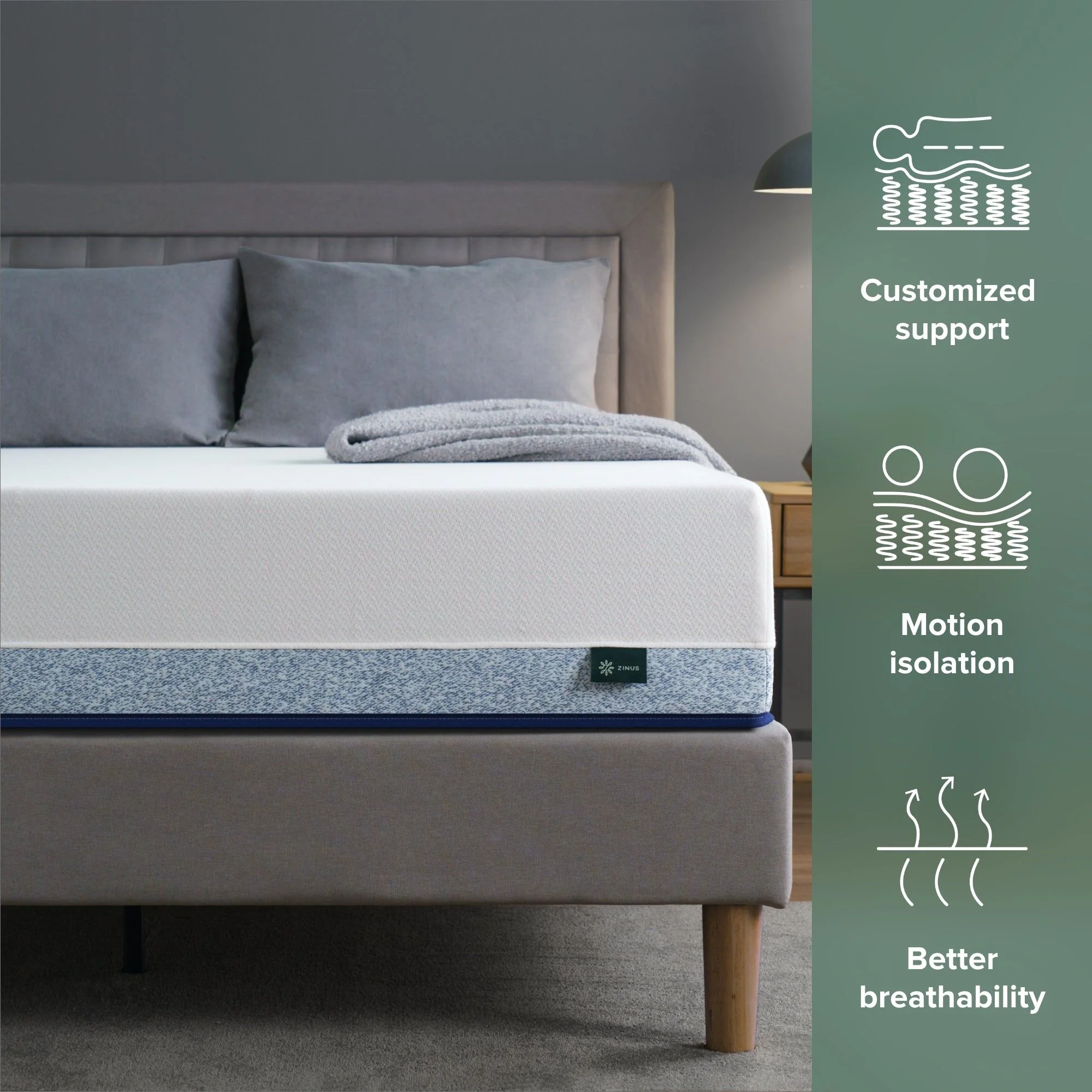
Zinus is one of the most popular budget mattress brands in the United States - the Green Tea memory foam bed has been an Amazon bestseller for years. But a wave of class-action lawsuits, viral TikTok contamination stories, and CBS News coverage have left shoppers asking a sharper question: are Zinus mattresses actually toxic?
Short answer: the foam itself is certified low-VOC and free of the most common harmful chemicals. The real concern is fiberglass - a fire barrier used inside many older Zinus mattresses that can shed and contaminate a home if the cover is unzipped or damaged. Zinus has since transitioned newly manufactured models to a carbon-rayon sleeve, but plenty of older units are still in circulation. This guide walks through what's inside a Zinus mattress, the certifications that matter, the fiberglass timeline, and how to check your own bed.
The short answer
- Zinus foam: CertiPUR-US certified - no formaldehyde, no heavy metals, no PBDE flame retardants, low VOC emissions.
- Zinus covers: OEKO-TEX Standard 100 certified textile components.
- Fire barrier: older models contain fiberglass (up to ~62% of the inner cover by mass in some units). Newly manufactured Zinus mattresses use a carbon-rayon sleeve instead.
- Safety rule: do NOT unzip or remove the white inner cover of any Zinus mattress, even on newer models. The tag explicitly says "do not remove."
What's actually inside a Zinus mattress?
Zinus's flagship lineup - the Green Tea Memory Foam, Cooling Green Tea, and Green Tea Hybrid mattresses - share a common construction pattern.
Comfort layer: CertiPUR-US certified memory foam infused with green tea extract, ActivCharcoal, and castor oil. These additives are marketed for odor and moisture control. The CertiPUR-US program independently tests foam for formaldehyde, heavy metals, ozone depleters, PBDE flame retardants, phthalates, and VOC emissions (must be under 0.5 parts per million).
Transition / support layer: high-density polyurethane base foam, or in hybrid models, individually pocketed steel coils with a foam encasement.
Cover: an outer fabric cover (typically polyester knit) over an inner sock that contains the fire barrier. The outer cover on most Zinus mattresses has a zipper - and this is where the trouble starts.
Fire barrier: U.S. federal law (16 CFR 1633, in effect since 2007) requires every mattress sold in the U.S. to resist an open flame for a specified time. To meet that standard at a budget price, Zinus historically used a woven fiberglass sleeve. Newer production has shifted to a carbon-rayon fire sock.
What Zinus does well
- All foam is CertiPUR-US certified - low VOCs, no formaldehyde, no PBDEs.
- Covers carry OEKO-TEX Standard 100 certification for harmful substances.
- Newly manufactured models use a carbon-rayon fire sleeve instead of fiberglass.
- Zinus discloses fiberglass on the law tag when present, per its own policy.
- 10-year warranty and 100-night trial on most current models.
Where the concerns are real
- Many older Zinus mattresses still in homes contain fiberglass fire barriers.
- If the outer zippered cover is opened, fiberglass fibers can shed and spread.
- Professional remediation for a fiberglass-contaminated home can cost $10,000-$20,000+.
- Multiple class-action lawsuits have been filed alleging defective cover design.
- New foam typically off-gasses for 24-72 hours and may have a noticeable initial smell.
The fiberglass problem, explained
Fiberglass is woven glass fibers - cheap, fire-resistant, and widely used as the flame barrier in budget memory foam mattresses since the 2007 federal flammability rule took effect. Inside an intact mattress, fiberglass is harmless and isolated by the inner cover. The problem is the design of the zippered outer cover on older Zinus models.
The zipper invites removal. Many owners assumed the outer cover could be unzipped and washed. Some Zinus covers are roughly 62% fiberglass by weight on the inner sock, according to a Green America summary of an Environmental Litigation Group analysis. Once exposed, the tiny glass fibers shed easily and travel through the HVAC system.
Health effects of exposure. The Washington State Department of Health lists skin rashes, eye irritation, dermatitis, upper respiratory infections, gastrointestinal symptoms, and asthma aggravation as common short-term reactions to fiberglass contact. The CPSC's position is that flame-retardant fiberglass is not considered hazardous when sealed inside an intact cover, and that long-term health risks are not established.
Property damage is the bigger cost. Reported cases include the Chandler-Durham family, who paid over $20,000 in professional remediation after fiberglass spread through their home (per the 2020 federal class-action complaint in Chandler et al. v. Amazon.com), and Vanessa Gutierrez, who told the Los Angeles Times in 2022 that a $400 Zinus mattress cost her nearly $20,000 in damages and left scars on her four-year-old daughter.
When did Zinus stop using fiberglass?
Zinus's official fiberglass FAQ confirms the change: "All Zinus mattresses meet U.S. federal flammability standards. Today, newly manufactured Zinus mattresses use a carbon-rayon sleeve to protect our customers in the unlikely event of a fire." The transition has been rolled out gradually across the product lineup rather than as a single dated cut-off, and Zinus declares fiberglass on the law tag of any mattress that still contains it.
If you're buying new in 2026, the safer bet is to:
- Check the product listing for the phrase "fiberglass-free" - Zinus now uses this language on updated SKUs, including the 6-inch Green Tea memory foam model.
- Inspect the law tag once the mattress arrives. Zinus's policy is to disclose fiberglass content on the tag.
- Confirm CertiPUR-US and OEKO-TEX Standard 100 markings.
VOCs and "toxic chemicals" - separate from fiberglass
The other half of the "are Zinus mattresses toxic" question is about chemical off-gassing, which is a different concern from fiberglass.
All polyurethane memory foam off-gasses some VOCs (volatile organic compounds) when new - that's the source of the "new mattress smell." The smell typically fades within 24-72 hours of unboxing. Because Zinus foam is CertiPUR-US certified, total VOC emissions must measure under 0.5 parts per million, and the foam is verified free of:
- Formaldehyde
- Mercury, lead, and other heavy metals
- PBDE, TDCPP, and TCEP flame retardants
- Ozone depleters (CFCs)
- Regulated phthalates
Consumer Reports' November 2025 mattress testing program separately notes that the strictest VOC compliance in the industry comes from GREENGUARD Gold and MADE SAFE certified mattresses - a tier above CertiPUR-US. Zinus does not currently carry GREENGUARD Gold. If chemical sensitivity is your priority, an all-natural latex or organic cotton/wool mattress will be cleaner than any foam mattress, including Zinus's.
How to use a Zinus mattress safely
Whether yours contains fiberglass or the newer carbon-rayon barrier, the same rules apply:
- Never unzip or remove the inner white cover. The "do not remove" tag is the single most important safety instruction.
- Always use a mattress protector. A zippered, tightly woven encasement adds a barrier between you and any potential shedding fibers, and also blocks dust mites and stains.
- Air it out for 48-72 hours after unboxing. Open a window. The initial polyurethane smell is normal and dissipates.
- If the cover tears, stop using it. Contact Zinus support; do not vacuum the area, which spreads fibers further.
What if I think my Zinus is contaminating my home?
If you've already unzipped the cover or see glittering fibers around the bed, treat it as an environmental cleanup rather than a normal mattress problem:
- Isolate the room. Close doors, shut off HVAC to that zone, and stay out.
- Don't sweep or shake fabric - both aerosolize the fibers.
- Contact a professional remediation company experienced with fiberglass; HEPA vacuuming and wet wiping are the standard methods.
- Document everything with photos and receipts.
- Contact Zinus customer service for warranty / replacement options, and check whether any active class-action settlements apply to your purchase.
Safer alternatives if you've lost trust in Zinus
If you'd rather skip fiberglass entirely, look for mattresses that use wool, silica-rayon, or carbon-rayon fire barriers instead. In the budget-to-midrange tier, Tuft & Needle, Leesa, Nectar, and Saatva all use non-fiberglass fire barriers. For the strictest air-quality standards, GREENGUARD Gold certified mattresses (Avocado, Naturepedic, Brentwood Home Cedar) measure VOC emissions over the lifetime of the product, not just at manufacture.
Zinus mattress safety FAQ
Do Zinus mattresses still have fiberglass in 2026?
Newly manufactured Zinus mattresses use a carbon-rayon fire sleeve, not fiberglass - but older units still circulate in retail and resale channels. Zinus discloses fiberglass on the law tag when it is present, and now markets fiberglass-free SKUs (such as the 6-inch Green Tea Memory Foam). Always check the listing and the law tag before buying.
Which Zinus mattresses contain fiberglass?
Historically, the Green Tea Memory Foam, Cooling Green Tea, and Green Tea Hybrid lineups used fiberglass as the fire barrier. Production has shifted away from fiberglass across the catalog. The only reliable check is the law tag on your specific mattress, which by Zinus's own policy must disclose fiberglass content when present.
Is it safe to sleep on a Zinus mattress that contains fiberglass?
Yes, as long as the outer cover stays intact and is never unzipped. The fiberglass is sealed inside an inner sock specifically to keep fibers contained. The CPSC has stated that flame-retardant fiberglass in an undamaged mattress poses minimal exposure risk. The risk only appears when the cover is removed, torn, or damaged.
Are Zinus mattresses CertiPUR-US certified?
Yes. All Zinus foam mattresses use CertiPUR-US certified memory foam, meaning the foam is independently tested for formaldehyde, heavy metals, PBDE flame retardants, ozone depleters, regulated phthalates, and VOC emissions (under 0.5 parts per million). The foam itself is not the toxicity concern - the fire barrier is.
How long does a Zinus mattress off-gas?
Most owners report the initial polyurethane smell fading within 24 to 72 hours of unboxing. Airing the mattress in a well-ventilated room speeds the process. If a strong smell persists past a week, contact Zinus customer service - that's outside normal range for a CertiPUR-US foam.
Is there an active lawsuit against Zinus over fiberglass?
Multiple class-action suits have been filed in U.S. federal courts since 2020, including Chandler et al. v. Amazon.com (Northern District of Illinois) and a Sacramento class action filed in July 2022. Some have settled, others remain active. If you've experienced contamination from a Zinus mattress, consult a product-liability attorney to find out whether you qualify for a current class.