

Pillows that slide between your mattress and the wall every night aren't a quirk - they're a symptom of a gap. Most beds have one somewhere: between the mattress and headboard, between the headboard and wall, or between the mattress and a borderless frame. Once that gap is wider than about 2 inches, gravity wins and your pillow ends up on the floor by 3 a.m.
The fix depends on the gap. Below we break down 12 solutions by budget and gap size, starting with what to try tonight (free) and ending with permanent rebuilds. Measure your gap first - it changes which solution actually works.
First: measure the gap
Pull your mattress flush to the headboard (or wall) and measure what's left. Three numbers matter:
- Mattress-to-headboard gap - usually 0.5" to 4". Caused by frame design or a mattress that's slightly undersized.
- Headboard-to-wall gap - usually 1" to 3". Caused by baseboards or trim pushing the bed forward.
- Mattress-to-wall gap (no headboard) - anywhere from 1" to 8"+. Caused by frame skirt or just the way the bed was placed.
Under 2 inches: bedding tweaks usually fix it. 2-4 inches: you need a wedge or DIY filler. Over 4 inches: the frame, mattress size, or position is the real problem and a wedge alone won't solve it.

Free fixes (try these tonight)
1. Push the mattress flush to the headboard
Sounds obvious - but most box-spring setups drift over weeks of use. Strip the bed, slide the mattress and box spring as far toward the headboard as they go, and re-make it. If your box spring is the wrong size for your frame, switching to a foundation that matches the mattress dimensions exactly often closes the gap entirely.
2. Reposition the bed against a wall
If you have a borderless mattress (no headboard) and the bed is in the middle of the room, just moving the head of the bed against a solid wall eliminates the gap that lets pillows slide back. This is the simplest fix listed in every Reddit thread on the topic for a reason.
3. Roll a towel or door snake into the gap
A tightly rolled bath towel, a draft stopper (a.k.a. door snake), or a pool noodle slipped under the fitted sheet across the head of the mattress all do the same job: turn a 2-inch valley into a flat surface. Cheapest possible test before you spend money on a real wedge.
4. Use a long body pillow as a bolster
Lay a body pillow horizontally across the head of the bed, behind your sleeping pillows. It blocks the gap and serves as backrest support if you read in bed. Works best with gaps under 3 inches.
Mid-range fixes ($25-$75)
5. A purpose-built bed wedge / gap filler
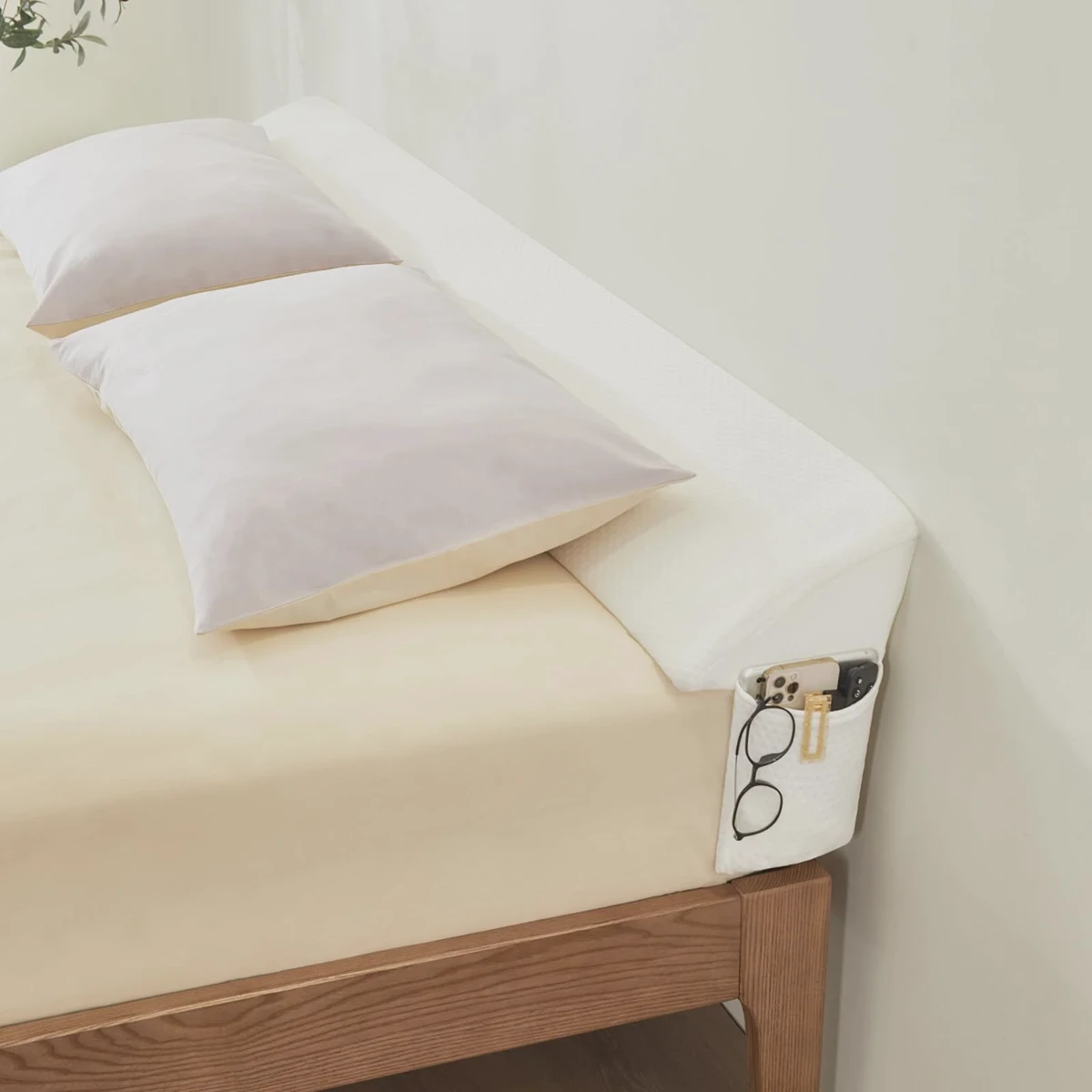
These are long triangular pillows sized to your mattress (twin/full/queen/king) that wedge between the mattress and headboard. Brands like SnugStop, Vekkia, and Gorilla Grip make them in 0-8 inch heights. Match the height to your gap - too tall and it pushes the mattress forward; too short and pillows still drop.
Look for a non-slip backing or a strap that loops around the mattress; a loose wedge migrates as much as the pillows it's supposed to stop.
6. Pillow stoppers and bed rails
Foam-padded bed rails (the kind sold for toddler safety) at the head of the bed work as pillow guards too. Lower-profile pillow stoppers - small foam blocks anchored under the fitted sheet - are less obtrusive but only suit gaps of 1-2 inches.
7. A new fitted sheet sized correctly
If your fitted sheet is a size up from your mattress, it tents at the head of the bed and gives pillows somewhere to slide. Measure the mattress depth (most modern hybrids are 12-14 inches; pillow-tops can hit 16) and buy a deep-pocket sheet that matches. A snug sheet with elastic all the way around alone fixes a surprising number of cases.
Permanent fixes ($75+)
8. Replace the bed frame
Some frames are the actual problem - sleigh beds, frames with deep skirts, or platforms with a recessed mattress sit. If the gap was built in, no wedge will look right. Look for platform beds where the mattress sits flush with the headboard rail, or low-profile frames with a tight headboard joint.
9. Upgrade the foundation
A high-profile (9") foundation under a thinner mattress can raise the sleep surface above the headboard's lower rail, eliminating the dip pillows fall into. Adjustable bases also let you raise the head of the bed slightly, which biases pillows down toward you instead of back into the gap.
10. Build a custom headboard insert
If you're handy: cut a piece of MDF or 1x lumber to match the gap width, wrap it in upholstery foam (1"-2" thick) and your fabric of choice, then screw it to the back of the headboard or the wall. Looks integrated, costs $30-60 in materials, and closes any gap up to 4 inches permanently.
11. Wall-mount the headboard
Detach the headboard from the bed frame and bolt it to the wall at the right height. Now the mattress slides all the way to the wall and the headboard sits behind it - gap eliminated. Bonus: it's a popular look in modern bedrooms anyway.
12. Replace an undersized mattress
If you have a queen frame and a full mattress (or any size mismatch), no fix on this list will work for long. Mattresses lose ~1" of perimeter to compression over years, and an already-undersized one will keep drifting. Sizing the mattress to the frame is the only durable answer.
Wedge gap fillers: pros
- Closes 0-8 inch gaps without modifying the bed or frame
- Doubles as a backrest for reading or watching TV in bed
- Renter-friendly - no drilling, no permanent changes
- Sized to standard mattress widths (twin through king)
Wedge gap fillers: cons
- Cheap models migrate without a non-slip backing or mattress strap
- Wrong height pushes the mattress forward instead of filling the gap
- Visible above the headboard line if the wedge is too tall
- Doesn't solve a mismatched mattress/frame size - only masks it
Match the fix to your gap
- Under 2": push mattress flush, switch to a snug deep-pocket fitted sheet, or use a body pillow bolster.
- 2"-4": bed wedge gap filler sized to your mattress width, or a DIY upholstered insert.
- 4"-6": wall-mount the headboard, build a custom insert, or move to a flush platform frame.
- Over 6": the mattress or frame is wrong-sized. No accessory will hold this long-term - replace the mismatched piece.
Frequently asked questions
Why do my pillows fall behind the bed every night?
Almost always one of three causes: a gap between the mattress and headboard (loose box spring, mismatched sizes), a gap between the headboard and wall (baseboards or trim push the bed forward), or no headboard at all on a borderless mattress. Measure the gap first - that tells you which fix you need.
What size bed wedge gap filler should I buy?
Match the wedge height to your gap size and the wedge width to your mattress: twin (39"), full (54"), queen (60"), or king (76"). For most gaps 0-4 inches, a 4-6 inch tall wedge works. Going taller than the gap pushes the mattress forward and looks bulky above the headboard.
Can I just push my bed against the wall?
If you have no headboard, yes - that's the simplest fix and eliminates the gap entirely. If you do have a headboard, baseboards usually keep it 1-2 inches off the wall, so you'll still have a small gap at the top. A low-profile wedge or wall-mounting the headboard solves it.
Will a mattress topper or pillow top stop pillows falling behind the bed?
Only if the gap is mostly caused by a thin mattress sitting low in the frame. A 2-3 inch topper raises the sleep surface above the lower headboard rail and can close a small gap, but it won't help with a 3-inch headboard-to-wall gap.
Is a headboard actually necessary?
No. Headboards started as insulation against cold walls; modern homes don't need that. They're decorative now, plus they double as pillow backstops. If you skip the headboard, push the bed against a solid wall or use a long bolster pillow to do the same job.
Need a foundation that fits the frame, not the other way around?
Banner Mattress carries platform frames, adjustable bases, and high-profile foundations sized to standard mattress dimensions - the most permanent fix for a stubborn pillow gap.