
Bed slats are the unsung heroes of a good night's sleep. They carry your mattress, distribute your weight, and keep your spine aligned - until one cracks, slips, or starts groaning every time you roll over. The good news: replacing slats is one of the cheapest, most beginner-friendly bedroom repairs you can do. Most jobs cost between $30 and $60 in materials and take under an hour with a screwdriver and tape measure.
This guide walks you through replacement for twin, full, queen, and king frames, including the popular plywood swap. We've also added current pricing on retail slat kits, signs your slats need replacing now, and fixes for the two most common complaints we hear from readers - squeaky beds and slats that keep falling through the frame.
Quick Steps to Replace Slats on a Bed
- Strip the bed and pull the mattress off
- Remove the old slats (unscrew or lift out)
- Measure the inside width of the frame and slat thickness
- Buy or cut new slats to size, sand any rough edges
- Lay slats with 2-3 inch gaps between them
- Secure with screws, brackets, or built-in clips
- Press-test the slats before re-mounting the mattress
If you'd rather skip the saw, pre-sized slat kits from IKEA, Home Depot, and Amazon run $40 to $150 and ship ready to drop in. We cover those at the end of this guide.
Why Replace Bed Slats?
Old or broken slats don't just creak - they actively damage your mattress and your spine.
Better sleep posture. Sagging slats let the mattress dip in the middle, which pulls your hips below shoulder height and unloads spinal disks unevenly. Side and back sleepers feel this first as morning lower-back stiffness.
Comfort and quieter nights. A rigid, level slat base eliminates the squeaks and shifting most people learn to live with. The fix is often $40, not a new bed.
Longer mattress lifespan. Most mattress warranties (Saatva, Helix, Tempurpedic, Purple) require slat spacing of 3 inches or less. Slats that are too far apart, missing, or sagging void the warranty and accelerate sag in the foam or coil layer above them.
How to Replace Bed Slats by Size
Twin-size beds
A twin frame measures about 38 inches wide on the inside, so each slat needs to span that span without flexing. Use 1×4 or 1×6 pine boards, 13 to 15 slats spaced evenly.
Step 1 - Remove the old slats. Use a Phillips screwdriver to back out the screws. If the originals are nailed in, slip a flat pry bar between the slat and the rail and lever them out gently. Save the screws if they're in good shape. If your slats sit in plastic or rubber sockets and refuse to pop out, pull upward in the center of the slat while pushing one end into its socket. Most slats curve enough to flex free, and starting in the middle of the bed gives you the most frame flex. A large flat screwdriver worked under the slat lets you lever each side of the socket alternately if hand flexing alone is not enough.
Step 2 - Measure and cut. Measure inside-rail to inside-rail, not the outer dimensions of the frame. Cut new slats to that length. Sand the cut ends and any splinters with 120-grit sandpaper - splinters tear mattress encasements.
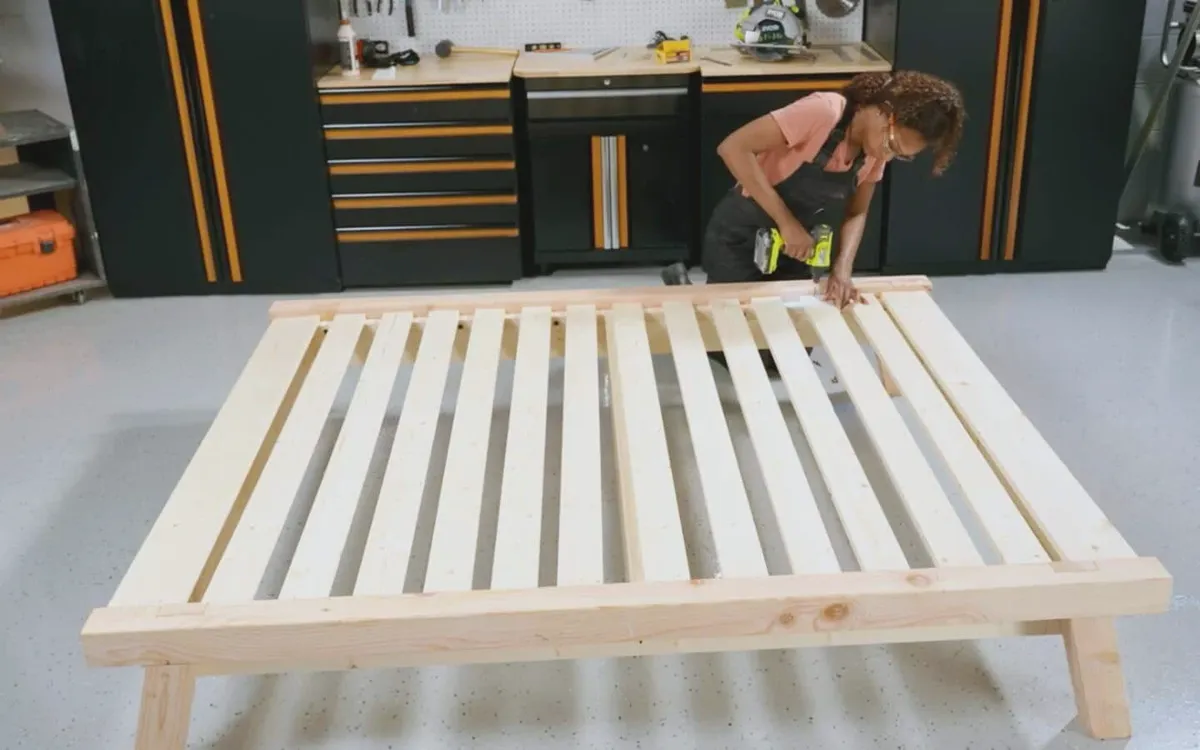
Step 3 - Attach the slats. Lay the first slat at the head of the frame and the last at the foot, then space the rest evenly between them (you want 2-3 inches of gap, no more). Predrill before driving screws into pine - softwood splits along the grain otherwise.
Step 4 - Test before mounting the mattress. Climb on. Bounce. Roll side-to-side. Anything that creaks, shifts, or flexes more than half an inch needs another screw or a tighter bracket.
Full and queen-size beds
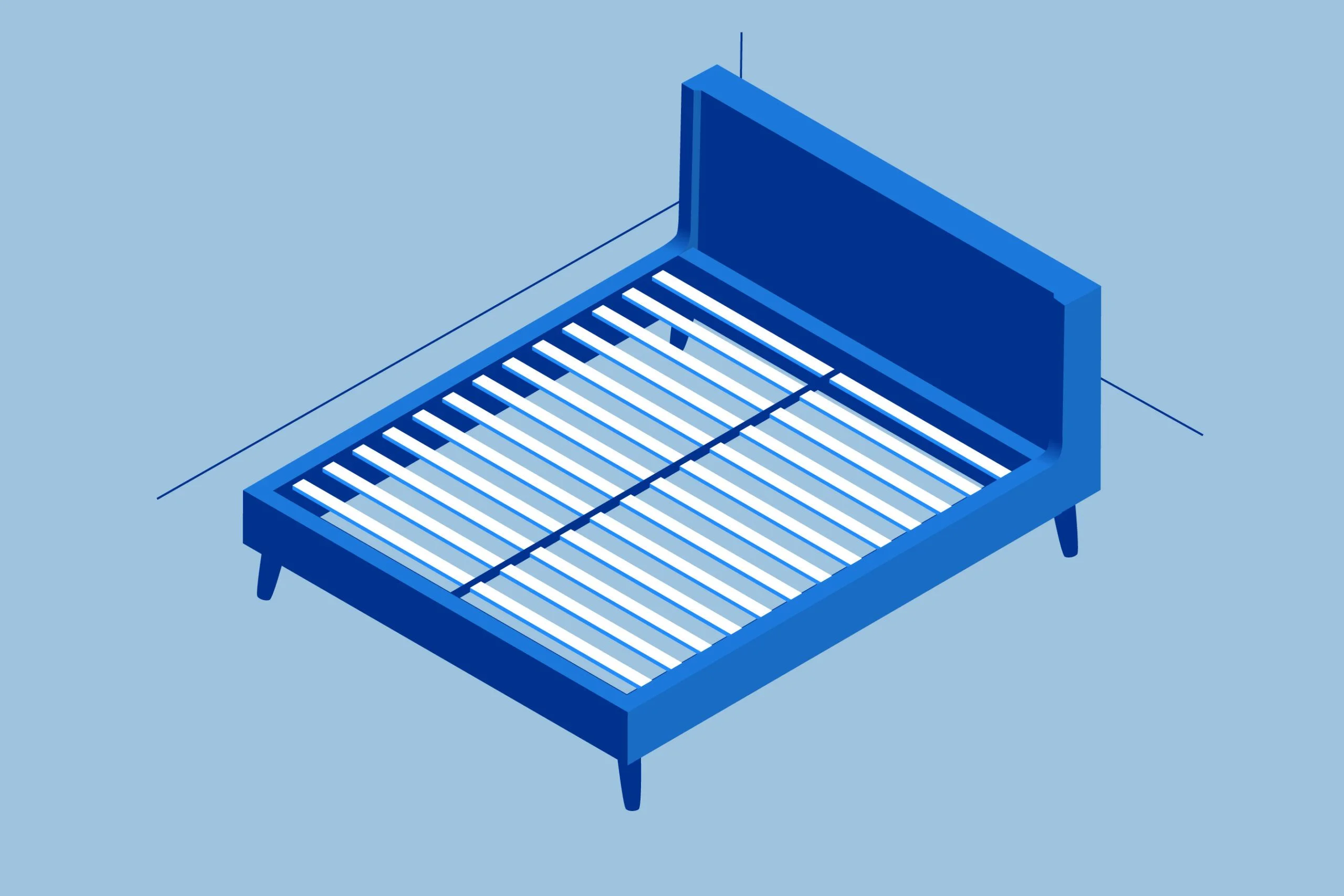
Full frames run about 53 inches inside-rail; queens run about 59. Both sizes benefit from a center support beam running head-to-foot down the middle of the frame - without one, the slats bow under load and your mattress sinks in the middle within months.
You'll need: tape measure, miter or circular saw, L-brackets (8 minimum), 1¼-inch wood screws, drill or impact driver.
Step 1 - Measure the frame width. Confirm full = ~53 in, queen = ~59 in. If your frame falls outside those dimensions, it's a non-standard build - measure twice, cut once.
Step 2 - Cut slats to length. Each slat should rest on the L-bracket lip, not jam against the rail. Subtract about ⅛ inch from your measurement for clearance.
Step 3 - Mount the L-brackets. Screw L-brackets to the inside of each rail at every slat position - typically 13 to 15 slats per bed.
Step 4 - Drop in the slats. Set them on the brackets and drive a screw through the bracket hole into the bottom of each slat. This stops slats from sliding out when you sit on the edge of the bed.
Step 5 - Add the mattress. Re-mount the mattress and check for any flex by sitting on the corners and middle.
King-size beds
King frames (76 inches inside) almost always need a center rail with a support leg to the floor plus 16 to 18 slats. Skip either and the middle of your mattress will sag within a year. If your king frame doesn't have a center rail, add one before you replace slats - a 2×4 with a leg costs about $15 at any hardware store.
Need a New Mattress After All This?
DIY Slat Replacement
- Cheapest fix - under $30 in pine for most beds
- Exact fit for non-standard frames
- Easy to add center support or extra slats
- No waiting for shipping
Buying a Pre-Built Kit
- Drop-in install with no cutting or sanding
- Built-in flex zones (curved birch) for better support
- Engineered to mattress-warranty spacing standards
- Often includes brackets or center supports
Replace Bed Slats With Plywood
Plywood is the cheapest fix and works for any size. It's not as breathable as individual slats, so memory foam mattresses on plywood may sleep slightly warmer.
Step 1 - Pull the old slats. Unscrew everything and lift the boards out.
Step 2 - Cut a single sheet. Measure your frame's inside dimensions. Have Home Depot or Lowes rip a ¾-inch plywood sheet to size - most stores cut for free. Quarter-inch is too thin; it will bow.
Step 3 - Drill ventilation holes. Drill 6 to 8 one-inch holes across the sheet so the mattress can breathe. This matters more for memory foam than innerspring.
Step 4 - Drop and screw. Set the plywood on the rail lip and drive a few screws through the edges into the rail to keep it from shifting.
Bed Slat Lifespan by Type
Solid flat (pine): 5-10 years. Lifespan tied to wood grade and how much weight the bed carries night after night.
Sprung (curved birch): 6-12 years. More comfortable under most sleepers but weaker under heavy loads.
Adjustable slats: 8-15 years. Mechanism quality drives durability - cheap plastic adjusters fail first.
Metal slats: 10-20 years. Rare in residential beds; need occasional retightening at the welds and bolts.
Laminated slats: 7-14 years. Lamination quality varies wildly between brands.
Reinforced heavy-duty slats: 10-18 years. Built for heavier sleepers and platform beds without a foundation.
Signs Your Bed Slats Need Replacing
- Visible cracks or splits in any slat - even a hairline crack will fail under load.
- Creaking or popping when you roll over or sit on the edge.
- Slats that fall out of the frame during normal use (a top reader complaint, addressed below).
- Mattress sagging in the middle - usually means the center slat or center support has failed.
- Slats bowing visibly when you press down with your hand.
Replacement Slat Kits and Pricing (2026)
If cutting your own slats sounds like more work than it's worth, pre-built kits are inexpensive and fast.
- IKEA LÖNSET slatted base - about $120. Curved birch plywood slats with built-in flex zones; fits IKEA frames directly and most standard frames with minor adjustment.
- ProWood pine slat board (7-pack) - about $49 at Home Depot. Solid pine, ideal for replacing broken individual slats with matching wood.
- Classic Brands Xtreme heavy-duty slats - about $135-$155 on Amazon and Wayfair. Built for heavier sleepers; includes a center support leg.
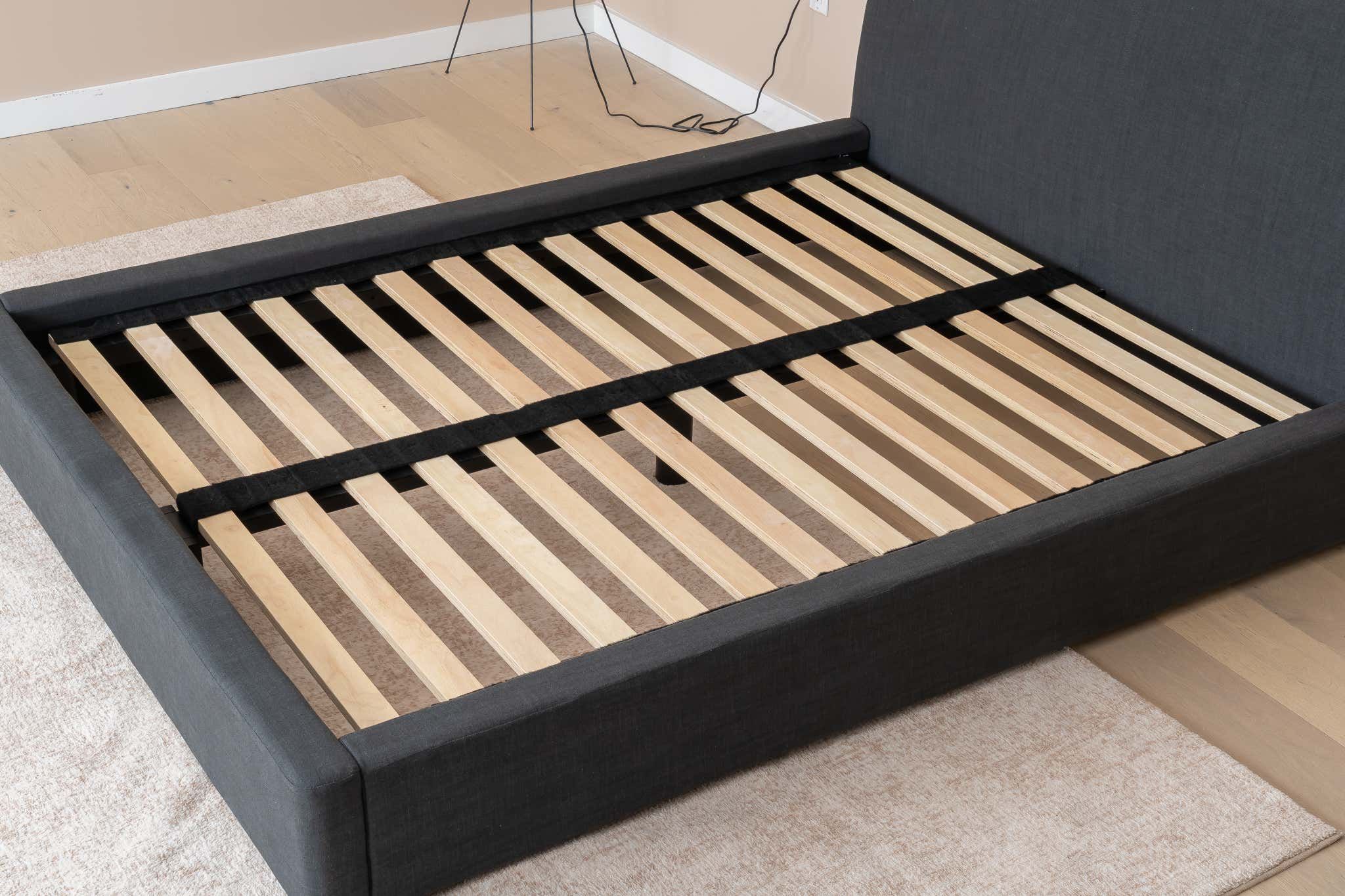
- Continental Sleep linked slats - fabric-bound, non-slip wood slats that roll out across the frame in seconds. Common on Amazon and Walmart in twin through king for $40-$80.
When in doubt, match the original material and slat count. Memory foam and hybrid mattresses (Nectar, Helix, DreamCloud, Purple) want 3-inch maximum spacing; innerspring is more forgiving.
Fixing Squeaky Slats and Slats That Keep Falling
Two of the most common bed complaints have simple fixes that don't require new hardware.
Squeaks usually come from wood-on-wood friction. Pull each slat off, add a thin felt pad or strip of cork to the rail lip where it sits, then drop the slat back in. The squeak almost always disappears. If a screw is the source, hit it with a tiny dab of beeswax or candle wax on the threads before tightening.
Slats that keep falling out are almost always the result of frames designed without retaining lips. Two fixes work:
- Screw a 1×1 cleat along the inside top of each rail so slats can't drop through the gap.
- Use L-brackets at every slat position and screw the slat to the bracket - this is the right answer for permanent installs.
Care Tips That Extend Slat Life
- Inspect slats every six months. Lift the mattress, look for hairline cracks, and re-tighten any loose screws.
- Rotate the mattress quarterly so the same slats aren't always under your hips.
- For wooden slats in humid climates, run a dehumidifier during summer months. Wood swells, then warps as it dries.
- Avoid sitting on the edge of the bed for long stretches - that's where slats fail first.
- Vacuum or wipe down the slat surface during seasonal mattress rotations. Dust and debris accumulate on slat tops over time, and grit between the slat and the rail accelerates wood-on-wood wear.
- Add a drop of light machine oil or paraffin wax to any moving connection point, including adjustable slat mechanisms and screwed L-bracket joints. Lubricating these prevents the squeaks that signal early hardware fatigue.
Bed Slat Replacement FAQ
Can you replace slats in a bed without buying a new frame?
Yes - slats are the cheapest replaceable part of any platform bed. A full set of pine slats costs $30 to $60 at any hardware store, and replacement takes under an hour. Replace the slats before considering a new frame unless the rails themselves are cracked.
Can you sleep on a bed with a broken slat?
You can, but it is a bad idea. A single broken slat shifts load to its neighbors, accelerates mattress sag, and usually voids your mattress warranty. Most warranties (Saatva, Helix, Tempurpedic, Purple) require continuous, intact slat support with gaps no greater than 3 inches. Replace any cracked or missing slat within a few days.
How much spacing should there be between bed slats?
Two to three inches between slats is the standard. Memory foam and hybrid mattresses prefer the tighter end (2 to 2.5 inches) to prevent the foam from dipping between slats. Innerspring mattresses tolerate up to 3 inches. Wider gaps will sag the mattress and void most warranties.
Can you replace bed slats with plywood?
Yes. A single sheet of three-quarter-inch plywood cut to fit the frame works on any size bed and costs around $30. Drill six to eight one-inch ventilation holes across the sheet so the mattress can breathe - this matters more for memory foam than innerspring. Plywood gives a firmer, less breathable feel than slats.
How to fix bed slats that keep falling through the frame?
This usually means your frame was built without retaining lips. The fix is to screw a 1x1 cleat along the inside top of each rail to catch the slat ends, or install L-brackets at every slat position and screw each slat directly to its bracket. Both fixes take under an hour and stop slats from dropping permanently.
Is it cheaper to replace slats or buy a new bed frame?
Replacing slats costs $30 to $150 depending on whether you cut your own or buy a kit. A new bed frame starts around $200 and runs over $1,000 for quality hardwood. Unless your rails or headboard are damaged, slats are almost always the right fix.
How do you pop out bed slats that are stuck in plastic holders?
Bed slats sitting in plastic or rubber sockets often resist a straight upward pull. The reliable trick is to pull upward in the middle of the slat while pushing one end deeper into its socket. Most slats are curved just enough to flex free that way. Start with a slat near the center of the bed, where the frame has the most give, and slide a large flat screwdriver under the slat to lever each socket if hand flexing alone is not enough. Once the first slat is out, the rest pop loose much more easily.
Can you buy bed slats at Home Depot or Lowes?
Yes. Both Home Depot and Lowes carry standard pine 1x4 and 1x6 boards that work as drop-in slats, plus pre-cut slat kits in the bed-frame and lumber aisles. Either store will rip a sheet of three-quarter-inch plywood to your exact frame width, usually for free with purchase, which is the fastest fix for a full or queen bed. For specific bed-frame replacement kits like IKEA LÖNSET or Continental Sleep, Amazon and Wayfair typically have a wider selection, but for raw lumber and basic solid slats, your local big-box store is the cheaper option.