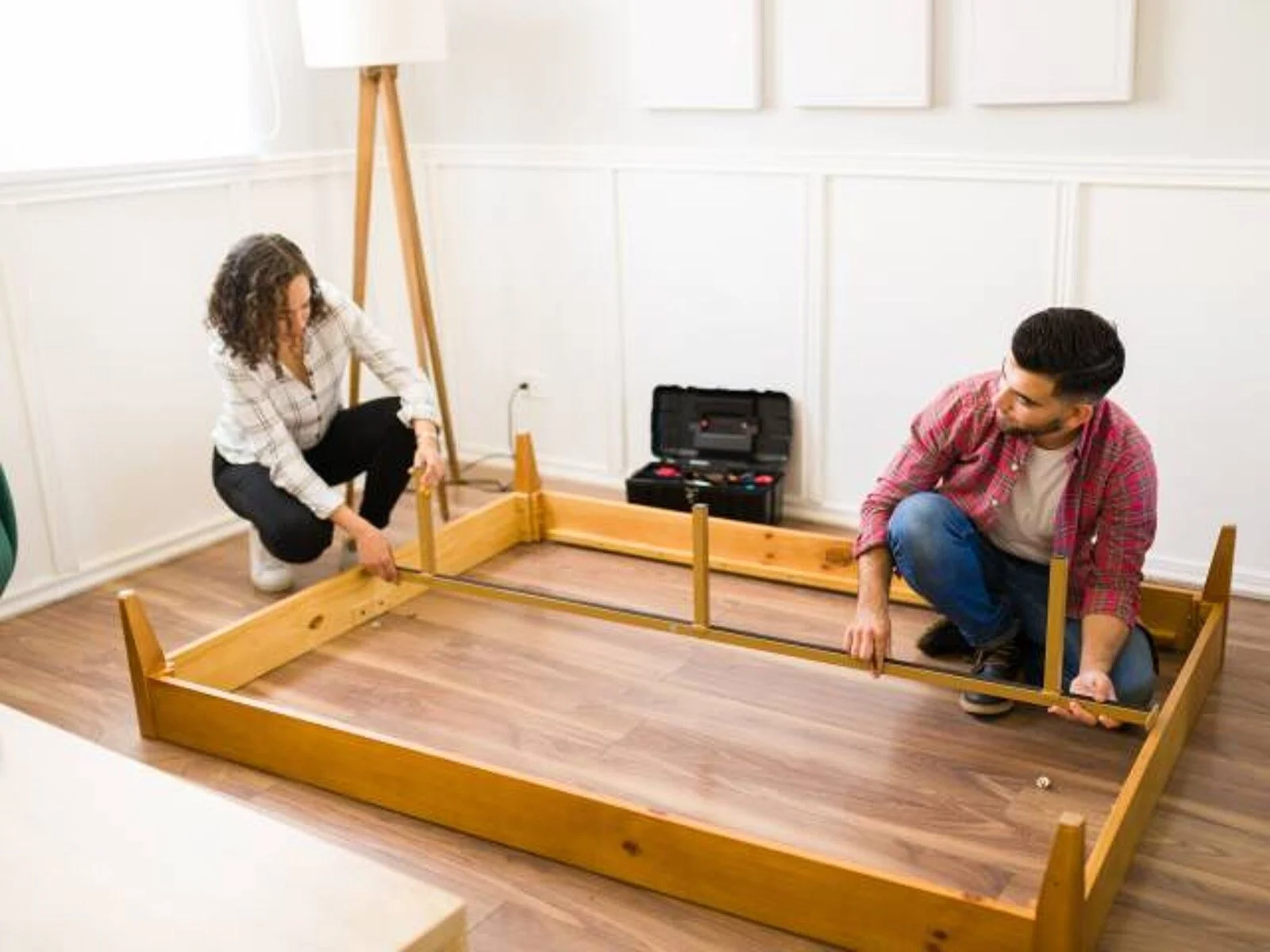
Bed frames look simple until moving day. Then the side rails snag in the doorway, the slats slide everywhere, and the screws you swore you'd keep track of vanish into a moving box. The good news: every common bed frame on the market - metal, wood, platform, IKEA cam-lock, storage beds with drawers - comes apart in roughly the same order with the same three tools. This guide walks you through the full sequence, then shows you what changes for each frame type so you don't end up Googling "cam lock won't release" at 11pm in your old bedroom.
Why disassemble a bed frame before moving?
Most beds are larger than the door opening they came through. Standard interior doors are 30-32 inches wide; a queen frame is 60 inches across with rails attached. Even if you can muscle a fully-assembled frame down a hallway, you'll trade scuffed walls, a bent rail, or a torn corner of mattress for the few minutes you saved.
Three practical reasons to take it apart:
- Doorway and stairwell clearance. Side rails on most queen and king frames exceed the diagonal of a standard 36-inch front door. Disassembled, the longest piece (the rails) fits flat against a wall in the truck.
- Damage control. Wood frames crack at the joinery when twisted. Metal frames bend at the welds. Both are far more likely to survive a move in pieces than as a single 80-pound unit being pivoted around a banister.
- Truck space. A disassembled queen frame stacks into roughly 6 cubic feet. Assembled, it eats 35-40 cubic feet of truck volume that mattress, boxes, or a dresser could occupy.
If your frame is bolted metal, the same fit-through-the-door math applies and you will need to know how to take a metal bed frame apart.
Tools you'll actually need
You don't need a workshop. Lay these out before you start so you're not hunting for an Allen key with the bed half-apart:
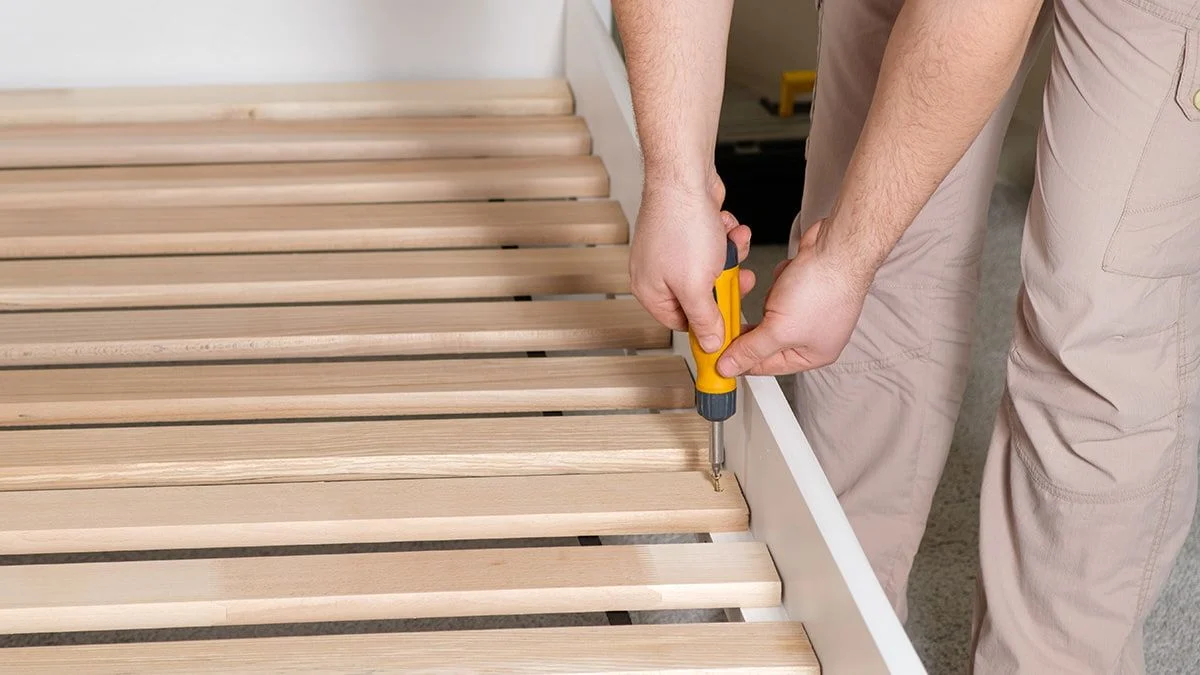
- Phillips and flathead screwdrivers - covers most wooden frames and older metal beds.
- Allen wrench / hex key set (metric and imperial) - almost every modern frame uses these. IKEA includes one in the original packaging; if you've lost yours, a $6 set covers every size you'll meet.
- Adjustable wrench or socket set - for hex bolts on platform and storage beds.
- Pliers - for stuck cotter pins, washers, and the occasional stripped fastener.
- Quart-size zip-top bags + permanent marker - the single most important item on this list. Read the hardware-organization section below.
- Painter's tape - for labeling slats and parts without leaving residue.
- Furniture blankets or moving pads - at least two; one for the headboard, one for rails and slats.
- A camera (your phone) - take a photo of every connection point before you unscrew it. Future-you will thank present-you.
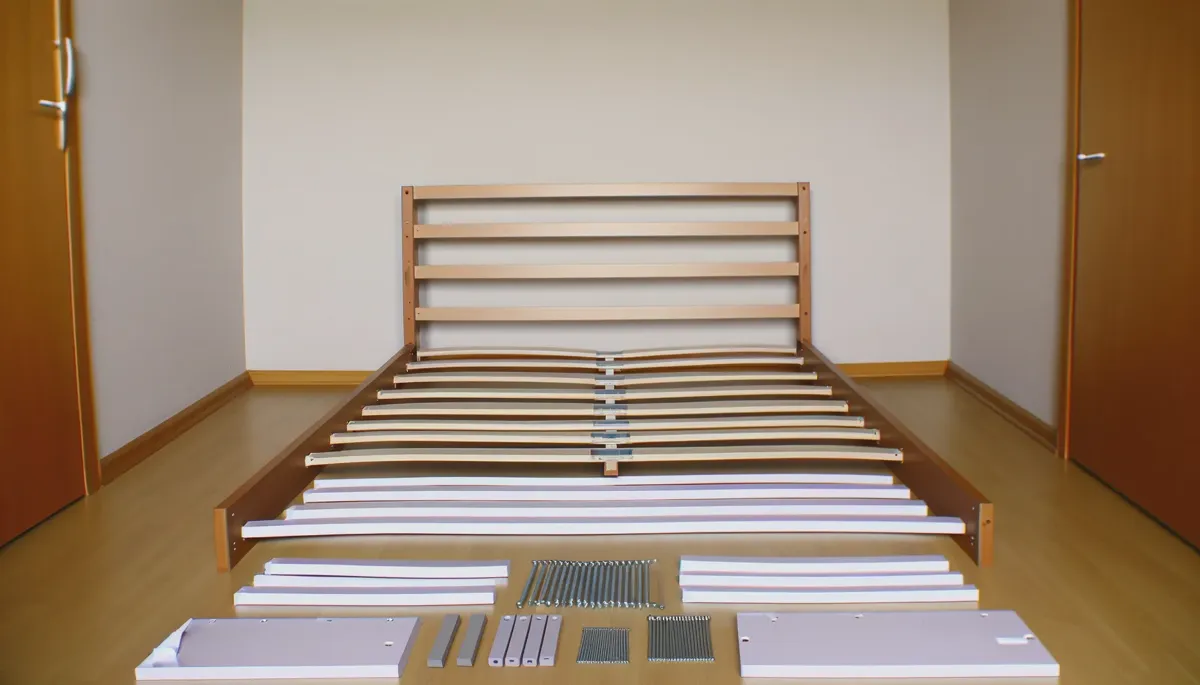
The 7-step disassembly sequence
This is the universal order. Frame-specific notes come in the next section - do those during the matching step.
Step 1: Strip the bed completely
Remove the duvet, sheets, mattress protector, and pillowcases. Wash anything that's been on the bed for more than a week before you pack it; sealed in plastic on a humid moving day, fabric grows mildew faster than you'd think. Once washed and dried, vacuum-seal or stuff into clean trash bags labeled "BEDDING."
Step 2: Move the mattress and box spring out of the way
Wrap the mattress in a mattress bag (under $15 at any moving supply store) or two layers of stretch wrap. A bare mattress picks up dirt, snags on door hinges, and absorbs water from a wet truck floor. Lean it against the wall outside the room you're working in - you need clear floor space around the frame.
If you have a box spring, it goes in the same bag style. Box springs are awkward but rigid; they don't disassemble. Mark which side is up so movers don't load it with the dust cover face-down.
Step 3: Photograph every joint
Before you touch a single screw, take phone photos of:
- Each corner where a rail meets the headboard or footboard.
- The center support beam (if you have one) and how its legs attach.
- The slat layout - especially any numbered or unevenly-spaced slats.
- Any wiring on adjustable bases (do not skip this).
These photos are your reassembly manual. The original instructions are almost certainly lost.
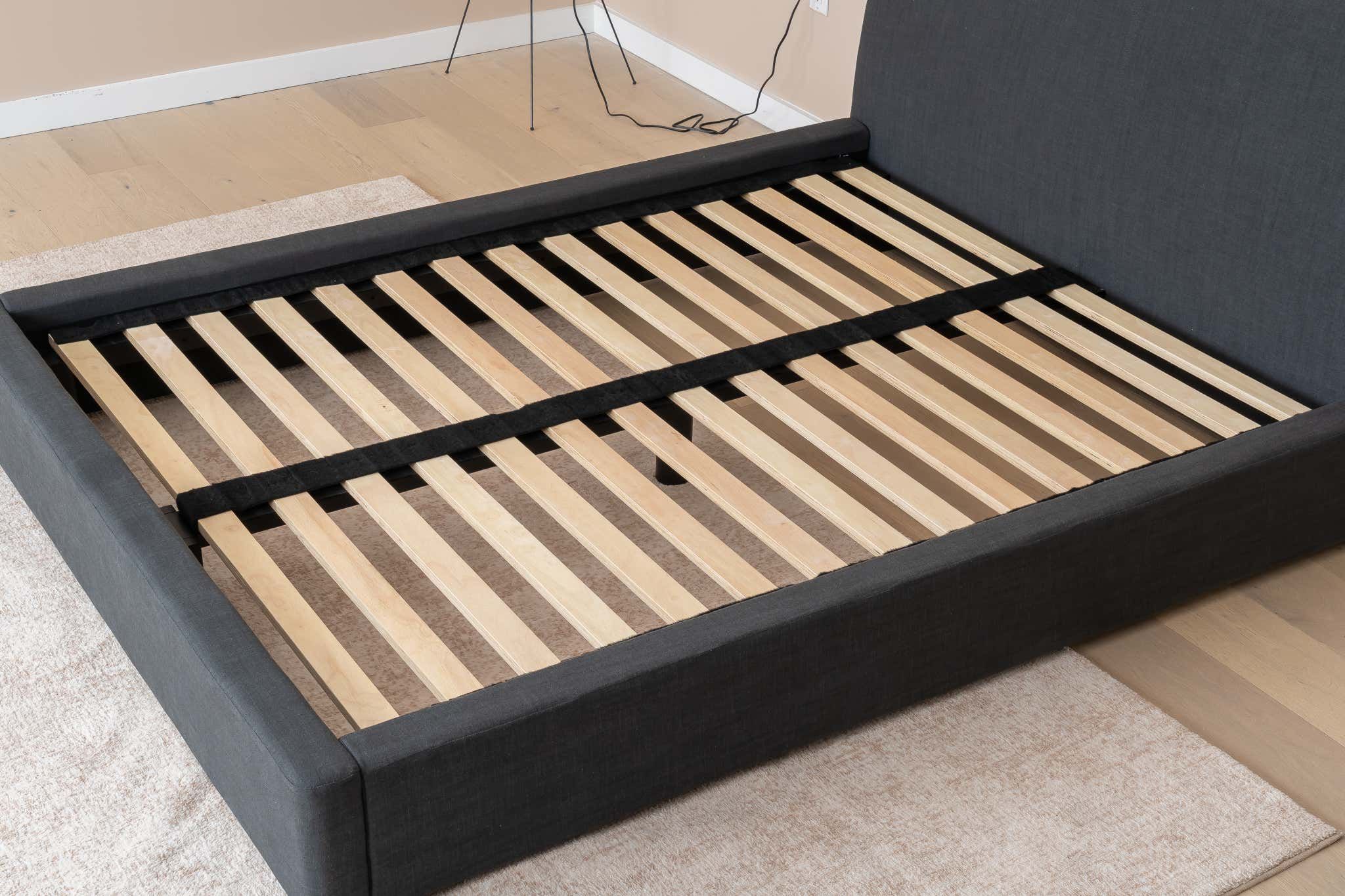
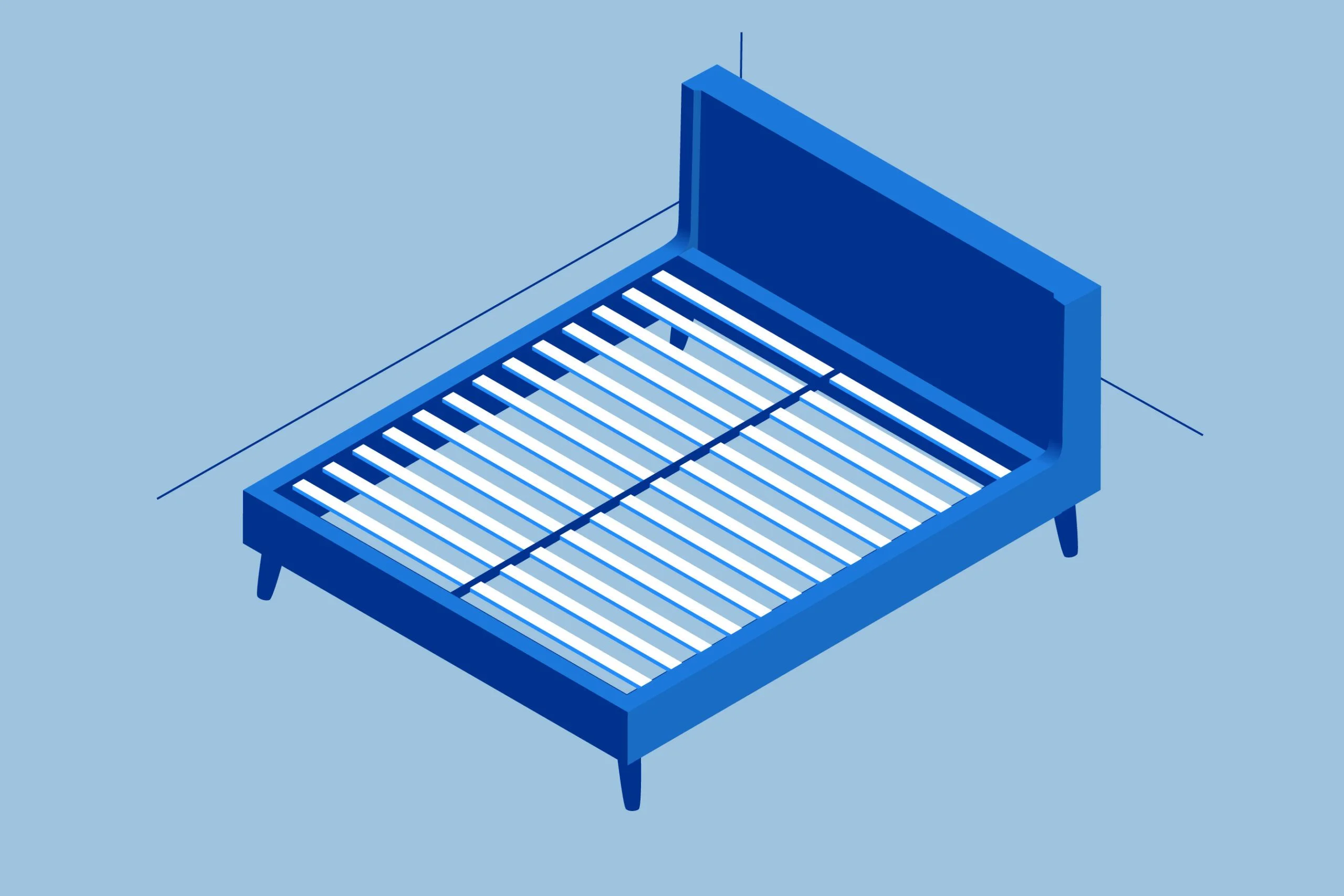
Step 4: Remove the slats
Most slats either lift straight out, roll up (if they're connected by fabric webbing), or unscrew at each end. If yours are screwed in, work from the foot of the bed toward the head - that's the order you'll reverse on the way back in. Stack them in the same order, wrap the bundle in painter's tape, and label it "SLATS - head end on top."
Step 5: Disconnect the side rails from the headboard and footboard
This is the big one. Most frames use one of three connection styles:
- Hook-and-bracket (common on older metal frames): lift the rail straight up to release the hooks. No tools.
- Bolt-through (most wooden frames): unscrew bolts from the outside of the headboard/footboard. The bolt usually threads into a barrel nut embedded in the rail.
- Cam lock (IKEA, modern flat-pack): turn the visible cam disk on the inside of the rail a half-turn counterclockwise with a Phillips screwdriver. The pin slides out of the rail.
Keep one hand on the headboard while you release the second rail - frames lose all their lateral stability the moment both rails are off.
Step 6: Detach the headboard and footboard
If your headboard bolts directly to the frame (rather than to the rails), this is its own step. Unscrew it now. Wrap it in a furniture blanket immediately - headboards are the most-damaged part of every move because people lean other things against them.
Step 7: Bag and label every piece of hardware
This is where moves go wrong. For each step above:
- Drop the screws/bolts/washers/cam barrels from that joint into a zip-top bag.
- Write the joint name on the bag in marker: "HEAD-LEFT RAIL - 4 bolts, 4 washers."
- Tape the bag to the inside of the headboard or to the matching rail with painter's tape.
Do not put all the hardware in one bag. One bag per joint, taped to the part it belongs to. You'll save 45 minutes of sorting on the other end.
Frame-type variations
The seven steps above work for everything. These are the gotchas you hit on specific styles:
Metal frames (Hollywood-style or basic metal box)
Usually the easiest disassembly. Most have hook-and-bracket rail connections - no tools beyond a wrench for the center support. The riser legs often unscrew completely; do that last so the frame stays stable while you remove the rails.
Solid wood frames (sleigh, panel, four-poster)
Use only Allen keys or socket wrenches; do not force flatheads into hex sockets, you'll strip them. If a bolt resists, spray a tiny amount of WD-40 and wait two minutes - wood swelling, not rust, is usually the culprit. Remove decorative finials before moving four-posters; they snap easily.
Platform beds
Platform beds combine the slat function and the support function into one big assembly, which means more bolts but the same logic. Look for a center support beam underneath - it almost always comes out as its own unit and is the heaviest single piece of the bed.
IKEA cam-lock frames (Malm, Hemnes, Brimnes)
Cam locks are designed for one or two reassemblies, not a dozen. Each disassembly slightly enlarges the cam socket; if you've moved the same Malm three times, expect wobble on the next reassembly and budget for replacement dowels (~$8 from IKEA's spare-parts counter or by order). Turn cams a half-turn only - full rotations re-engage them. Keep the original instruction sheet if you have it; IKEA part numbers don't always survive sticker wear.
Storage beds (drawers, ottoman lift, hydraulic gas-lift)
Remove all drawers first and pack them separately - they ride better full of clothing than empty. For ottoman/gas-lift beds, fully open the lift and prop it with a 2x4 before disconnecting the gas pistons; releasing a piston under load will slam the platform down hard enough to crack the frame. Photograph the piston connections especially carefully; left and right are not always interchangeable.
Adjustable bases
Not strictly a "frame" - but if you have one, treat it like an appliance. Unplug it, coil the cord, and tape the cord to the underside. Most bases split into a head and foot section connected by a long center bar; consult the manufacturer's site for the latching mechanism. Never lift an adjustable base by the surface - always by the structural frame underneath.
Packing the disassembled bed for the truck
- Headboard: wrap in a furniture blanket, tape closed (tape on the blanket, not on the wood). Load it flat against the truck wall with nothing leaning on the front face.
- Side rails and slats: bundle together with stretch wrap, label clearly. They'll ride against a wall stacked vertically.
- Hardware bags: even though they're taped to parts, drop a master bag containing copies of any oddly-shaped pieces (cam discs, decorative caps) into the box marked FIRST DAY - the box that opens first at the new place.
- Tools: pack your screwdrivers, Allen keys, and wrench together in that same first-day box. You will need them within the first hour at the new place to put the bed back together so you can sleep that night.
Reassembly: the 5-minute sanity check
Reversing the process is straightforward if you bagged hardware correctly. Two things go wrong most often:
- Slats installed in the wrong order or direction. If your slats were numbered or had a curved profile, getting them backwards causes squeaks and uneven mattress support. Refer to the photos from Step 3.
- Bolts cross-threaded on first turn. Always start every bolt by hand for two full turns before reaching for the wrench. Cross-threading a barrel nut on a wooden rail is one of the few damages that's hard to reverse.
Once reassembled, sit on each corner of the bed and rock side-to-side. Anything that creaks or moves needs another quarter-turn. A correctly-tightened frame is silent under normal load.
Should you pay movers to do this?
Most full-service movers will disassemble and reassemble bed frames as part of their hourly rate, and they're fast at it - usually 10-15 minutes per bed for a two-person crew. If you're paying for a full-service move, let them; you're already paying for the time.
If you're moving yourself or paying labor-only movers (load and unload only, no disassembly), do it yourself the night before. It frees the movers to handle the heavy carry, and you control how the hardware gets packed. Twenty minutes of prep beats arriving at the new place and discovering the bag of bolts is in a box you can't find.
When to replace the frame instead
Moving is also the cheapest possible audit of your bed's condition. If, while taking it apart, you find:
- Cracked wood at any rail-to-headboard joint,
- Stripped bolt holes that no longer hold a screw,
- A bent metal rail that doesn't sit flush,
- More than three loose cam locks on an IKEA frame,
it's worth pricing a replacement before you reassemble. A used frame will live another decade in a sturdy bed; a compromised frame usually develops a creak within months and needs replacement anyway. Better to handle that decision now, with the truck still empty, than after you've slept on a wobbly bed for six weeks.
The short version
- Strip the bed and move the mattress out of the room.
- Photograph every joint before touching tools.
- Remove slats first, rails second, headboard last.
- One zip-top bag of hardware per joint, taped to the matching part.
- Wrap the headboard immediately and load it flat.
- Pack tools and a master hardware bag in your first-day box.
- Reassemble in reverse, starting every bolt by hand.
Do it in this order with these tools and your bed survives the move ready to put you to sleep on night one.